
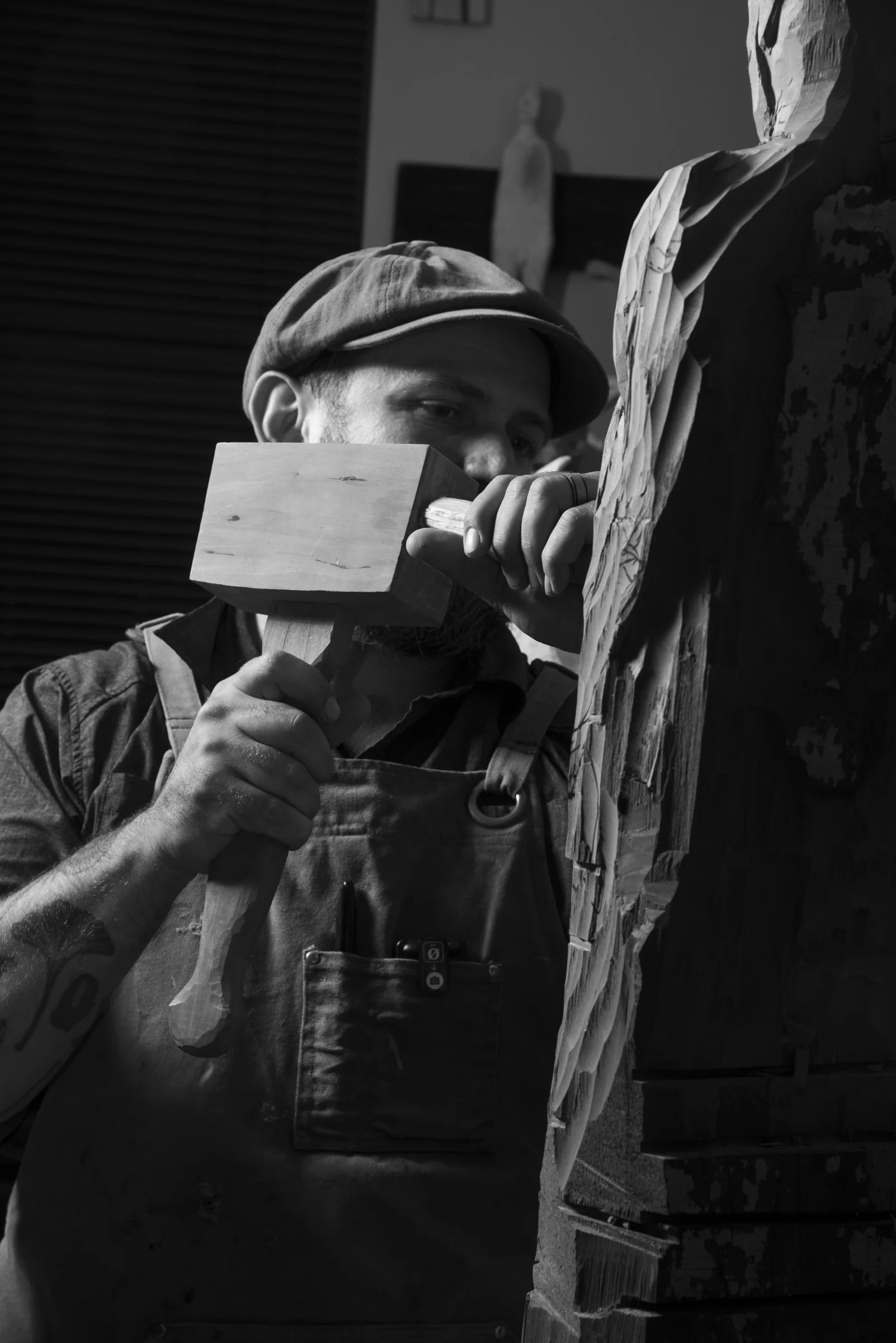
Chris Wagner: Carving Identity, Memory, and Myth
An Interview with the Artist at Matney Gallery, July 2025
“Whether it’s carving a bison, sculpting a veteran, or designing a mount for a 2,000-year-old bowl—it's about attention. You show up for the form in front of you. You treat it with respect. That’s what keeps me going in the studio.” —Chris Wagner
Christopher Wagner is a sculptor of uncommon depth and quiet intensity. Trained at Edinboro University and shaped by years working in Portland studios and teaching on both coasts, Wagner has developed a practice rooted in wood carving, narrative figuration, and emotional complexity. His use of reclaimed materials and fragmented forms speaks to memory, trauma, and transformation—often pairing human and animal figures in unexpected, symbolic relationships.
Matney Gallery:
Chris, to begin, can you tell us a bit about your background, the materials you work with, and what draws you to the human figure?
Chris Wagner:
I studied sculpture at Edinboro University and worked in professional studios in Portland, Oregon. I’ve taught in California and now teach at William & Mary. In my studio practice, I focus primarily on wood carving—mostly using reclaimed lumber—and I work almost exclusively with the human figure.
I explore the figure in different ways. Sometimes I pair it with animals in strange, symbolic interactions. Other times I alter or fragment the form—removing limbs, replacing heads, shifting posture—to test the boundaries of how much can be taken away before it no longer reads as human. That interest started when I read Johnny Got His Gun in graduate school. It made me think about what remains when so much is gone. And today, in a time when AI and automation challenge what is distinctly human, that question feels more urgent than ever: what makes a form human? What makes a gesture art?
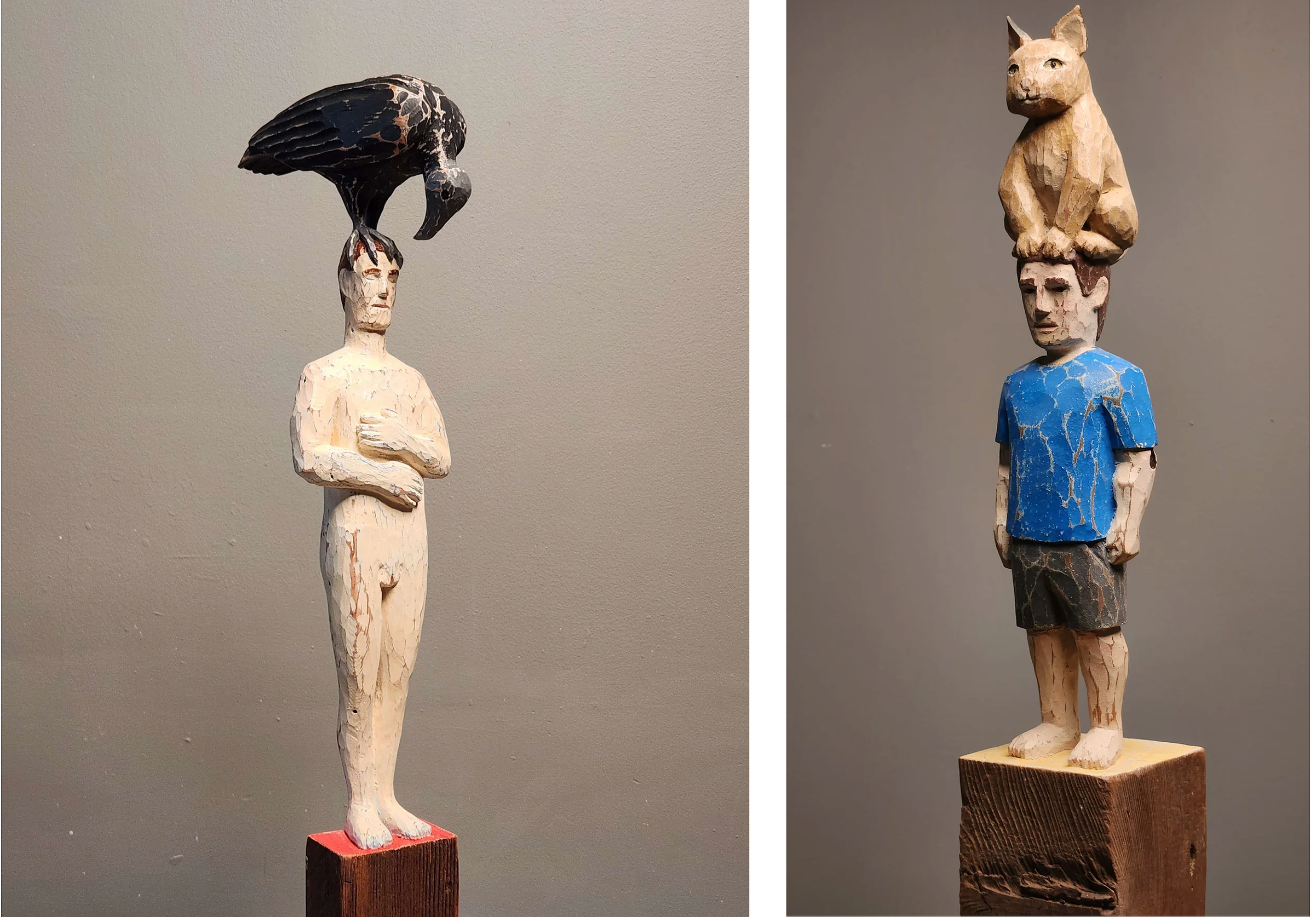
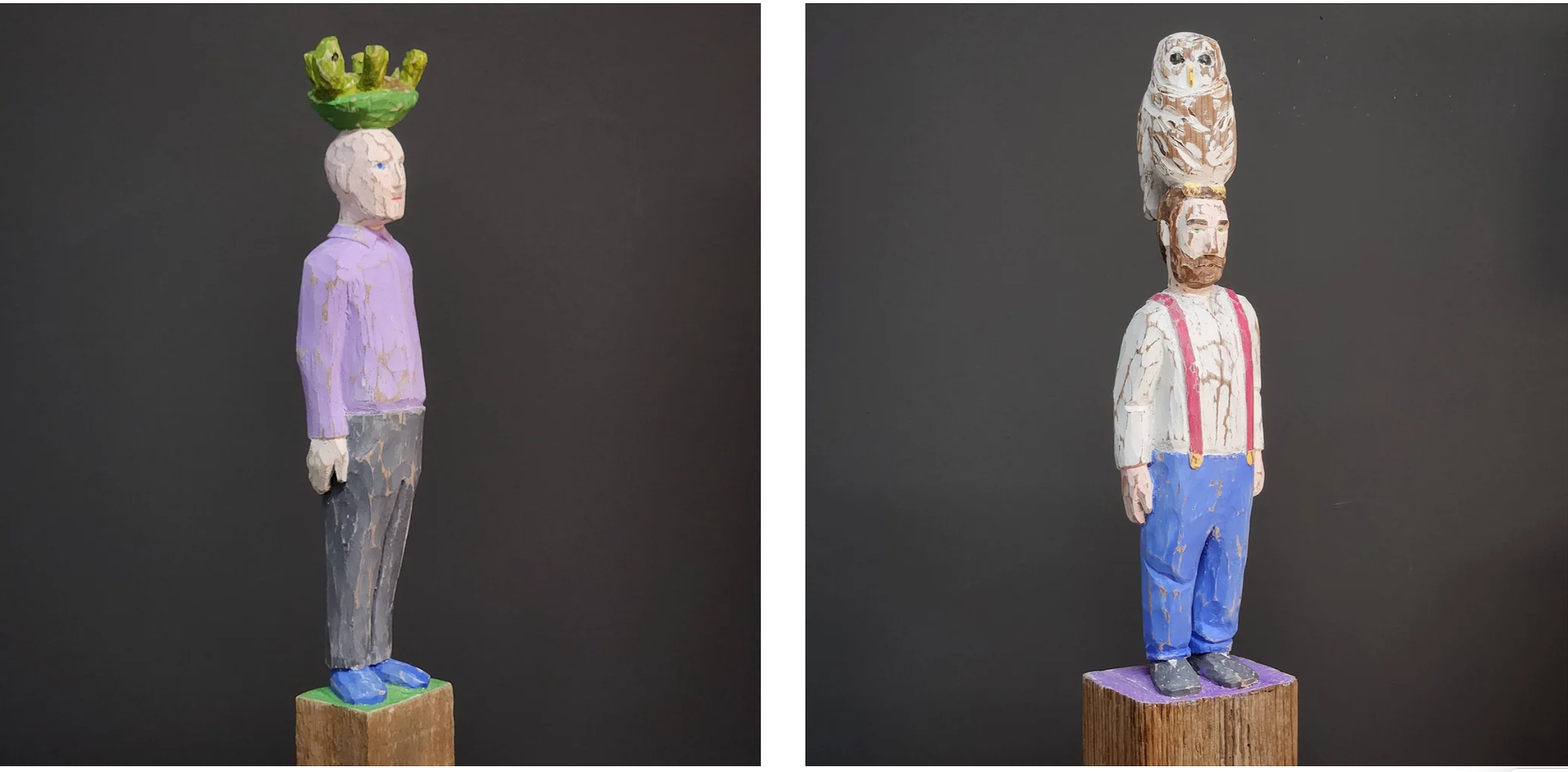
One sculpture I return to often stands on its stumps—no feet, yet still standing. It feels awkward and pained, but unmistakably alive. In another piece, a female torso has no head; instead, a plant grows from the neck. That transformation raises questions rather than answers. What happens when we change the expected? What do people see, or feel, when something familiar is altered just enough to become strange? I find that kind of viewer response more meaningful than a clear takeaway.
Matney Gallery:
Was there a particular turning point in your practice that led you down this path?
Wagner:
Not a single piece, no. I’d say the larger turning points have always come through reading. Johnny Got His Gun planted the seed early, and Siddhartha by Hermann Hesse helped shift my attention inward—toward identity, impermanence, and spiritual duality.
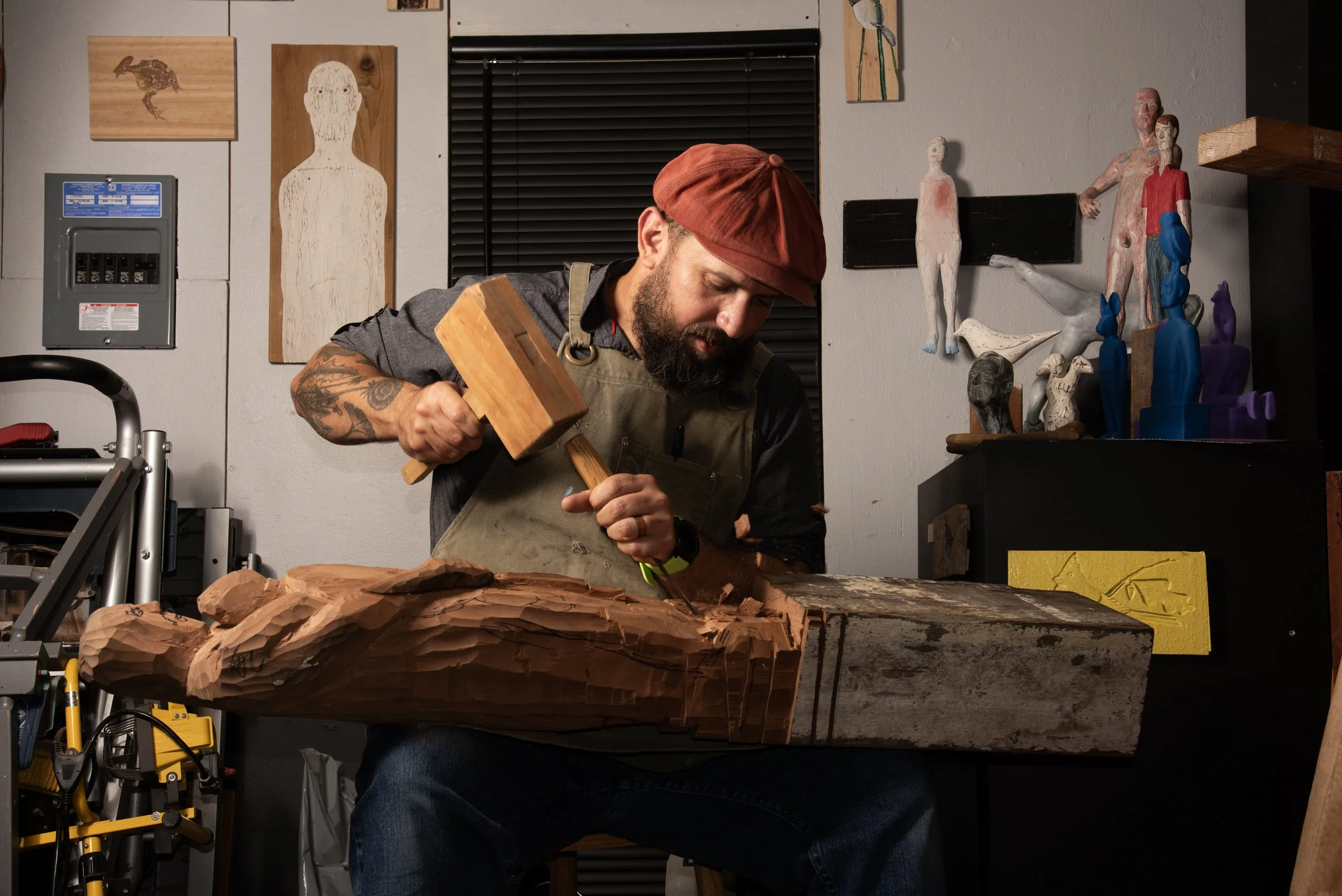
Chris Wagner in the studio
Hesse’s writing often reads like a precise, methodical attempt to engage with something nonlinear and emotional—a kind of German rationality meeting Eastern philosophy. That friction—the logical meeting the transcendent—resonates deeply with me.

These days I’ve been surrounding myself with poetry. Sylvia Plath and Ted Hughes have been important to me, especially in the way they each handle intensity and form. And Leonard Baskin—he was both a printmaker and a sculptor, but also a remarkable illustrator of poetry. He collaborated on books that are long out of print, and I’ve been slowly collecting them over time. Most of the volumes are slim, quiet things, but there’s a real power in them. I often keep one open near my bench while I work. I’ll pause to read a line or two in the middle of carving—it’s like resetting your attention, grounding the hand and the mind at the same time.
Matney Gallery:
That interest in memory and identity carried directly into your next major body of work—the Veteran Portrait Project. Can you tell us how that series began?

Christopher B. Wagner
“Veteran Portrait Project: Lance”, 2015
Cast Polyurethane, Acrylic, and Concrete, $950
This piece was created in collaboration with painter Paul X. Rutz as part of our Veteran Portrait Project. This project was funded through a grant from the city of Portland, Oregon. Both Paul Rutz and I worked from the same combat veteran model together. I worked on a sculpture, and he worked on a painting. We used the same pose but provided different perspectives. This body of work was meant to serve as an acknowledgement of the sacrifice our combat veterans made. We had representatives from four wars: World War 2, Vietnam, Gulf War, and the Iraq Afghanistan Conflict. This body of worked was displayed together for several years at five different galleries on the west coast. Now all of the work exists as individual pieces.
The specific piece “Veteran Portrait Project: Lance”, was sculpted from a Vietnam Combat Veteran named Lance. The original study was made in clay, that I made a mold of and then cast in Polyurethane, filled with concrete, and painted with Acrylic. The corresponding painting in the portrait project can be seen on the website of Paul X.Rutz,

Paul X.Rutz,
Wagner:
The Veteran Portrait Project started around 2015. I was in Portland and had received a grant from the city. I collaborated with a painter, Paul X.Rutz, and we worked with live models drawn from the veteran community. We created portraits of individuals from different generations: World War II, Vietnam, Iraq, Afghanistan. The goal was to shift how we view veterans. Not as tools of service or statistics, but as complex individuals returning home, with their own presence and weight. We wanted to work from life—no photography, no static references. The sculpting happened face to face, in real time. At the very first session, something unexpected happened. We were setting up the space, arranging lighting, and the veteran who came in quietly undressed and sat down. We hadn’t asked for that, but he was completely comfortable. That set the tone. Some posed clothed, some didn’t. The trust became part of the work. The sculpture we have at Matney Gallery now is of a contemporary veteran who originally posed with a guitar. He played and whistled during the session. It was disarming and beautiful. I removed the guitar in the final piece so the body could speak more directly. The previous work we placed was of a Vietnam-era veteran who chose to pose with his rifle—an object that clearly still carried emotional weight for him.
Matney Gallery:
Both pieces are resin rather than wood, correct?
Wagner:
Yes. They were modeled in clay and cast in resin. But even then, I approached them like carvings. I’m a subtractive sculptor by nature. Even when I build something up—in clay, wax, or plaster—I end up reducing it back down. I use carving tools even in those materials. That relationship to form doesn’t change.
I think that mindset goes back to my childhood. I grew up on a cattle farm, and I’d spend hours with a pocketknife, whittling wood. It wasn’t art, it was just a way to pass time. But in grad school, I found myself doing it again—carving small figures late at night when I was overwhelmed by the conceptual work I was supposed to be doing. One night, a professor saw what I was working on and said, "That’s the most honest thing I’ve seen from you." I submitted that piece to a show. It won Best in Show. That moment shifted everything.
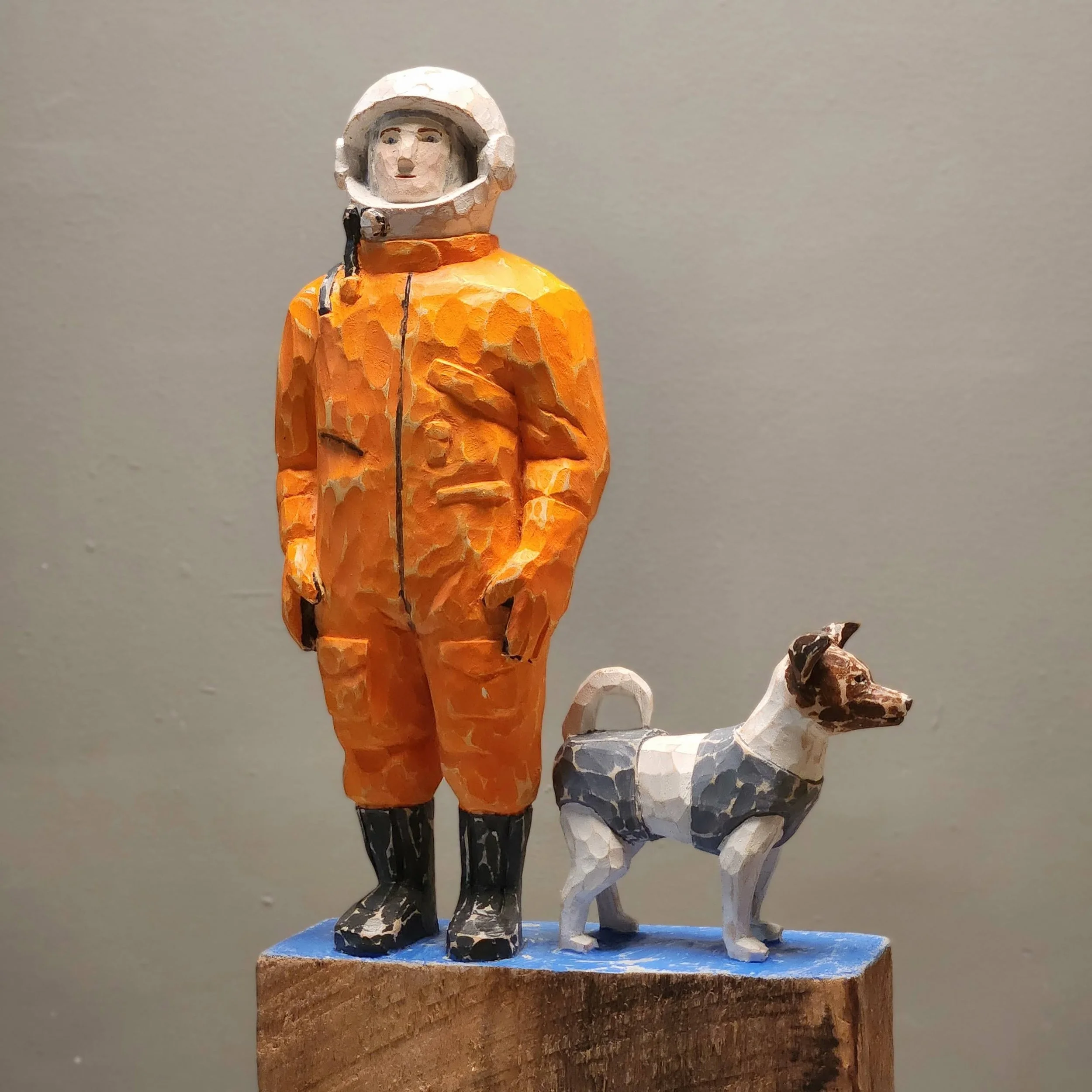
Laika , 2024, Reclaimed Lumber and Milk Paint
Matney Gallery:
That kind of sincerity really comes through. Let’s talk about the Laika sculpture—the one with the dog and cosmonaut. It feels both mythic and mournful.
Wagner:
Absolutely. I’m a space nerd. Always have been. I think of astronauts as modern-day mythological figures. The training, the isolation, the danger—it feels epic. Laika was the first dog in space. A stray from Moscow, selected for her calm demeanor. She didn’t survive. She didn’t even know what was happening. That contrast—between innocence and historic consequence—moved me. In the sculpture, I paired her with a human figure based on Yuri Gagarin. He survived his mission but died young and mysteriously. He was never allowed to fly again because they couldn’t risk losing their hero. That pairing—the anonymous and the icon, both ultimately sacrificed—was central to the piece. I include an astronaut in almost every show, even if the theme doesn’t call for it. It’s personal. And if someone at the opening is also into space, I know we’ll find each other.
Matney Gallery:
You also work with animals a lot. Where does that connection come from?
Wagner:
Animals were a constant presence in my life growing up—on the cattle farm, in the woods, and wading through the creeks near our home. I’ve always felt connected to them in a physical, observational way. That early exposure instilled a kind of personal code in my practice: I don’t carve animals I haven’t encountered in real life. If I’m going to sculpt a bison, it’s because I’ve stood near one, observed how it moves, how it breathes.
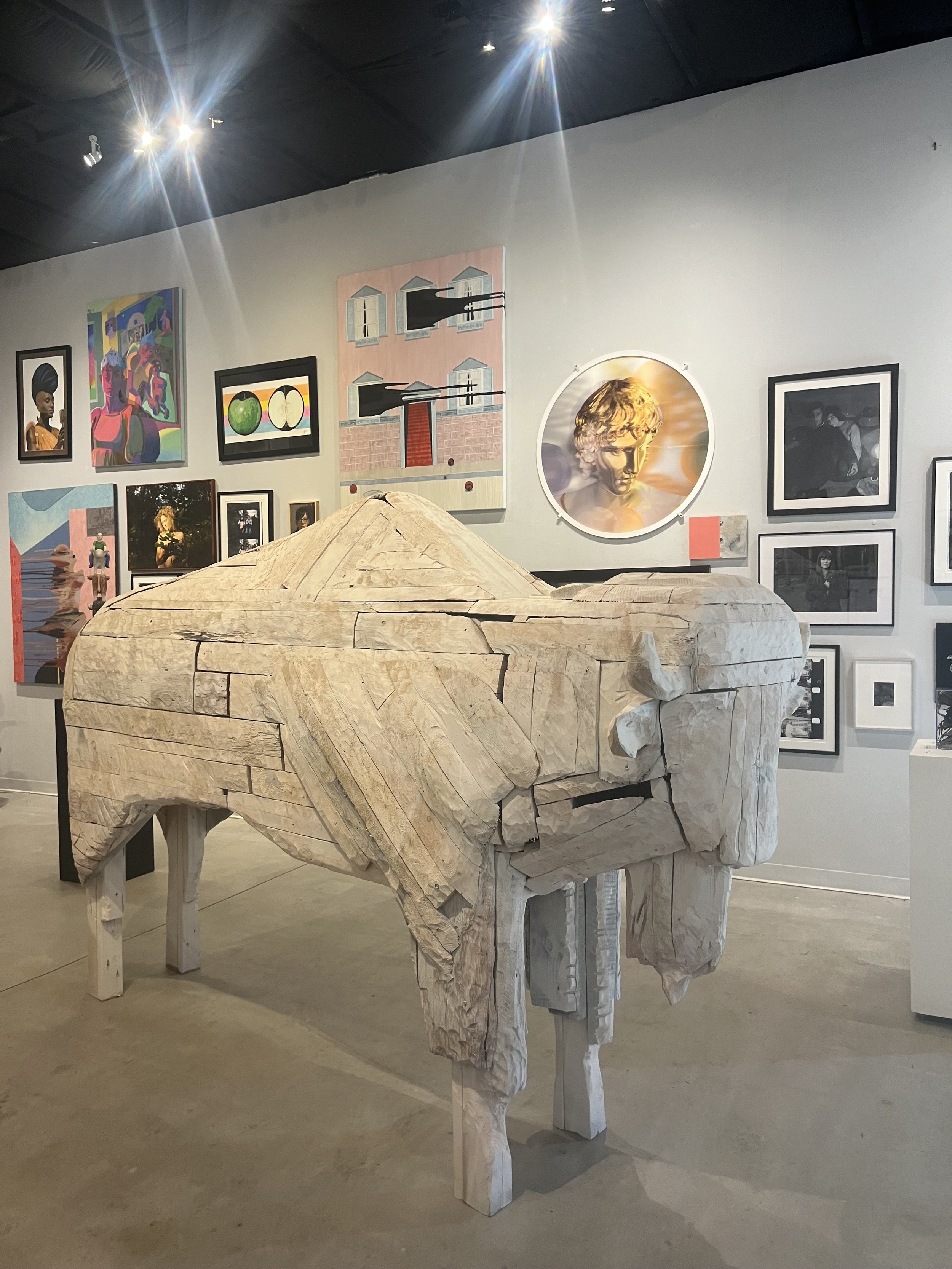
Standing Bison, 2025, Reclaimed Lumber
I’ve made annual trips to see them—herds in Yellowstone, Custer State Park, and Antelope Island. That ritual of seeking them out has become part of the process. When I was living in Utah, I started carving turtles after hiking through a desert tortoise preserve. It wasn’t something I planned—it just came from that direct encounter. That firsthand experience matters deeply to me. The physical memory of being around these animals informs how I shape them.
Bison, in particular, hold a strong place in my work. There’s something elemental about them. They’re massive, deliberate, and seem to carry a gravity that you can feel just by standing nearby. They're quiet animals, but there’s nothing passive about them. I’ve always felt they were like the untamed version of the cattle I grew up with—larger, wilder, with this rooted energy. I wouldn’t say they’re heroic in a mythic sense, but they don’t need to be. Just being what they are is enough.
Matney Gallery:
And you often combine animals with humans in surreal or symbolic ways.

Building Blocks, 2024, Reclaimed Lumber and Milk Paint
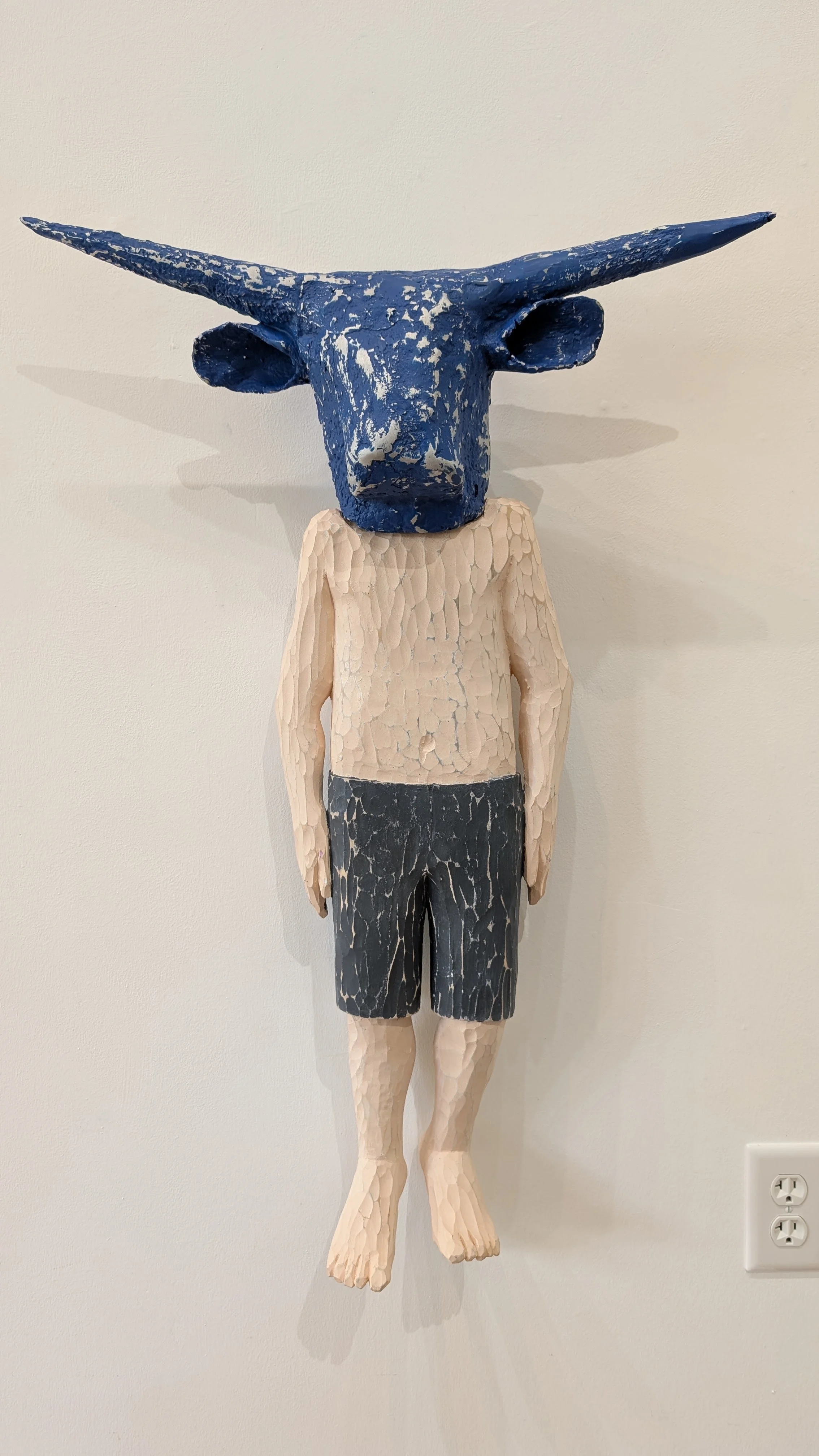
Borrowed Perspective, Bull, 2025. Basswood, Milk Paint, Aluminum, and Enamel,
Wagner:
Yes. I like disrupting expectations. Sometimes I make what I call stacks—human and animal figures arranged in vertical groupings, almost like totems, but with realistic proportions and physical relationships. A turtle balanced on someone’s head, or a person reclining across the back of a bison. Other times, I’ll create hybrids, like a human figure with a bull’s head. It’s not about offering a fixed symbolism. It’s about interrupting the familiar just enough to spark questions.
Our relationships with animals are complicated. We eat them. We keep them as pets. We name them, mourn them, and sometimes dress them up. We assign meaning to their shapes, their movements, their roles in stories. We treat them as symbols, food sources, family members, and objects of entertainment—all at once. I’m not saying any of it is right or wrong. I just want people to step back and consider how strange and layered those relationships actually are.
Matney Gallery:
Earlier you mentioned Michael Ayrton—can you talk more about his influence?
Wagner:
He’s an artist and writer who really captures what it feels like to make things. His novel The Maze Maker reimagines the myth of Daedalus not just as a story of invention, but as a meditation on what it means to be a maker. Ayrton goes into rich, almost obsessive detail about sculpting with beeswax, packing a mold, and pouring molten bronze—he treats it like an epic ritual. And honestly, it is. There’s a heroism in that physical labor, in the trial and error, in the solitude and craft of it all. That book stuck with me because it reflected how sacred and difficult the act of making can feel.
I also love when films or books slow down and let the act of making take center stage. Studio Ghibli does that beautifully—Spirited Away, for instance, will pause to show someone quietly cooking or folding laundry. Those in-between moments carry a kind of emotional weight. Sculpture is like that for me—equal parts mundane and monumental. It’s both hands-in-the-dust work and something deeply meditative.
Matney Gallery:
You’ve had a long connection with William & Mary and the Muscarelle Museum. How has that shaped your practice?
Wagner:
It’s been amazing. The students, the museum team—they care deeply about the work and the artists behind it. I’ve had opportunities to exhibit my own pieces there, but also to take on roles that are less visible but just as meaningful. I’ve worked with artists to prepare their installations, built custom mounts and plinths, and helped solve logistical challenges that come with displaying three-dimensional work.
Lately I’ve been more involved with 3D scanning for the Muscarelle. I started doing it years ago to preserve records of my own sculptures, and now it’s become a tool I use to help the museum. In a recent exhibition of Native American artifacts, for instance, there were ancient bowls that were originally meant to sit in earth or sand. On a flat museum surface, they just wouldn’t sit right—they wobbled. So I scanned them and designed custom negative mounts that cradle the bottom contours of each object precisely, holding them steady without altering or adding pressure.
I’m not making the artwork in those cases—but I’m helping it be seen the way it deserves to be seen. And there’s something deeply satisfying in that.
Matney Gallery:
That quiet care runs through everything you do.
Wagner:
I hope so. Whether it’s carving a bison, sculpting a veteran, or designing a mount for a 2,000-year-old bowl—it’s about attention. You show up for the form in front of you. You treat it with respect. That’s what keeps me going in the studio.

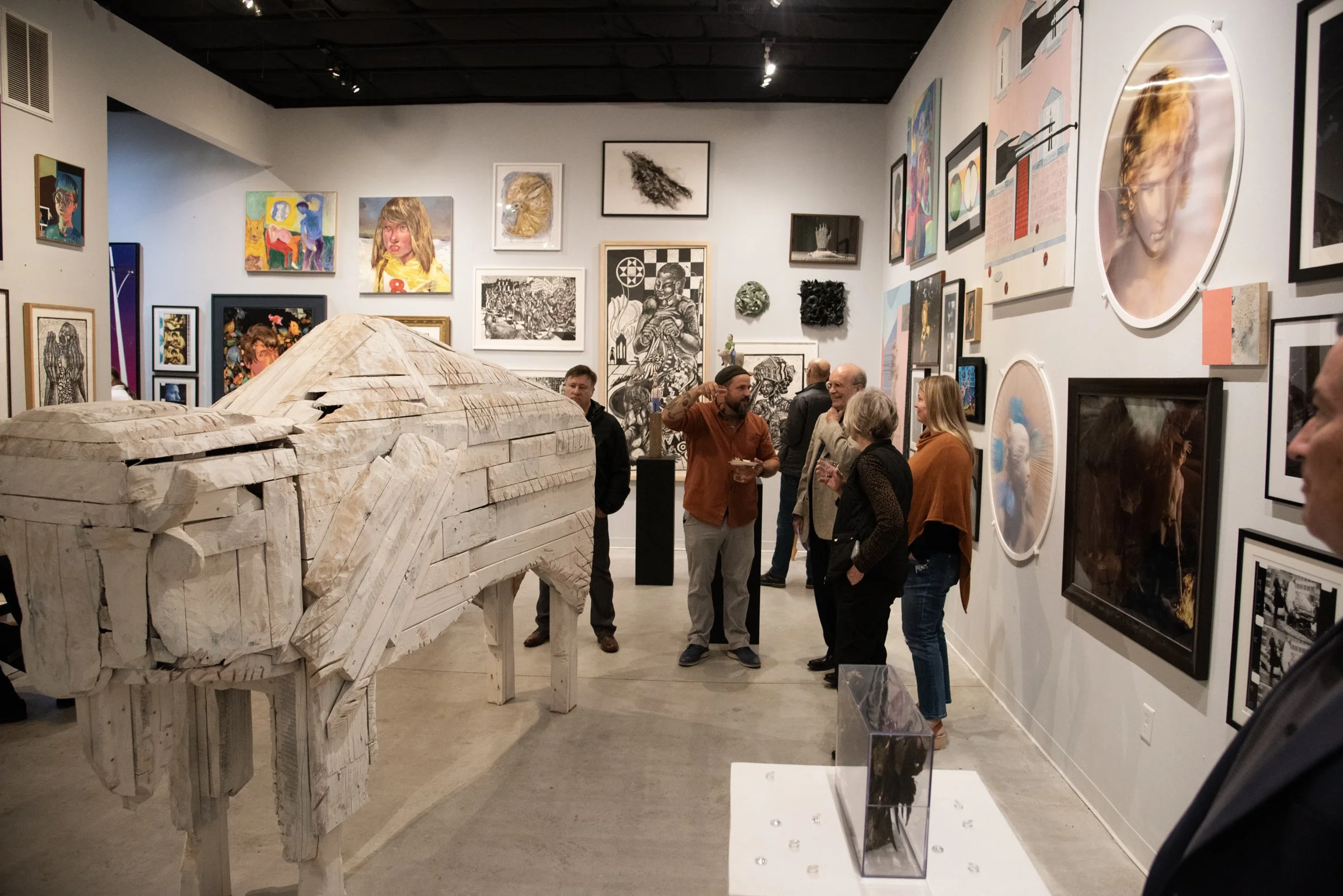
As this exhibition continues to unfold, Matney Gallery will be developing additional events, public conversations, and educational programming around Chris Wagner’s work. These initiatives will include opportunities to explore his carving process, discussions on the evolving role of animals in contemporary sculpture, and family-friendly activities that reflect the collaborative spirit present in his studio practice. Details will be announced as schedules are finalized, expanding the exhibition’s reach and deepening community engagement with Wagner’s remarkable body of work.
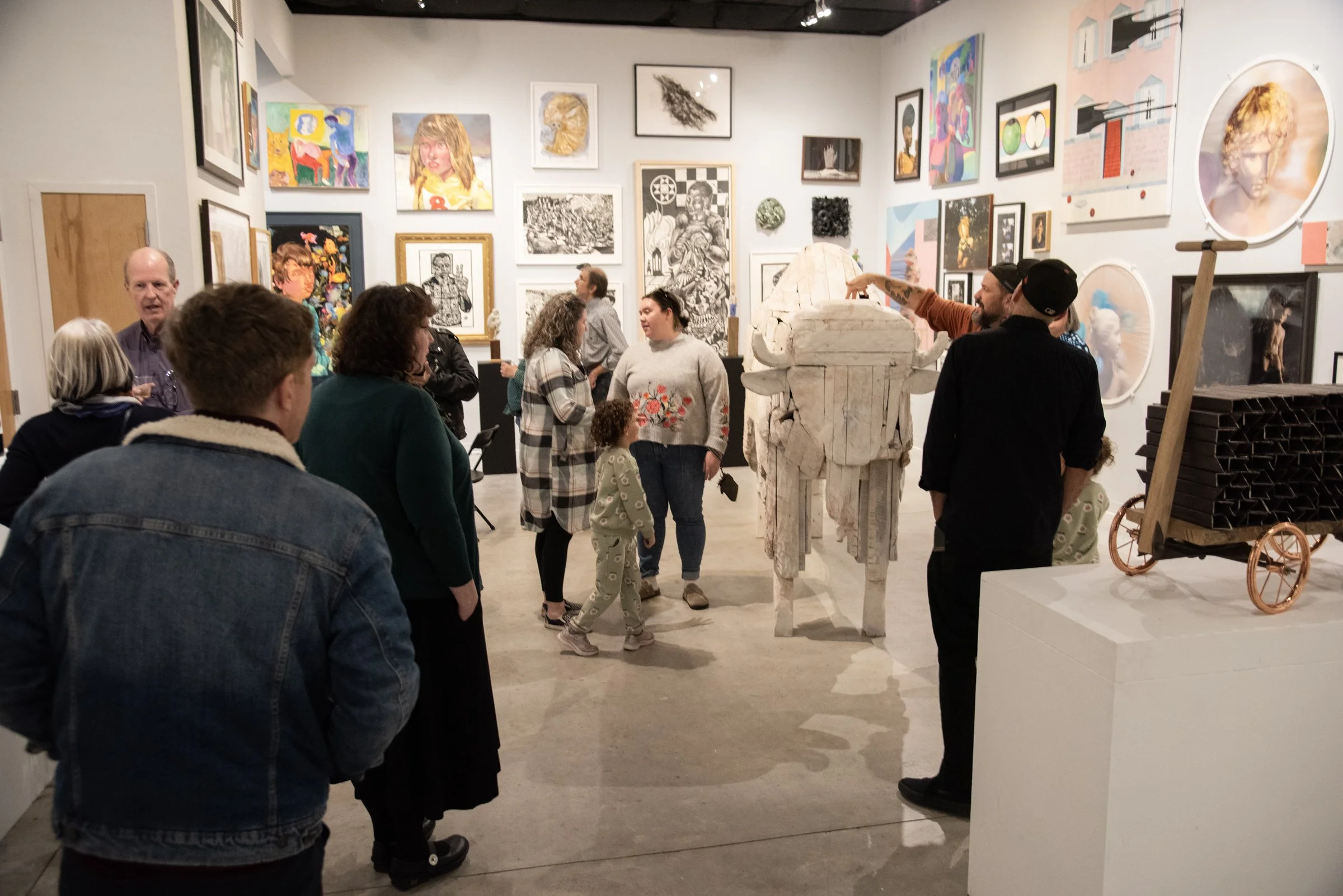
Extended Conversation with Chris Wagner
Following our initial interview, Chris and I continued our discussion and several works in the Fall Salon opened up into deeper stories—personal, material, and ecological. What follows expands on themes only touched on in the original article: loss, family, children in the studio, and the ways animals become both symbols and collaborators in his practice. These reflections bring new context to the works on view and reveal more of the private narrative space behind Wagner’s sculpture.
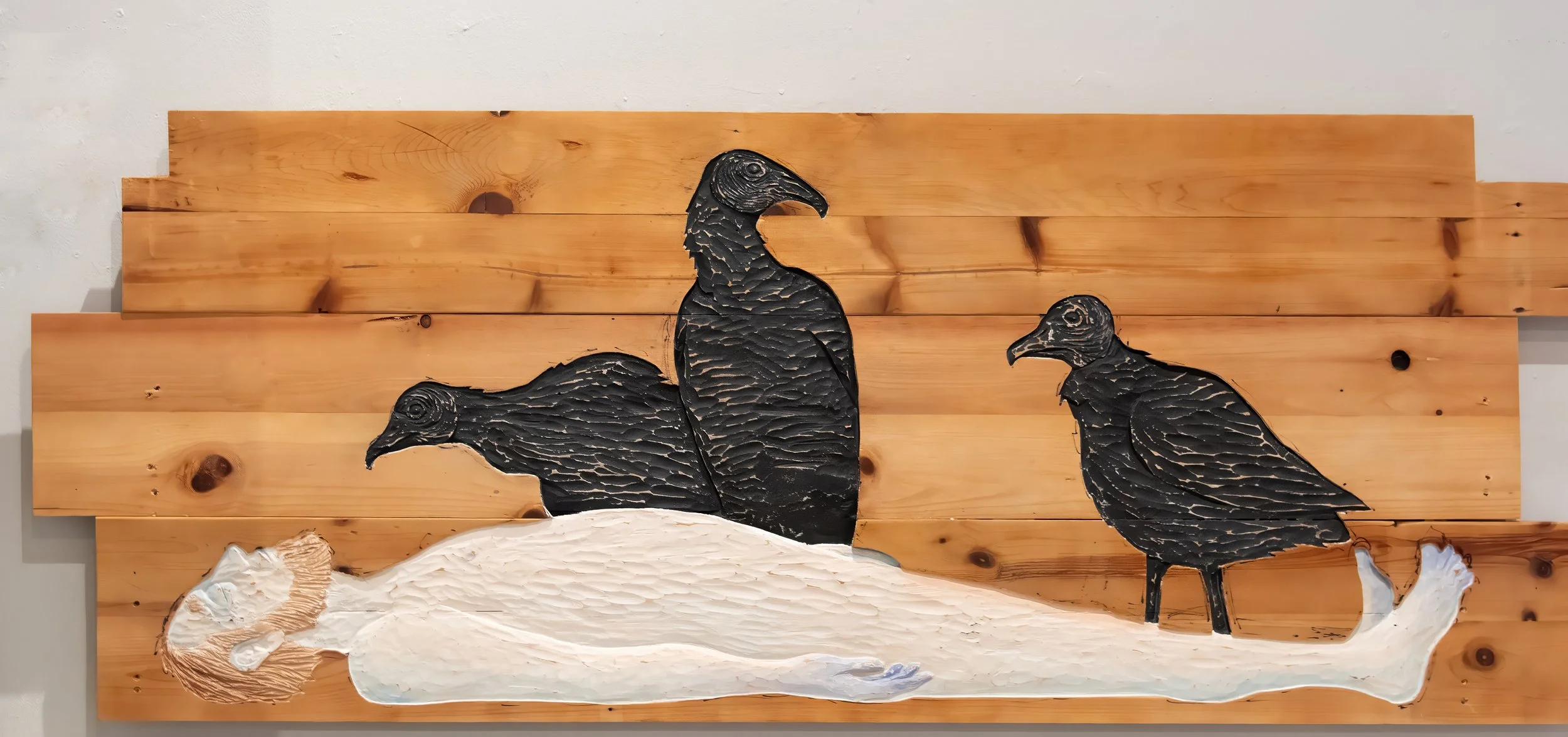
DEAD DAD, DISTANCE, AND ORIGIN POINTS
Chris Wagner:
The piece titled Dead Dad was a direct response to learning that my father—someone I never truly knew—had passed away. I never met him beyond a few phone calls and emails. Through those brief interactions I also learned I had two half-brothers I’d never met. The whole situation felt remote and emotionally disconnected, and I found myself thinking about those relationships—these people tied to me in name but in no real, lived way.
That’s where the buzzards came from. In the sculpture they’re simply looking at the dead figure, not consuming or interacting with him. They’re suspended in this moment of consideration, deciding whether there’s anything there for them at all. That sense of ambiguity, of distance, felt true to the experience.
You never know where inspiration will surface. I sketch constantly, filling pages while I’m thinking through an idea, and this particular image was what emerged.
Lee Matney:
I loved when you mentioned how much you enjoy your kids drawing on your sketches. Some of the yellow marks were still visible.
Chris Wagner:
Yes—and I actually let them draw on my sculptures, too. Nothing is off-limits to them except what’s unsafe. Their marks become these small moments of collaboration. Even when they’re not physically in the room, the work carries traces of them, and I want that to remain part of their lives. I didn’t grow up with an artist as a parent, and I would’ve loved that experience—so I’m happy to give it to them.
Someday I’d like to make a whole body of work where I do the carving and they do all the painting. I think it would be incredibly fun.
Lee Matney:
We’re planning a kids’ show at some point—your children could be part of it.
Chris Wagner:
I’d love that. The challenge with kids, of course, is stopping them at the right moment. Sometimes they’ll make this beautiful, accidental passage, and then immediately cover it in purple. I’ve often wanted to incorporate one of their drawings or carvings directly into a finished piece so they can feel the pride of seeing their work in a gallery.
ANIMALS, RELATIONSHIPS, AND RECONTEXTUALIZATION
Lee Matney:
Tell me about the cluster of pieces in the show—the heads with animals perched on them, the turtle, the vulture.
Chris Wagner:
When I stack figures or place animals on heads, I’m usually recontextualizing our relationship with those animals—turning that dynamic upside down. Sometimes it’s literal: if I’m thinking a lot about a particular animal, I’ll put it directly on the head as a signal of what’s occupying the mind.
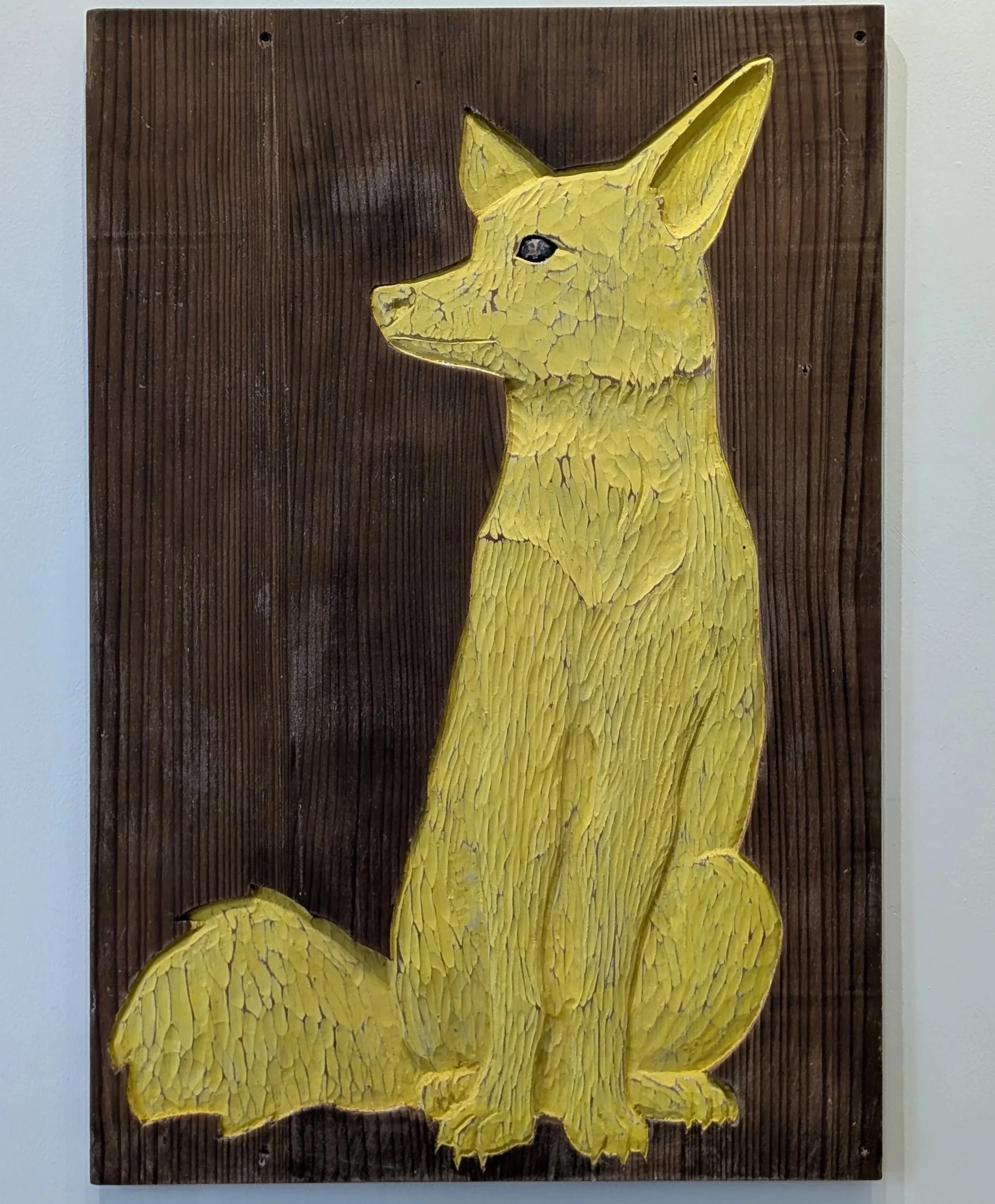
I sketch animals I’m genuinely engaged with. I’ll read about them, look for people who study them, observe how others interact with them. For example, the tortoise piece came from reading an article about a Japanese man who walked his pet tortoise around his neighborhood. Paired with my time living near a tortoise sanctuary in Utah, those experiences fused into the final sculpture. I never carve an animal I haven’t developed some kind of relationship with.
BOBCATS, OWLS, AND THE EVERYDAY WILD
Chris Wagner:
The bobcat pieces came from when I lived in California. I worked on a farm where a bobcat kept killing our birds every night. One day it leapt from a shrub as my dog and I were checking the fence line—my dog chased it into the brush, and I was sure she’d be hurt, but she came out fine. Those encounters lodged the bobcat firmly “on my mind.”
The owl piece is more recent. It’s loosely based on a coworker who always wears suspenders, but the owl itself comes from the calls we hear constantly outside our house. I walk the park hoping to see it, but never do. At night, it’s either the owls or the frogs keeping me company.
STUDIO, SCALE, AND MATERIAL
Lee Matney:
Your studio is only 250 square feet, but it feels much larger.
Chris Wagner:
It’s the biggest personal studio I’ve ever had. Everything is modular, and most of my tools are handheld, so space works differently when you’re carving. If the space were bigger it would probably feel colder. This size feels right.
COYOTES AND THE “TASTE OF THE WILD”
Chris Wagner:
Coyotes and bison are my most recurring subjects. Growing up camping on a cattle farm, coyotes would walk right up to our tent. Even in major cities—Portland, San Francisco—you can sometimes catch that skulking shape at dawn. Wherever you are, a coyote is a reminder that a little piece of the wild still shares your space.
BORROWED PERSPECTIVE
Lee Matney:
Why did you call that series Borrowed Perspective?
Chris Wagner:
Because with the mask pieces, I’m trying to imagine the world through the eyes of another creature. It isn’t only about depicting the animal—it’s about thinking through how that animal perceives the world. You can never truly see through their eyes, so the mask becomes the intermediary. I’ve made masks with eye holes before, but in the aluminum pieces it worked better to keep the form simplified. The contrast between the cast metal and the carved wood underneath adds to that separation between the inner life and the outward form.
MATERIAL LOGIC AND CARVING APPROACH
Lee Matney:
Tell me about the large bison—your approach to carving something at that scale, and how the material choices shaped the final form.
Chris Wagner:
I have a lot of progress shots and even time-lapses of that piece. When I’m carving large animals, I base the measurements on the real scale of the species. At the Muscarelle, for example, the deer and coyote I made are precisely the actual size of those animals. With the bison, I wanted viewers to feel the true physical presence of something that massive—something you rarely get to experience safely in the wild.
When working at that size, you’re not carving from a single gigantic tree. You’re laminating reclaimed lumber, stacking it, and constructing the mass from smaller structural components. Then I carve it down with a range of tools—chainsaws with different blades, angle grinders, and smaller hand tools. I leave all the tool marks visible. Wood has its own language, and those marks honor the process.
If you wanted hyperrealism, wood wouldn’t be the material. But wood carries a physical and emotional truth that I like to highlight, especially when building something monumental.
DIALOGUES WITH STEVE PRINCE
Lee Matney:
You and Steve Prince are shown side by side in the gallery. Do you see intersections?
Chris Wagner:
Absolutely. We use similar tools, but we work in completely different ways. Steve is incredibly gestural and fast—almost additive in spirit, even when he’s carving. I’m slow, subtractive, patient. Yet our marks can arrive at a similar energy. That’s what fascinates me: two artists using related tools and materials can arrive in adjacent emotional territories through entirely different processes.
That crouched figure you pointed out echoes Steve’s work unintentionally. I was simply sketching how I sleep—studying my own body positions. But those resonances happen, and they’re interesting.
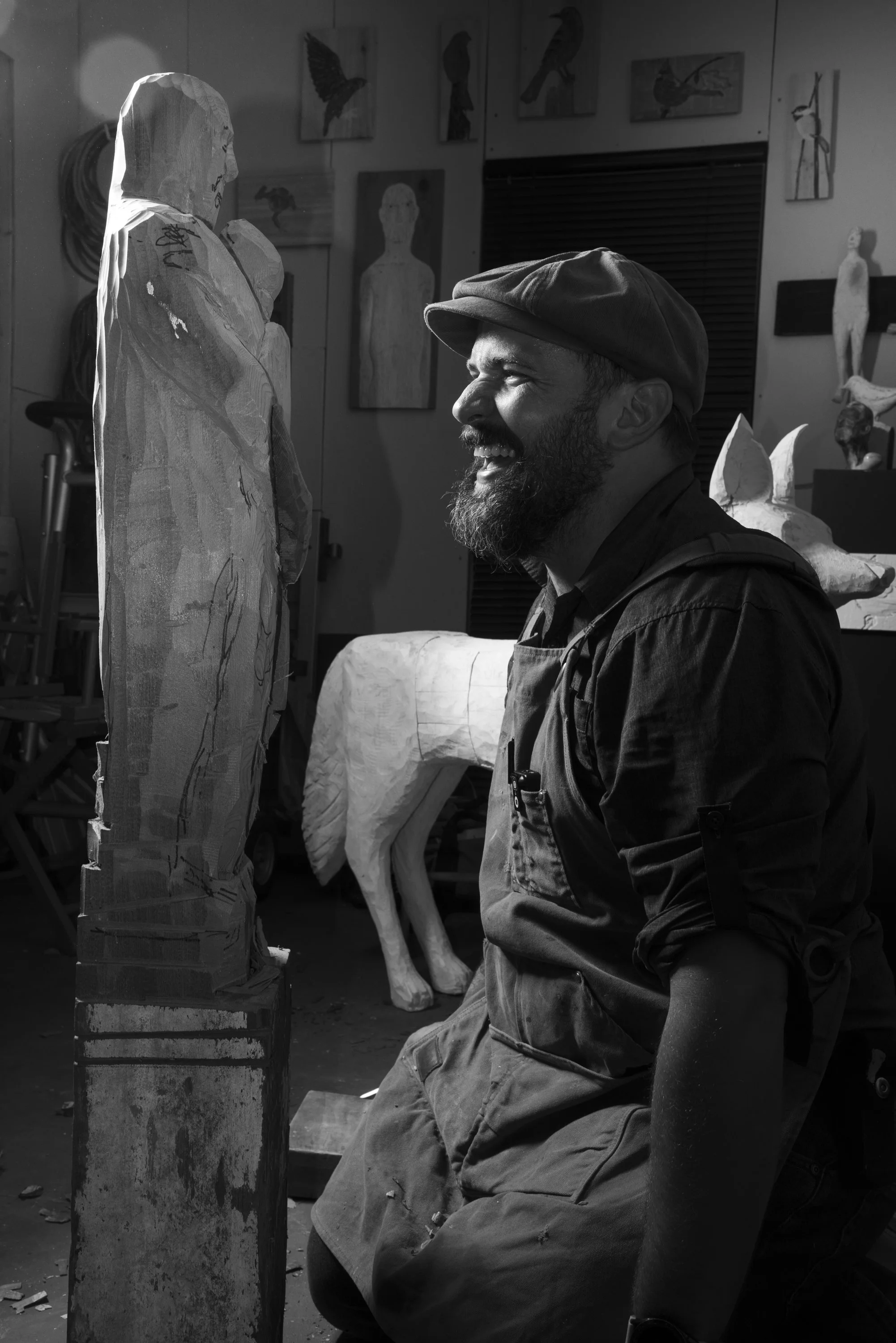
What emerges from these extended conversations is a fuller portrait of Wagner’s practice—one grounded in attention, humility, and an ongoing dialogue with the natural world. The works in the Fall Salon carry these stories quietly, but with unmistakable resonance: the layered presence of family, the pull of the wild, the weight of memory, and the disciplined patience of carving. Together they deepen the sense that Wagner’s sculptures are not only objects but lived experiences distilled into form.
