
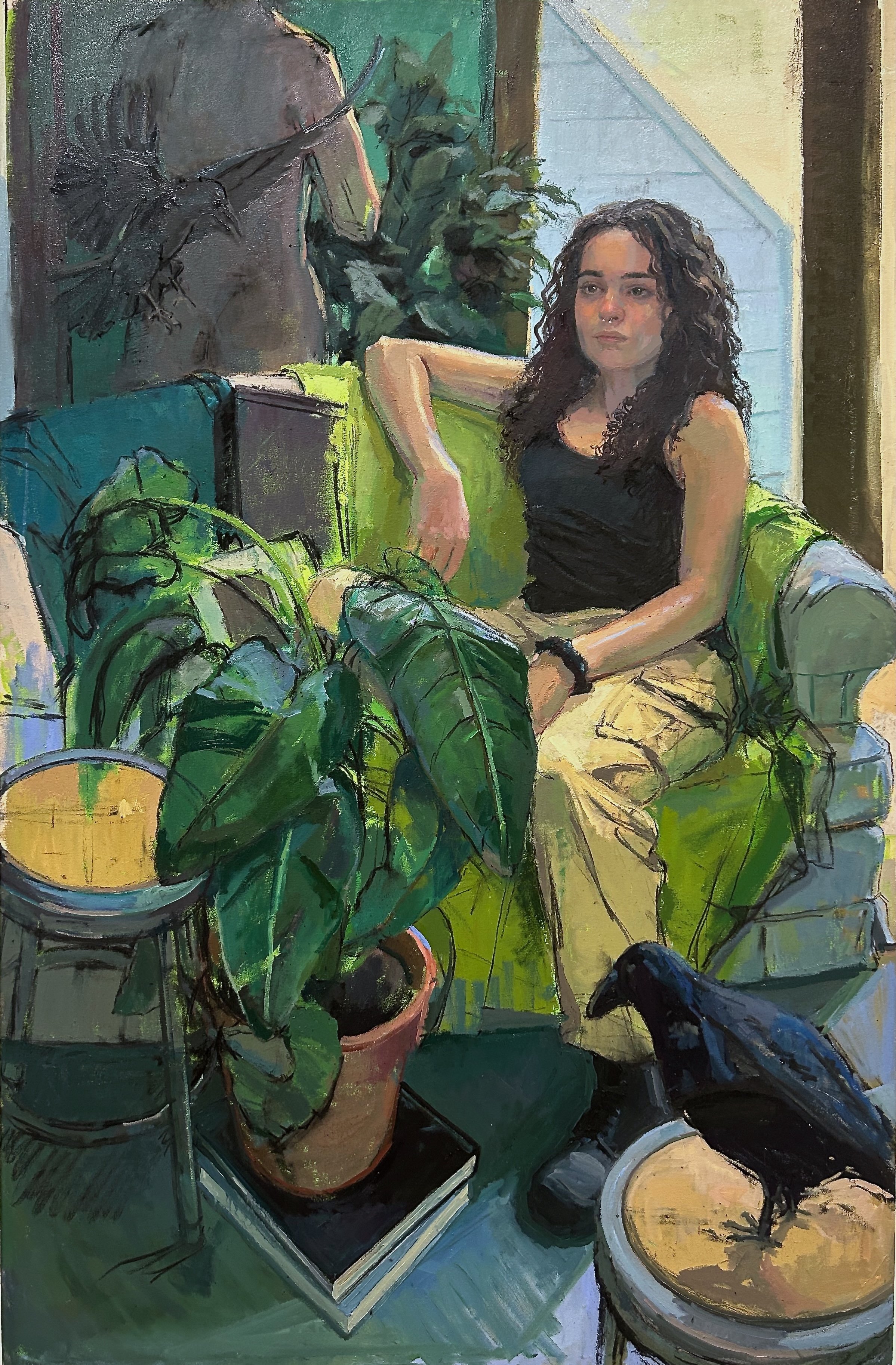
Nicole Santiago: Painting as a Sustained Practice
Nicole Santiago’s paintings move quietly but decisively between still life, interior, and figure. Her work resists narrative resolution, allowing mood, surface, and spatial tension to carry meaning instead. As both an artist and educator, Santiago brings a sustained attention to structure and looking- concerns central to her teaching at William & Mary, and equally present in her studio practice. Objects and figures are arranged with care, never decorative, often withholding just enough to keep the viewer present. Her recognition as a finalist for the Bennett Prize underscores a practice grounded in observation, discipline, and long engagement. The result is painting that feels lived with rather than performed, and that aligns naturally with academic and institutional contexts.
Lee Matney: Tell me about the pieces at Current Midtown.
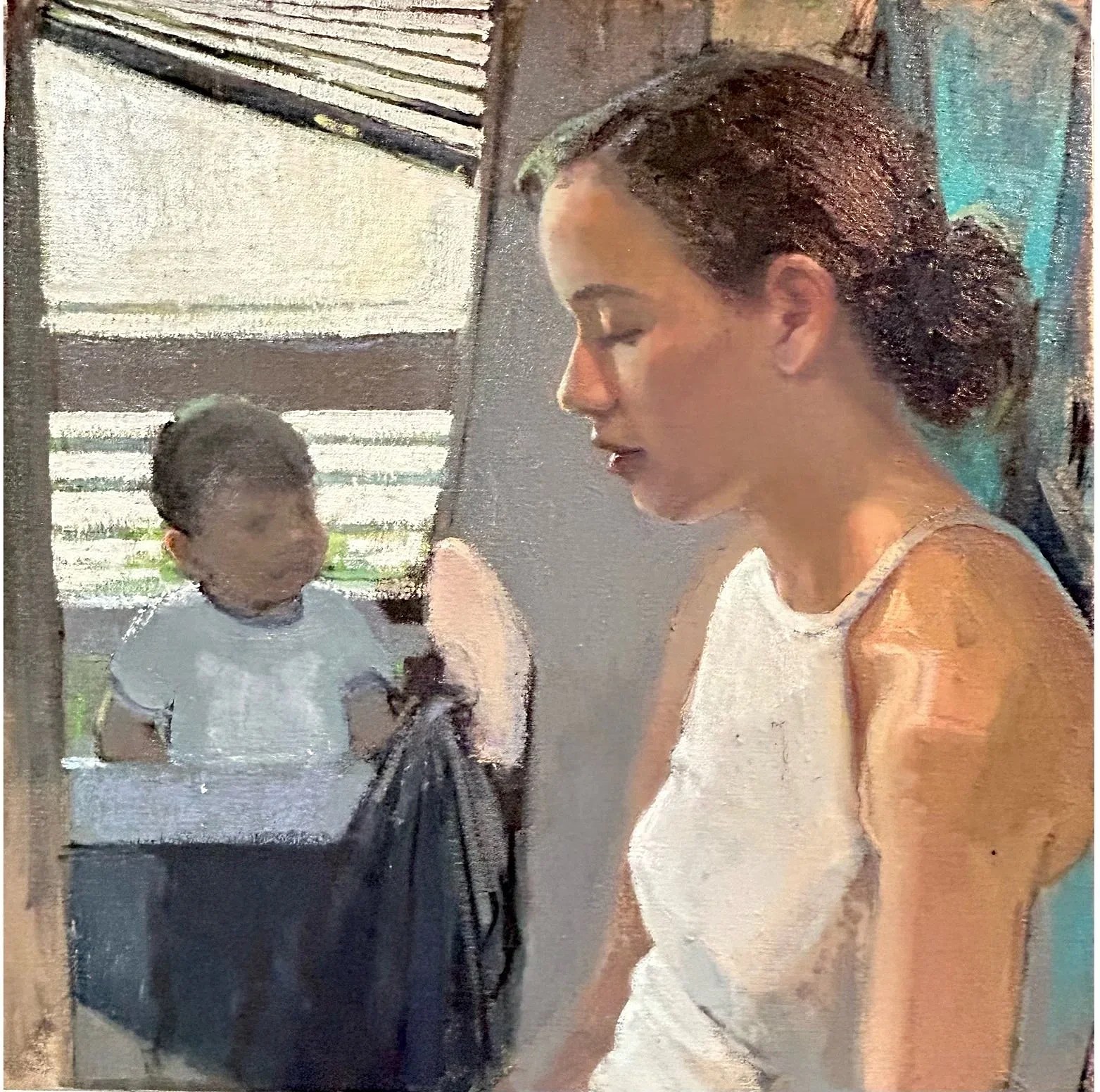
Mother 26"x26" oil/panel,
Nicole Santiago:
This piece, Mother, comes out of my own experience as a mother. It was originally a study for a larger work and focuses on my relationship with my son and the distance between us at that time. He was about two years old, and I had just started leaving him at preschool. It’s something everyone goes through, but it was incredibly difficult for me, especially because he had health issues. You leave your child with someone else and spend the entire day worrying. The work is really about that separation, being constantly in each other’s minds while physically apart.
Nicole Santiago:
This painting, Kay, was just a study. I wanted to focus on the figure. I had a good model, and I loved the color of the chair against her flesh and the blue of her dress. It was purely a formal painting. There is no narrative behind it. I simply wanted to describe the figure in the chair.
Lee Matney: Can you talk about what’s been happening in your work more recently?
Nicole Santiago:
My work has always had some narrative element, but recently it has become more layered. I am making paintings that are loosely and very obscurely about the state of our country. I do not think that is immediately readable, but ominous elements enter the work, like crows and other symbolic presences.
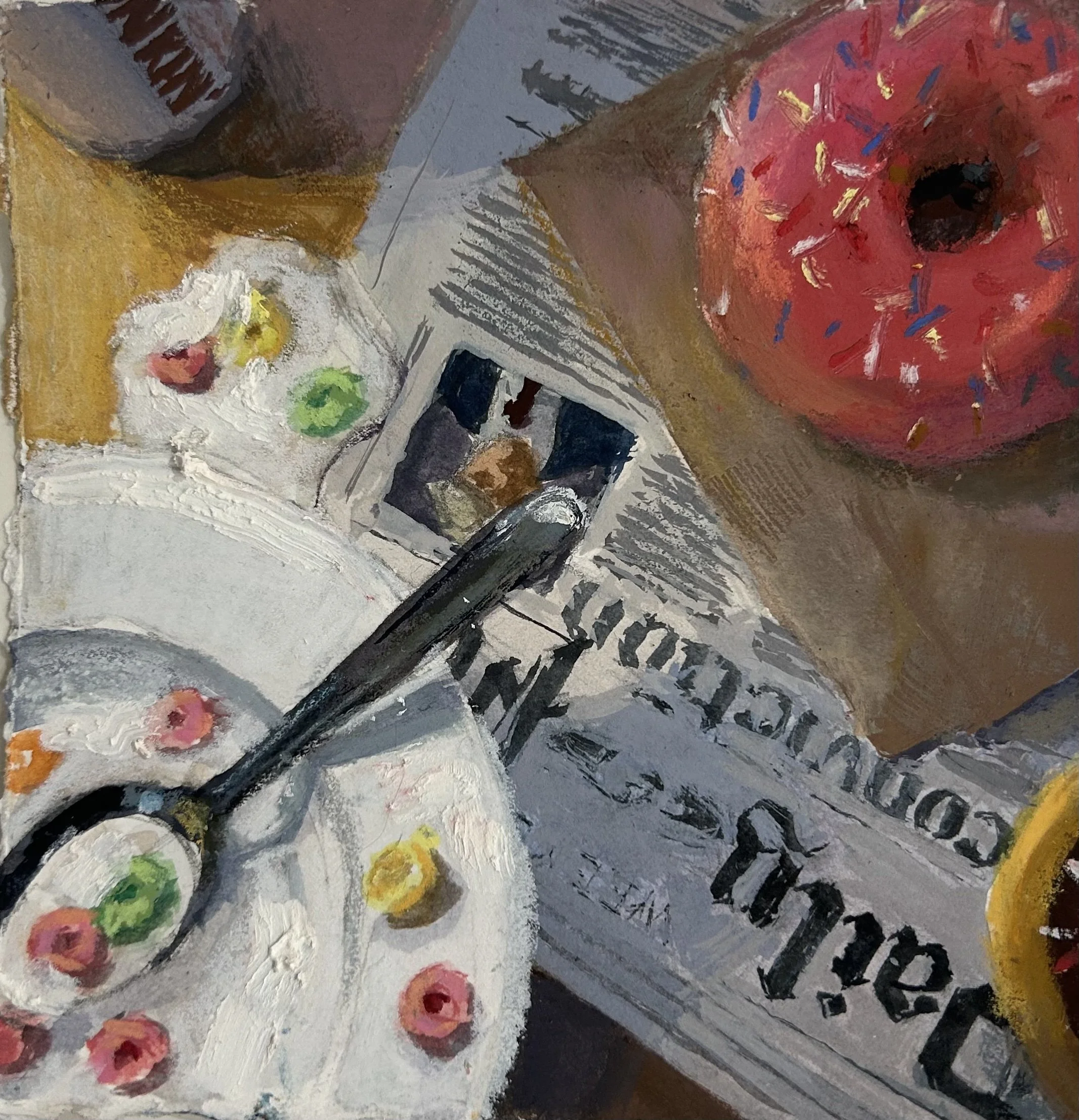
Convicted, 5x5, gouache & oil pastel on paper, 2025
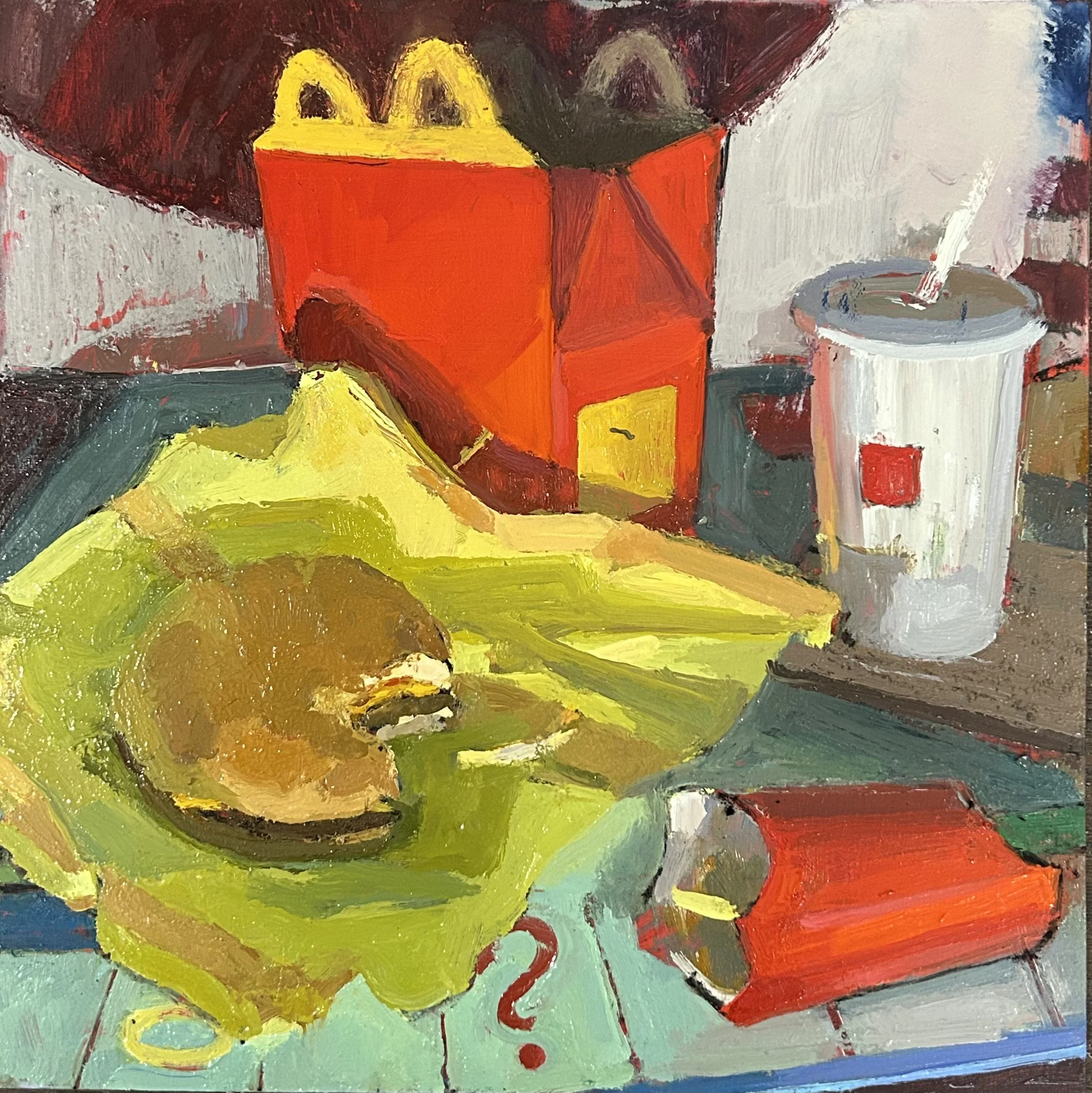
McAmerica, 10x10, oil on panel, 2025
At the same time, I am making work about my daughter and her journey after being diagnosed as autistic. Learning how her brain works and how her world operates differently from mine has been incredibly fascinating. That experience has begun to enter the paintings as well.
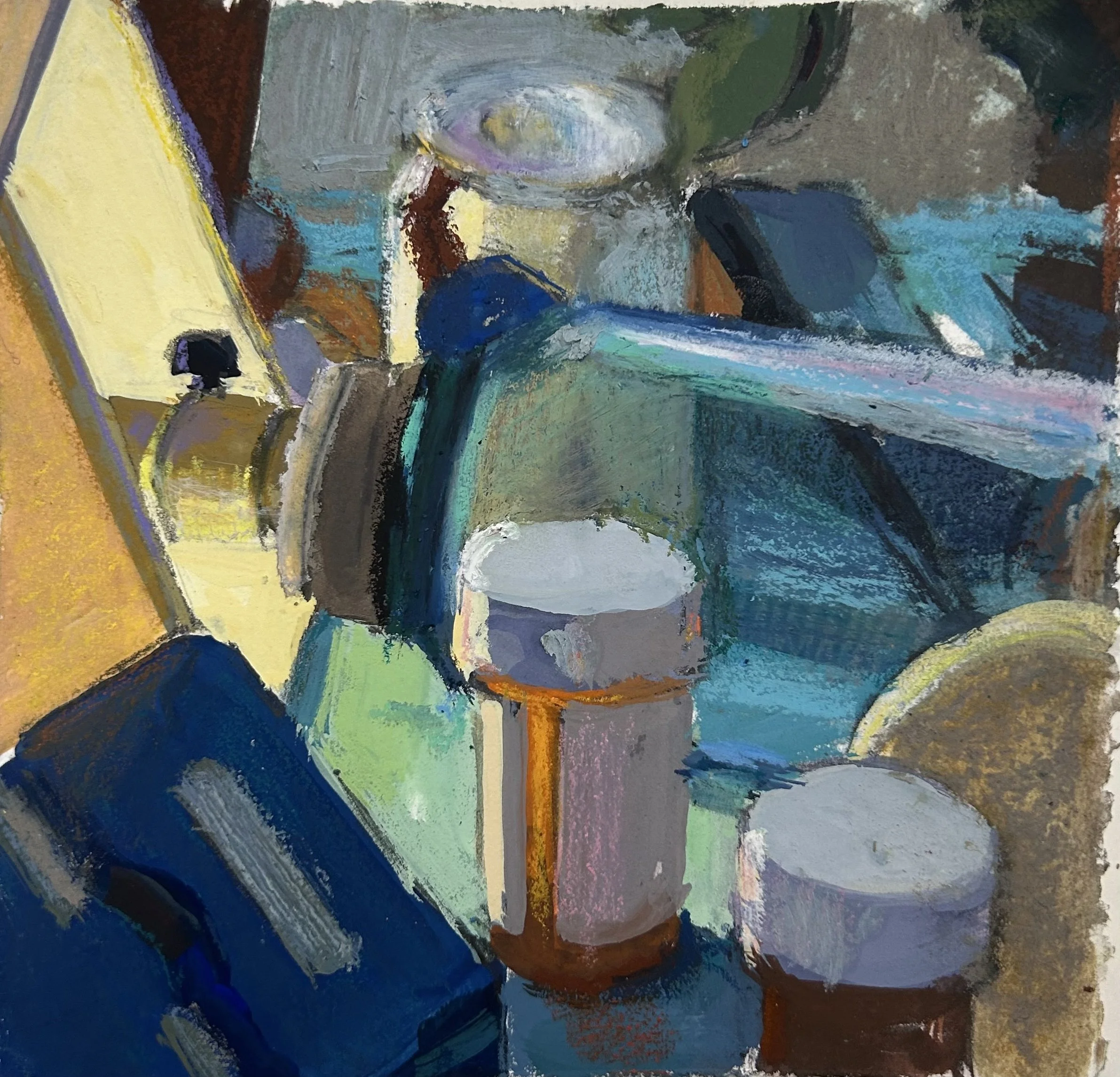
Where Things Land Study No. 2, 5x5, gouache & oil pastel on paper, 2025
Lee Matney: Is there anything else you would like to talk about, your work, William and Mary, or anything else?
Nicole Santiago:
Yes. I am always surprised when I hear local high school art teachers say that William and Mary is not a place to go for art, because we have an exceptional faculty who are deeply engaged in their own practices. If you look at their resumes, it is exhibition after exhibition with significant accolades. We may be small and somewhat constrained by our facilities, but we are mighty. We produce strong artists, many of whom go on to earn MFAs and become professional artists.
Lee Matney: Was Rebecca Shkeyrov one of your students?
Nicole Santiago:
Yes, she was.
Lee Matney: Could you say a little about her?
Nicole Santiago:
There was a distinct quirkiness and a strong personal voice in her work early on. She was not mimicking her instructors. Her hand was clear from the beginning. She is intense, sincere, and deeply committed to her work. It has been wonderful to see her succeed and continue developing as an artist.
Lee Matney: Is there anything else about the students or the work coming out of William and Mary that you would like to talk about?
Nicole Santiago:
Absolutely. William and Mary students are incredibly bright. It is a highly selective school. Many of them are double majors, and even those who are not bring knowledge far beyond art into their work. That interdisciplinary foundation is fascinating to see reflected in their artmaking.
Some students go on to become doctors, lawyers, or enter other professional fields, but they carry with them an understanding of beauty, structure, symmetry, and pattern recognition. Those skills transfer beautifully into other disciplines.
Lee Matney: Is there anything about your practice or art education more broadly that you feel strongly about?
Nicole Santiago:
I think there are generally two types of studio art programs. There are those that are heavily conceptual and those that emphasize formal foundations. The studio faculty at W&M have made a clear commitment to ensuring students have a complete and thorough grasp of foundational, formal artmaking. , while still engaging with concept and idea. Making art is a craft and a discipline. It takes a long time to develop, and we help them do that. When our students graduate, they have the tools to execute their ideas. That foundational training matters!
Lee Matney: You have spoken before about the relationship between the art department and the Muscarelle Museum.
Nicole Santiago:
Yes, the Muscarelle is wonderful. There is a real synergy between us. Having Steve Prince as artist in residence strengthens that connection even more. Since I arrived in 2006, there has always been a strong collaborative relationship. We support one another and overlap in meaningful ways, and that collaboration strengthens both entities.
Lee Matney: You have had art history students in your classes as well?
Nicole Santiago:
Yes, occasionally, though I actually get a lot of students from biology, psychology, neuroscience, and computer science. That has been consistent across institutions. I once asked a biology student why so many of them gravitate toward drawing, and she immediately said pattern recognition. Observational drawing requires that same skill.
Psychology students come for similar reasons. Studying human behavior also involves recognizing patterns. Those students tend to learn quickly and do very well.
Lee Matney: Could you talk a bit about your own path into art?
Nicole Santiago:
Unlike many of my students, I was not strong academically across a wide range of subjects. I probably should have gone to art school, but I chose a university and struggled academically. What I always knew was that I could draw and paint well, and that is what I wanted to do. I did not care about a specific job. I just wanted to get better at making art.
Even in graduate school, I was not career focused. I simply wanted to improve as a painter. That drive has been there since I was young, though I do not think it has to start early for everyone. I have seen students come to art late in their academic career and still go on to earn MFAs and build strong careers.
Lee Matney: You were runner up for the Bennett Prize. Would you like to talk about that?
Nicole Santiago:
Yes, that was a huge surprise. The Bennett Prize is open to female figurative representational artists whose work sells for under $25,000 per piece, which certainly applies to me. There were over 800 applicants. I became a finalist and then runner up.
There were ten finalists, and all of us were included in a traveling exhibition shown primarily in museums across the eastern United States. It began at the Muskegon Museum in Michigan and will travel for two years. The Bennetts are extraordinary philanthropists with a deep commitment to supporting women artists, particularly in figurative representation.
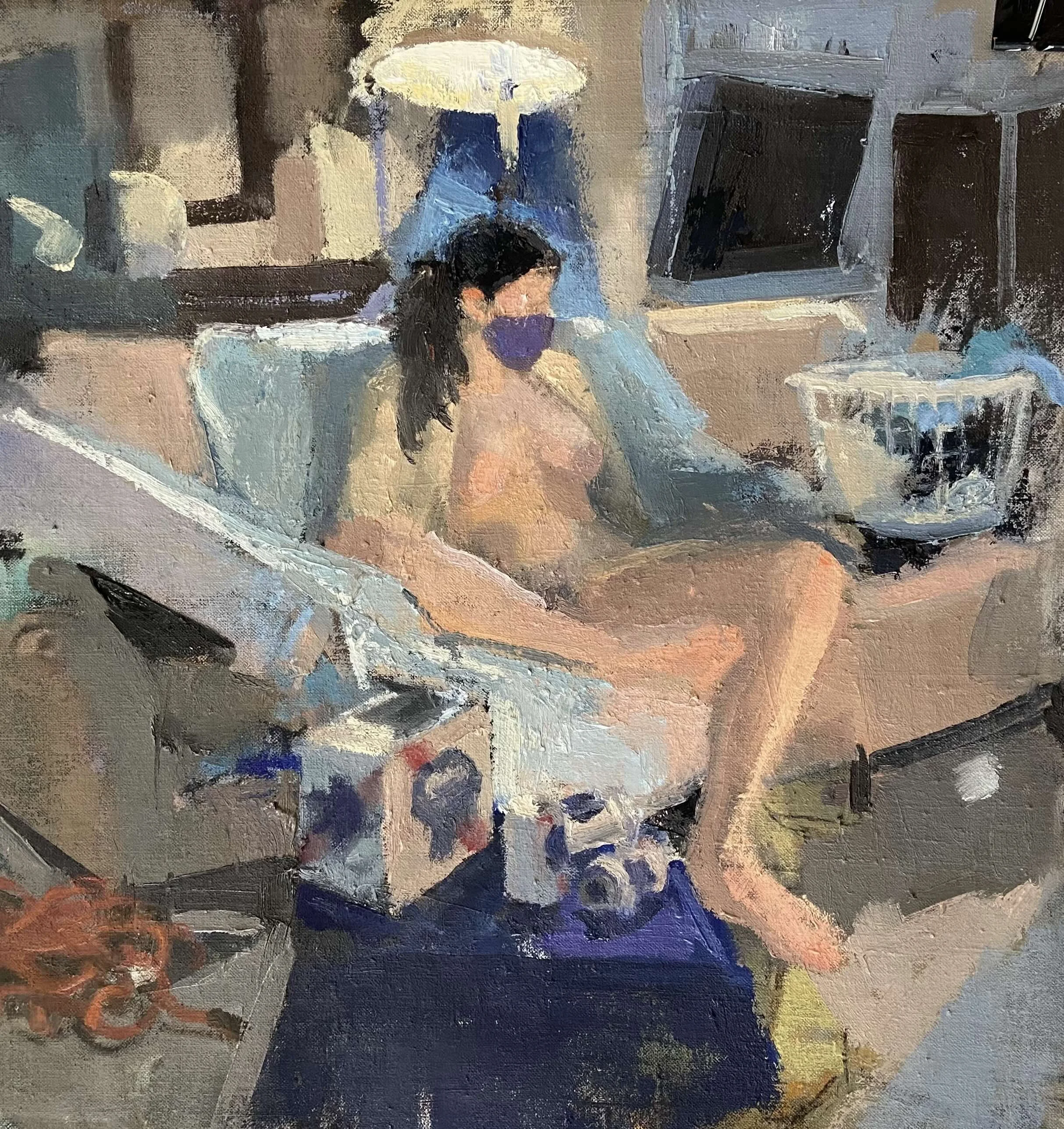
Laundry, 16x16, oil on panel, 2021