
Matney Gallery: Year in Review
On Practice, Time, and Stewardship
Matney Gallery’s work unfolds across time rather than seasons.
Over the past year, the gallery continued to operate in the space where artists, collectors, educators, and institutions begin to align—often quietly, and often before anything becomes public. Projects developed through sustained conversations, repeated studio visits, research, and long periods of looking. The emphasis remained on care, continuity, and long-term relevance rather than speed or visibility.
This Year in Review reflects how that work has taken shape.
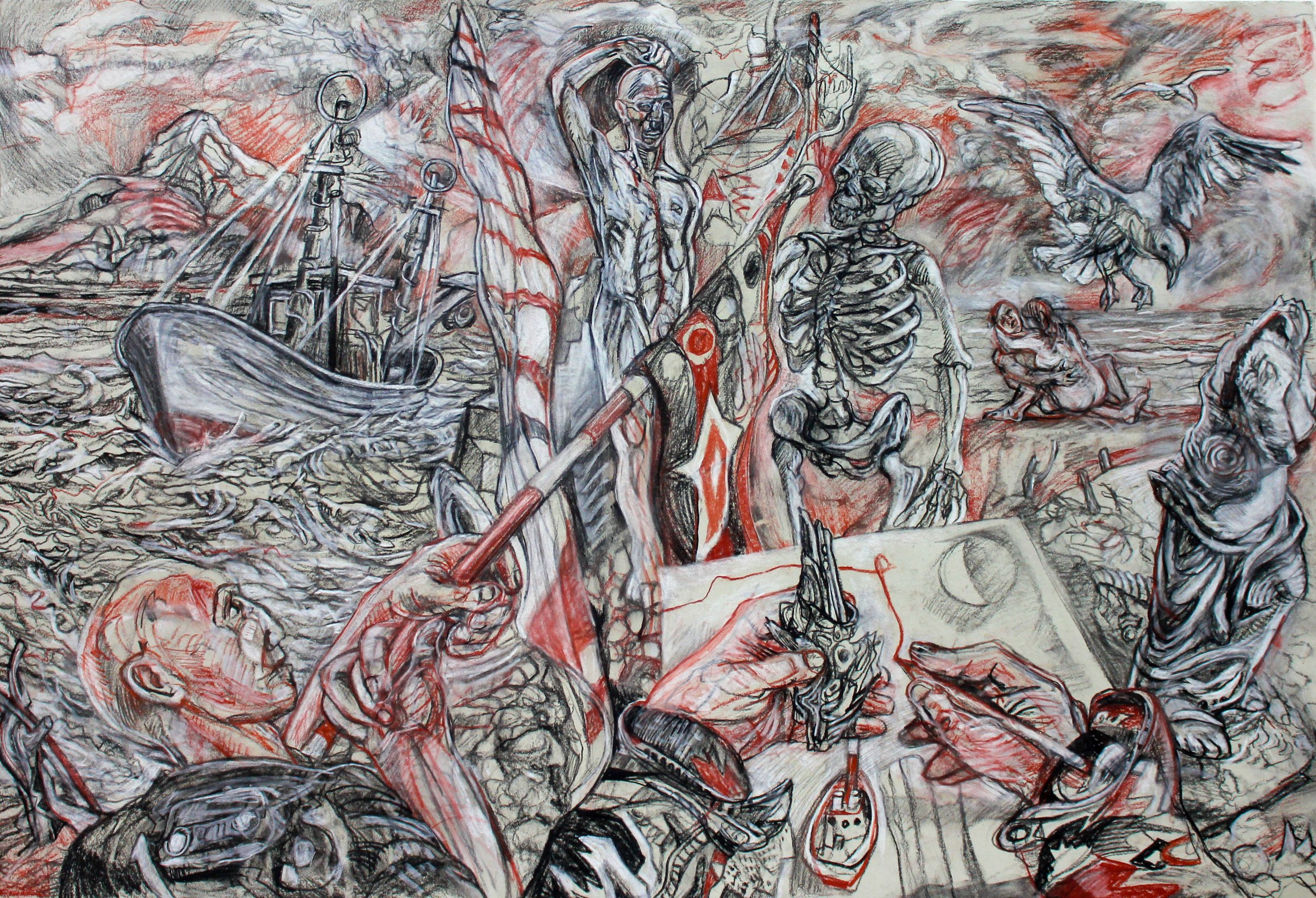
Art Rosenbaum, Studio and the Sea I.
Drawing exploring the relationship between studio space and the natural world, positioned within traditions of Southern visual language and cultural memory.
From conversation into form
Many projects at Matney Gallery begin not with proposals, but with attention. Ideas develop through dialogue and return visits, allowing practices to be understood on their own terms and within broader historical and cultural contexts.
Work by Art Rosenbaum remained central to this approach. His drawings and fieldwork were framed not as isolated artifacts, but as part of a longer lineage of Southern visual language, ethnographic attentiveness, and cultural memory. Rather than responding to short-term market signals, this work continued to be positioned through stewardship, context, and institutional relevance over time.
Alongside this, projects with Jill Carnes and Steve Prince foregrounded labor, process, and material intelligence. Carnes’s practice, grounded in drawing and embroidery, emphasizes repetition and handwork, allowing meaning to emerge gradually through time and close looking.

Steve Prince,
Print emphasizing narrative, spiritual inquiry, and community engagement within contemporary print practice.
Prince’s work bridges studio practice, pedagogy, and public engagement. His prints and installations move fluidly between narrative history, spiritual inquiry, and contemporary social context, shaped by a sustained commitment to teaching and to working within communities beyond the gallery. Across multiple projects, his practice demonstrates how printmaking can function simultaneously as image and archive, carrying knowledge through storytelling, instruction, and shared experience, while remaining deeply legible within both gallery and museum settings.
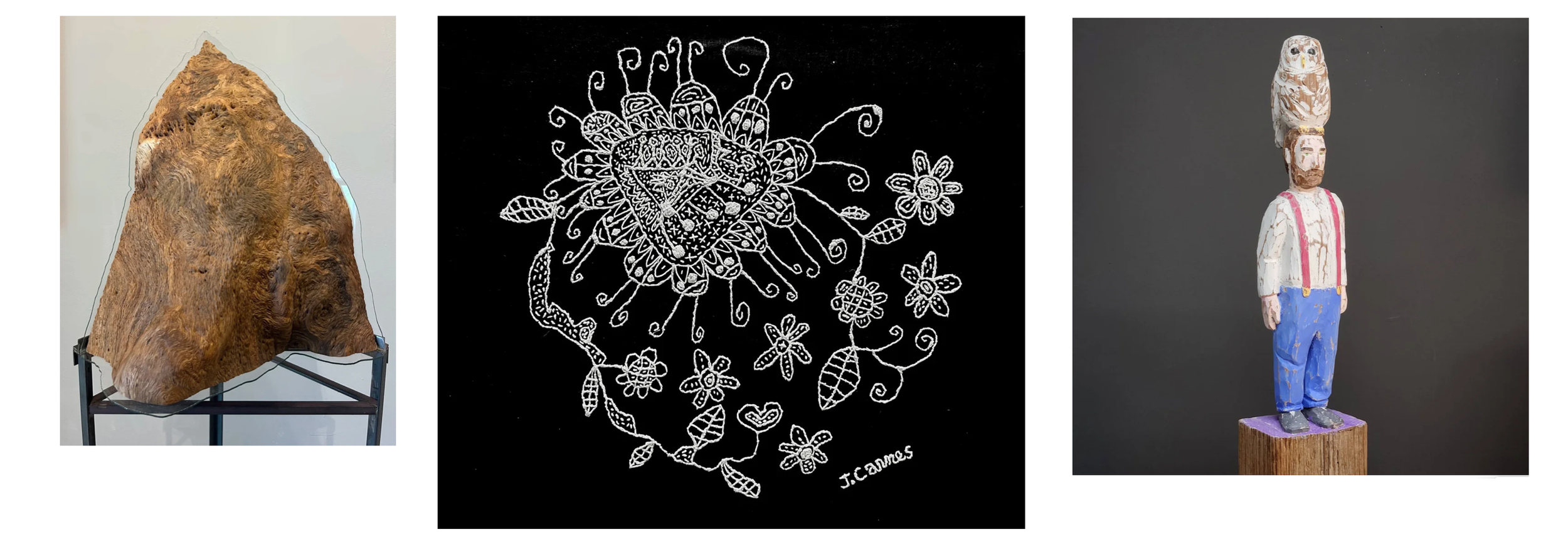
Selected works from The Fall Salon: Ecology, Memory, and Renewal, featuring approaches to material responsibility, labor, and intergenerational dialogue across sculpture, textile, and print.
Exhibition as shared structure
Exhibitions at Matney Gallery are conceived as shared structures rather than singular statements.
One recent manifestation of this approach was the Fall Salon, which brought together a wide range of practices without imposing a fixed hierarchy. Anchored by a Salon Takeover from sculptor Chris Wagner, the exhibition centered themes of ecology, endurance, and renewal. Wagner’s reclaimed-wood sculptures functioned as witnesses shaped by labor, time, and material responsibility.
Around this core, the exhibition created space for dialogue across mediums and generations. Around this core, the exhibition created space for dialogue across mediums and generations. The Salon also marked the return of Dana Jo Cooley, whose mixed-media work brings intuition, ritual, and material presence into conversation with the gallery’s longer arc Sculptural and mixed-media work by Garth Fry explored material experimentation and transformation. Works by Carnes and Prince extended conversations around labor, ethics, pedagogy, and narrative.
Photography played a significant role as well. Portrait and interior studies by Ian McFarlane approached the medium as witness, registering stillness, vulnerability, and psychological presence. Landscape-based work by Lita Tirak revealed layered ecologies and histories through sustained engagement with place.
Rather than resolving these practices into a single conclusion, the exhibition functioned as a living structure—one that invited return visits, rereading, and continued dialogue.
The gallery’s work this year also remained in dialogue with artists whose practices extend across geographic and cultural contexts. Ongoing engagement with Rebecca Shkeyrov, William Ruller, Olga Tobreluts, Ivan Plusch, and Jean-Daniel Lorieux reflects a shared commitment to long-term studio practice, image-making, and historical continuity. Across painting, photography, and mixed media, these artists’ works engage questions of memory, presence, and cultural transmission, reinforcing the gallery’s interest in practices that develop through time rather than trend.
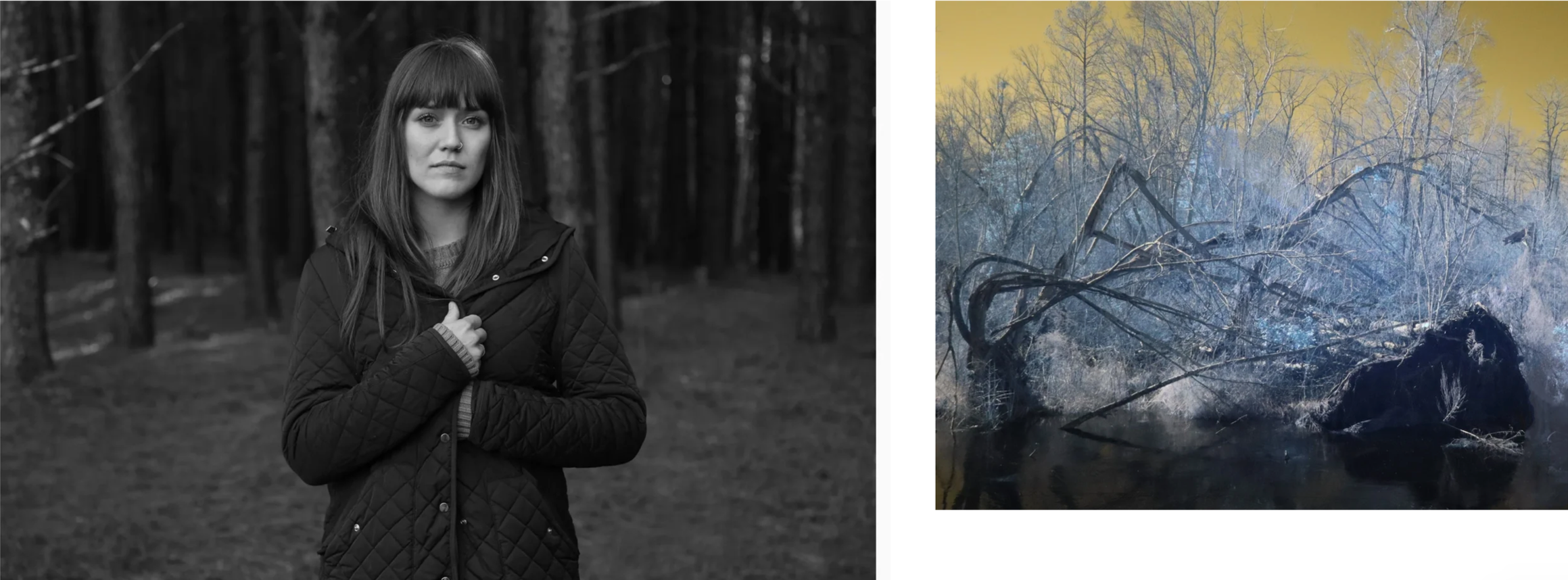
Photographic works by Lita Tirak and Ian McFarlane, approaching landscape and portraiture as forms of witness, duration, and psychological presence.
Photography, film, and long memory
Photography at the gallery functioned not only as documentation, but as a primary artistic and research practice grounded in duration and collaboration.
Lee Matney’s photographic work developed through long-term engagement with artists and cultural figures, treating images as psychological landscapes in which meaning emerges between frames, objects, and relationships rather than within a single image.
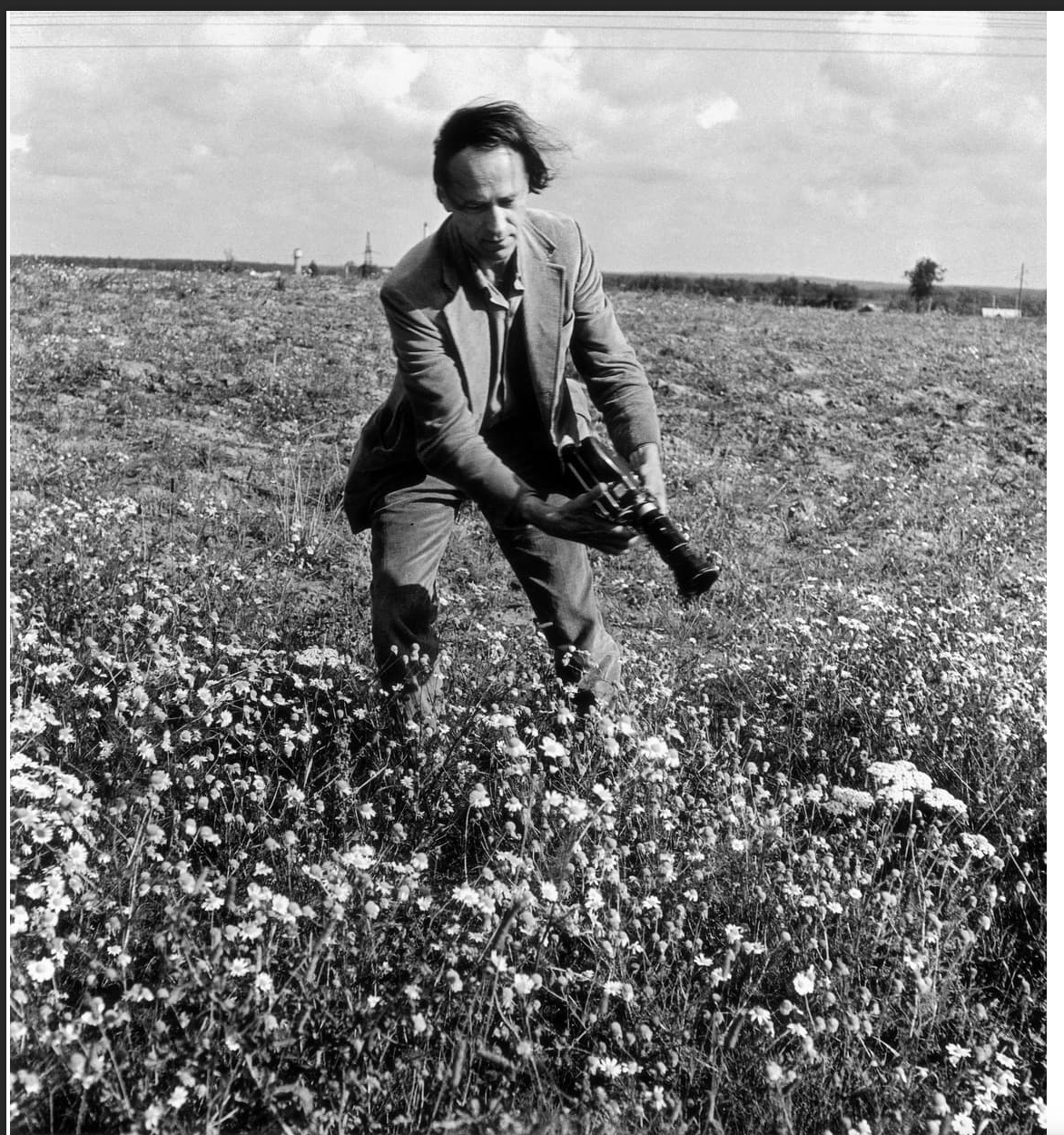
This sensibility aligns closely with the gallery’s ongoing engagement with the legacy of Jonas Mekas in conjunction with OUTPOST NYC DCG.. Mekas’s diaristic approach to film and photography, attentive, intimate, and resistant to categorization, continues to inform how the gallery thinks about archives, cultural memory, and the ethics of preservation. His work offers a model for how lived experience, observation, and artistic practice can remain open across time without being reduced to spectacle.
This engagement continues through ongoing research, advisory work, and film programming connected to the Jonas Mekas Film Festival, developed in dialogue with archives, artists, and institutional partners.
Stewardship as method
For Matney Gallery, alignment with museums and institutions is not a designation, but a practice.
It involves working within curatorial language, conservation standards, and institutional timelines, often well before proposals are formalized. It values slow looking, return visits, and conversations that deepen understanding rather than conclude it. This approach reflects a belief that cultural work gains strength through patience, rigor, and care.
This approach has included ongoing dialogue and project-based engagement with Muscarelle Museum of Art, reflecting the gallery’s commitment to thoughtful placement, curatorial context, and long-term public stewardship.
This commitment to stewardship also extends to mentorship, pedagogy, and sustained dialogue across institutions. Ongoing conversations with artists and educators including Elizabeth Mead, Nicole Santiago, Brian Kreydatus, John Lee, Dennis Harper, Michael K. Paxton, Kent Knowles, Teddy Johnson, Christi Harris, Glenn Shepherd, and Thais Shepard, reflect the gallery’s role as a site of exchange grounded in close looking, critical inquiry, and long-term engagement with artistic practice. Ongoing mentorship with George Papadakis further embodies this approach, emphasizing sustained studio dialogue and the development of practice over time.
Much of this work advances best through presence rather than promotion.
Several bodies of work discussed here have reached a point of readiness for deeper institutional engagement. These include focused selections shaped through long-term studio practice, teaching, and community-based work, as well as research-driven projects grounded in archival and historical inquiry. The gallery is open to conversations around acquisition, exhibition, and research partnerships that build on this foundation, with an emphasis on fit, context, and long-term stewardship.
An open practice
Matney Gallery is open by appointment and welcomes artists, educators, collectors, museum colleagues, and those engaged in curatorial and research work. Visits are intentionally unhurried, offering space for conversation, close looking, and reflection.
The work continues.