
What Remains Unseen: Mia Guile and the Psychology of Place
Mia Guile’s recent paintings are populated by absence. A chair remains unoccupied. Glass reflects the landscape rather than revealing the room behind it. Water moves without a visible swimmer. Shadows register a source of light beyond the picture. In her newest work, a tree assumes an unexpected presence beside the architecture.
Across No Reason to Leave, Casting Call, and Between the Pink Walls, Guile has developed these elements into a language of indirect portraiture. The human figure rarely appears, yet the paintings remain concerned with human experience. Rather than describing an individual through likeness, Guile approaches architecture, landscape, objects, light, and reflection as traces of presence.
She has described the paintings as portraits made without the people themselves. That distinction is important because the environments are not substitutes for figures in a simple symbolic sense. They operate more ambiguously, allowing a person to be felt without being fully described. What remains visible offers evidence, but never complete access.
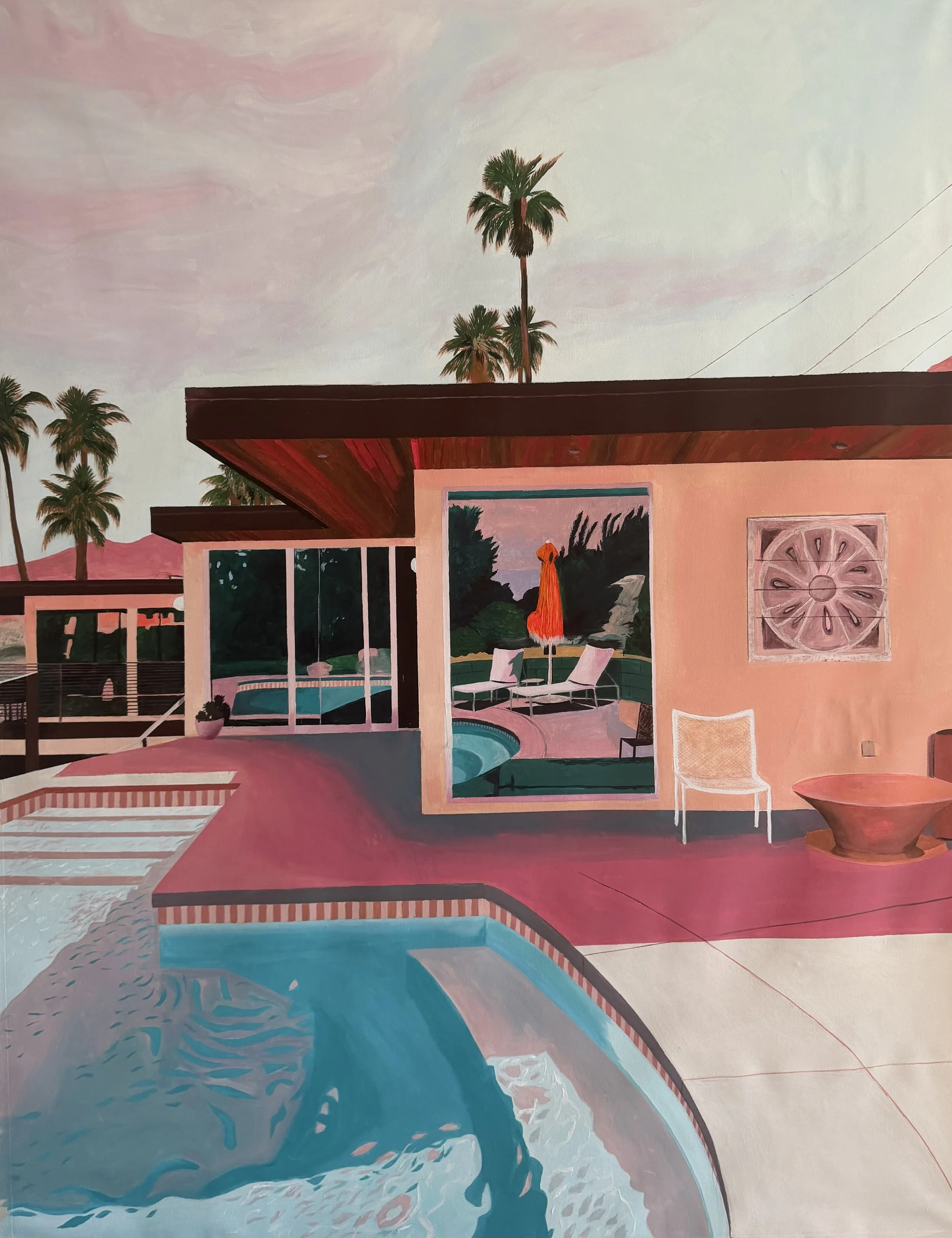
This tension is especially pronounced in No Reason to Leave. Architecture, foliage, water, and glass establish a highly ordered environment, but the painting repeatedly redirects the viewer away from the interior. The windows return the surrounding landscape as reflection. The house can be seen, yet the private space within it remains largely unavailable.
The refusal of access becomes part of the painting’s structure. Guile is interested in the disparity between an outward life and what remains internal. The reflected glass establishes that boundary without illustrating it literally. The viewer encounters a surface that appears transparent while behaving almost like a screen. Reflection also complicates the spatial logic of the painting. Landscape appears both around the architecture and again within it. Exterior space is folded back across the surface of the house, producing what Guile has described as a kind of painting within the painting. The effect is simultaneously expansive and withholding: the visible world multiplies while the interior recedes.
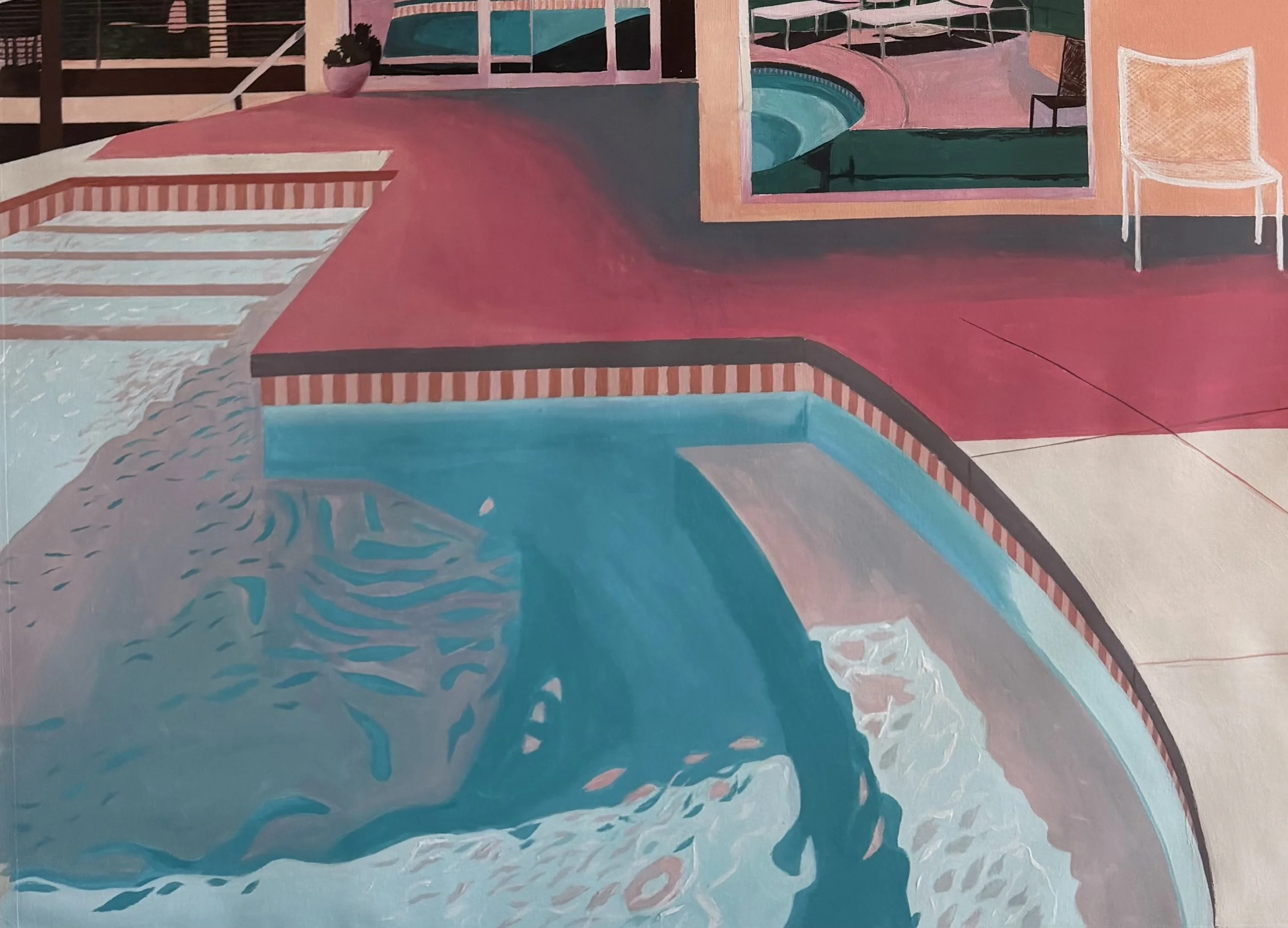
Water performs a related function. Guile has long been attracted to pools, but in these paintings water is more than a source of atmosphere. Its surface introduces movement into otherwise still environments. Ripples may result from circulation, wind, or recent human activity. Their cause remains unresolved, and that uncertainty is important. Guile does not construct a narrative and then provide the evidence needed to solve it. Instead, she creates situations in which the viewer becomes attentive to small indications that something has happened, may be happening elsewhere, or has only recently ceased.
The empty chair has become one of the clearest examples of this process. Guile has spoken about becoming increasingly interested in chairs as characters within the paintings. Their familiarity makes them easy to overlook, yet an empty chair almost inevitably implies a body. Someone may have occupied it, may return to it, or may have placed it there for another person.
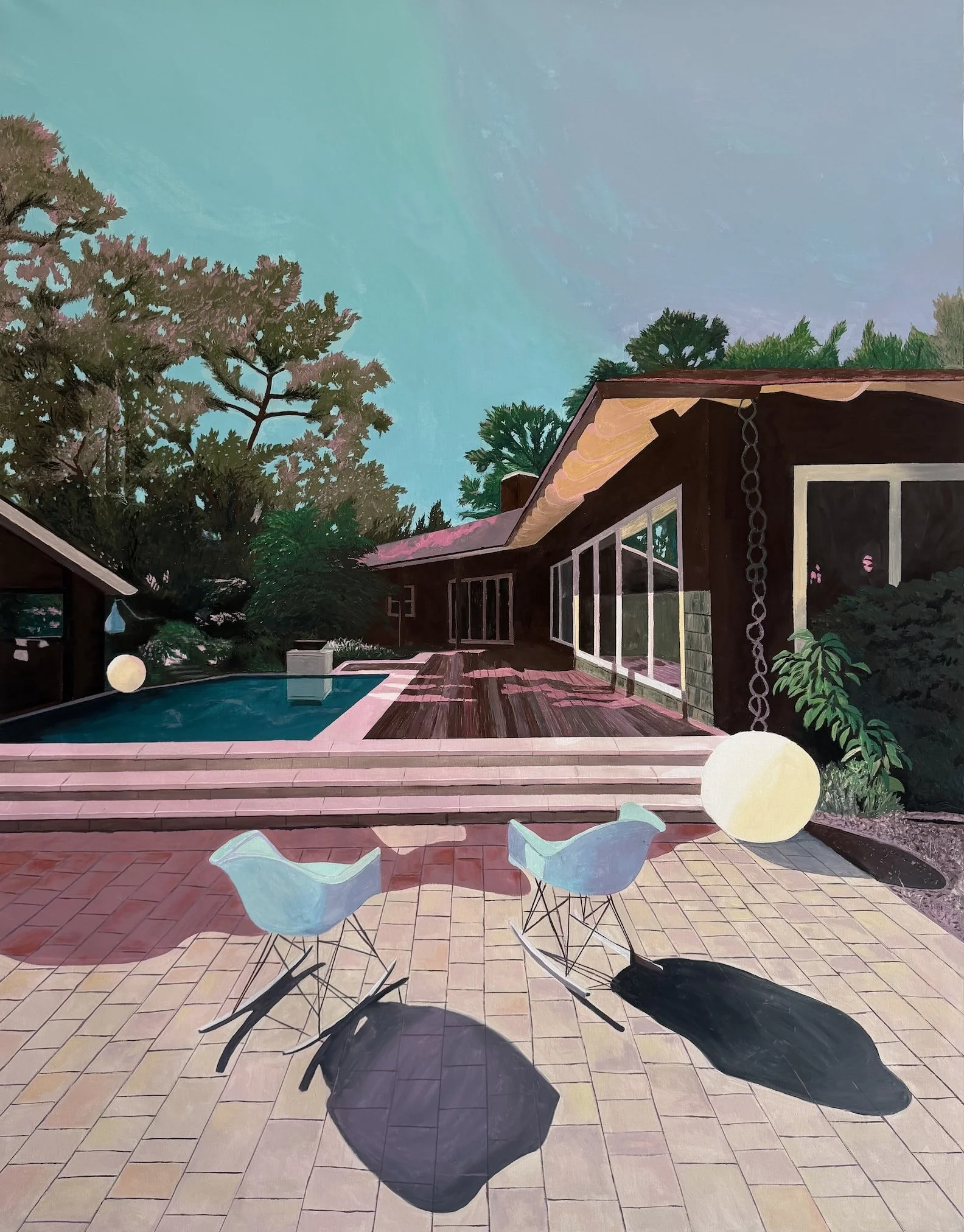
In Casting Call, the chair takes on a more explicit role. Its association with a director introduces ideas of performance, observation, and control. Guile connects the image to a question about agency: whether we direct our lives, watch them unfold, or continually move between those positions. The title extends the idea further. A casting call implies the assignment of roles, but here the role remains uncertain. Guile turns the familiar object toward questions of self presentation. The painting asks how identity is constructed publicly and what might remain beneath that construction without illustrating either answer.
This distinction keeps Casting Call from becoming an allegory with a fixed interpretation. The chair retains its identity as an object within a particular environment even as it accumulates psychological weight. Architecture, vegetation, water, and shadow remain equally important to the composition. That balance between recognizable place and psychological suggestion is central to Guile’s recent work.
Her process begins with photographs she makes herself. She does not simply transfer the photograph into paint. She selects a viewpoint, eliminates information, emphasizes particular forms, and sometimes returns to a location when changing light introduces something the earlier image lacked. In one instance, she returned later in the day specifically because stronger shadows gave the scene the visual tension she had been seeking.
Light increasingly operates through such indirect evidence. Guile has spoken about moving away from depicting the sun itself and becoming more interested in showing its presence through illumination and shadow. A bright leaf, a band of light beneath a structure, or a shadow continuing across water can establish the sun without placing it inside the composition. This formal shift parallels the larger movement within the paintings, where presence is established through consequence rather than direct representation.
Guile’s material choices reinforce the intensity of that experience. She works with a matte vinyl emulsion paint originally developed for theatrical applications. Because the surface absorbs rather than strongly reflects light, color remains unusually direct. The saturated color gives the paintings immediate visual force, but Guile resists allowing that intensity to resolve into pure decoration. Color directs the eye across the composition and establishes relationships between architectural planes, vegetation, reflections, and shadow.
Although her paintings begin in observed places, she has emphasized that she does not want photographic perfection. Water, for example, emerges through the arrangement of shapes and color rather than through an attempt to reproduce every optical detail. This allows the paintings to remain visibly constructed even when their subjects are readily identifiable.
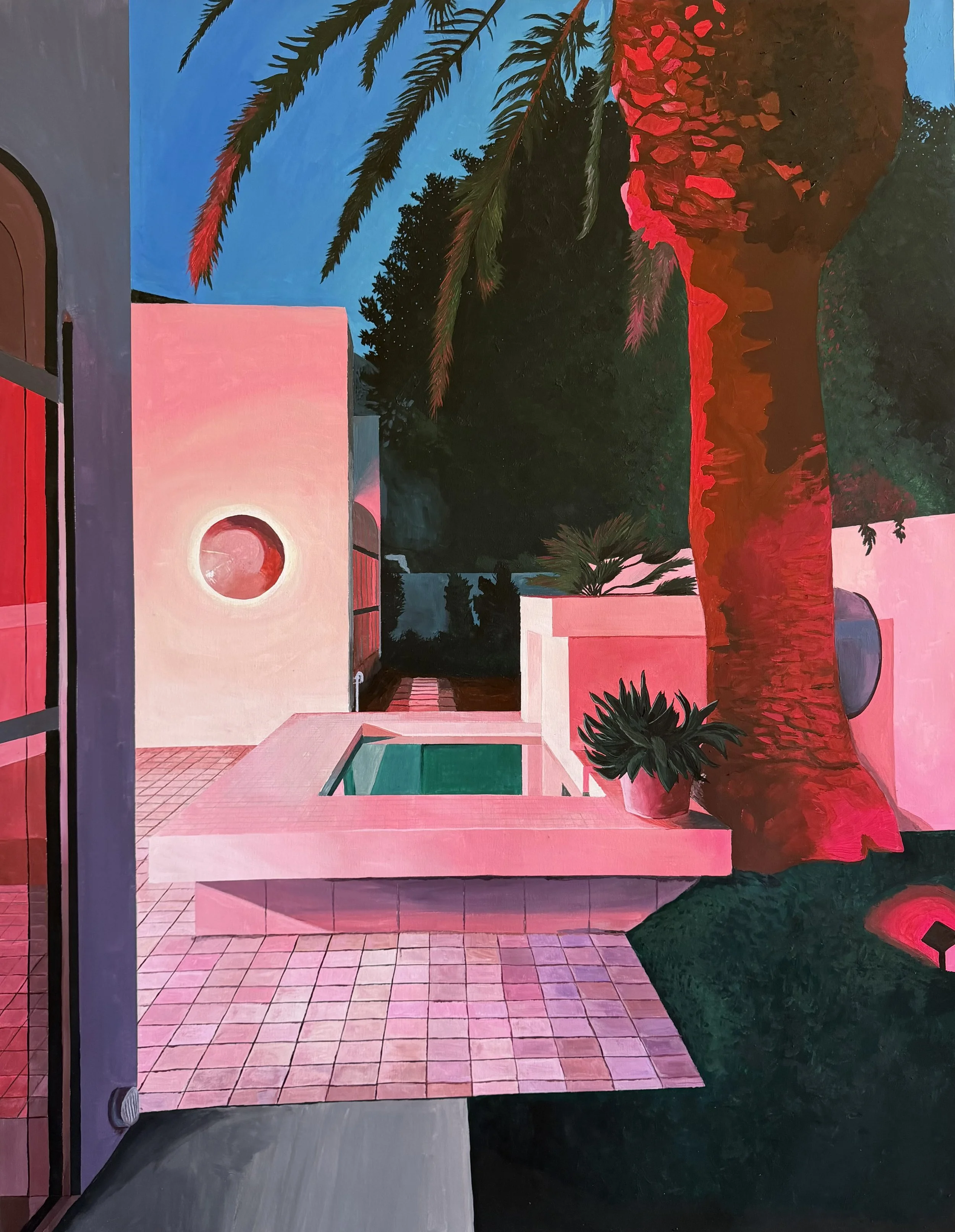
Between the Pink Walls, 2026
Flashe on linen
56 × 44 in | 142.2 × 111.8 cm
Unique work
Between the Pink Walls carries these concerns into new territory. The title turns attention toward what architecture contains rather than simply how architecture appears. Guile asks what occurs within private spaces that remains unknown to those outside them, and who a person might be within those walls when there is no public audience.
The most significant development may be the tree. Guile describes it almost as a character, but more specifically as a witness. The tree has occupied the space outside the architecture, observing without speaking. The viewer then occupies a second position: in Guile’s formulation, we become a “witness to the witness.”
The idea changes the role that nature has played in her work. Guile has long been interested in the relationship between the built environment and the natural world. Architecture, trees, plants, water, and landscape regularly share the composition. In Between the Pink Walls, however, the tree is no longer simply one element within that relationship. It acquires a temporal dimension, suggesting duration, observation, and the accumulation of events beyond what the painting itself can disclose.
Nothing specific is revealed. The painting does not tell us what has taken place between the pink walls, and the tree cannot actually testify. Its role remains imaginative, leaving the viewer with the awareness that a place may contain histories that are unavailable to us.
That withholding connects Between the Pink Walls directly to the reflected windows of No Reason to Leave and the unresolved role playing of Casting Call. Each painting constructs a limit around knowledge. In No Reason to Leave, we can see the house but cannot fully enter it. In Casting Call, we encounter the possibility of performance but cannot determine where performance ends and private identity begins. In Between the Pink Walls, the architecture again protects an interior life, while the tree introduces the possibility of a witness that cannot speak.
Guile’s earlier professional background in social work offers useful context for this attention to presence and omission. She has described learning to consider not only what people express, but what they leave out. When looking at the environments she paints, she similarly pays attention to what seems significant and to what is missing.
That experience informs a way of looking rather than providing a psychological explanation for the paintings. Guile remains attentive to detail without assuming that detail produces certainty, and that restraint is increasingly important to the work.
The paintings contain recognizable architecture, carefully composed environments, pools, gardens, and intense color. Those qualities make them immediately accessible, but sustained looking reveals a more complicated structure. Reflections prevent entry. Empty furniture suggests absent bodies. Light announces something outside the frame. Water records movement without identifying its source. A tree may appear to watch a house without ever revealing what it has seen.
The visual appeal of these environments and their psychological uncertainty are not opposing qualities. They depend upon one another. The beauty of the surface draws the viewer toward spaces that ultimately resist complete possession through sight.
Across No Reason to Leave, Casting Call, and Between the Pink Walls, Guile is pushing further into this territory. The paintings remain grounded in specific places, but their significance is not dependent upon knowing those places or the people connected to them. Instead, they engage a broader and more enduring question: how much can we understand about another life from what surrounds it?
Guile does not attempt to answer that question. She gives the viewer architecture, water, chairs, trees, reflections, color, and light, and allows the remaining distance to stay intact. That distance may be where the paintings become most compelling. The figure is absent, the evidence remains, and what cannot be seen continues to shape what can.