
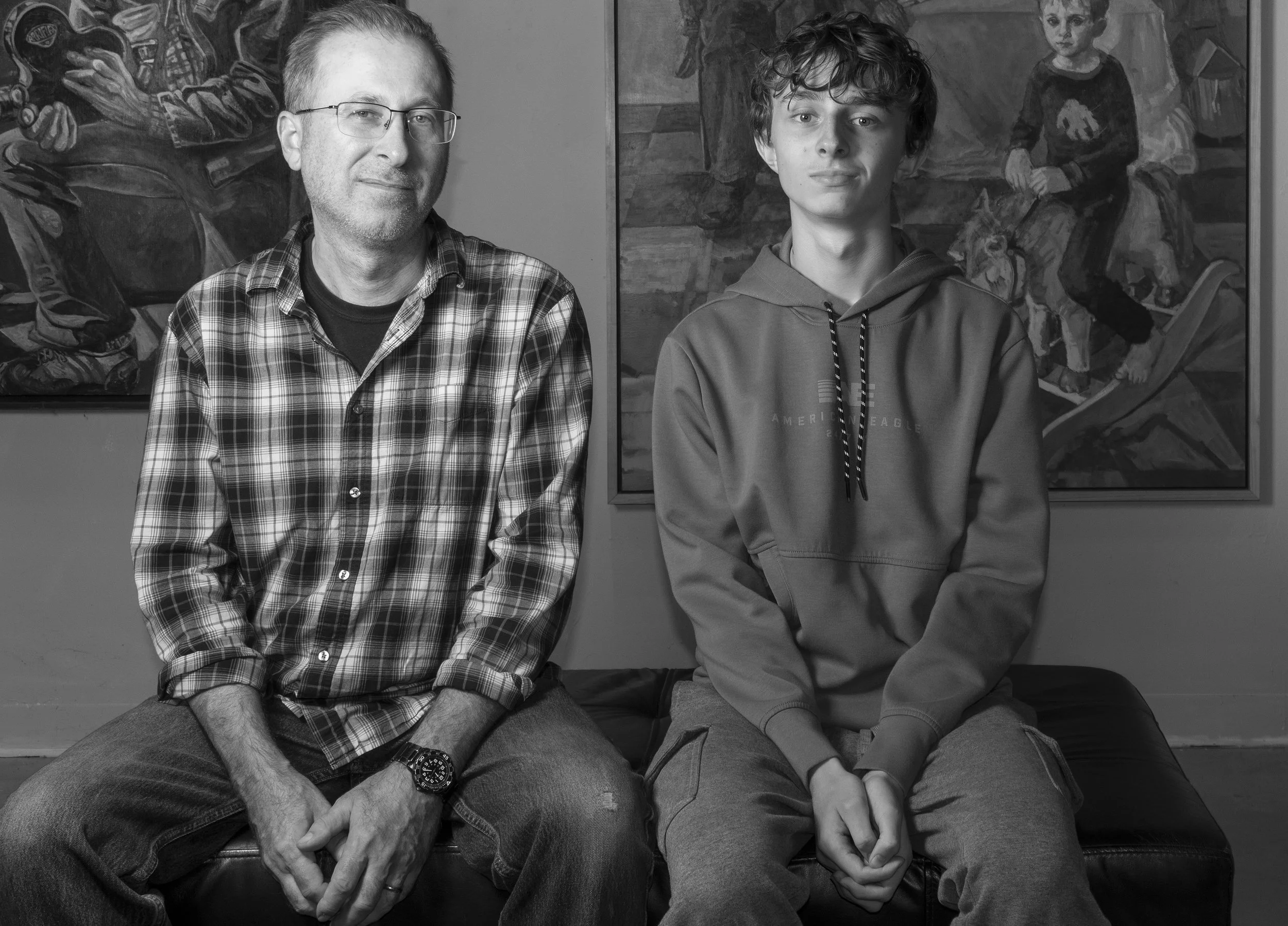
Brian Kreydatus: Tell Me a Story
Observation, memory, and the imaginative life of childhood
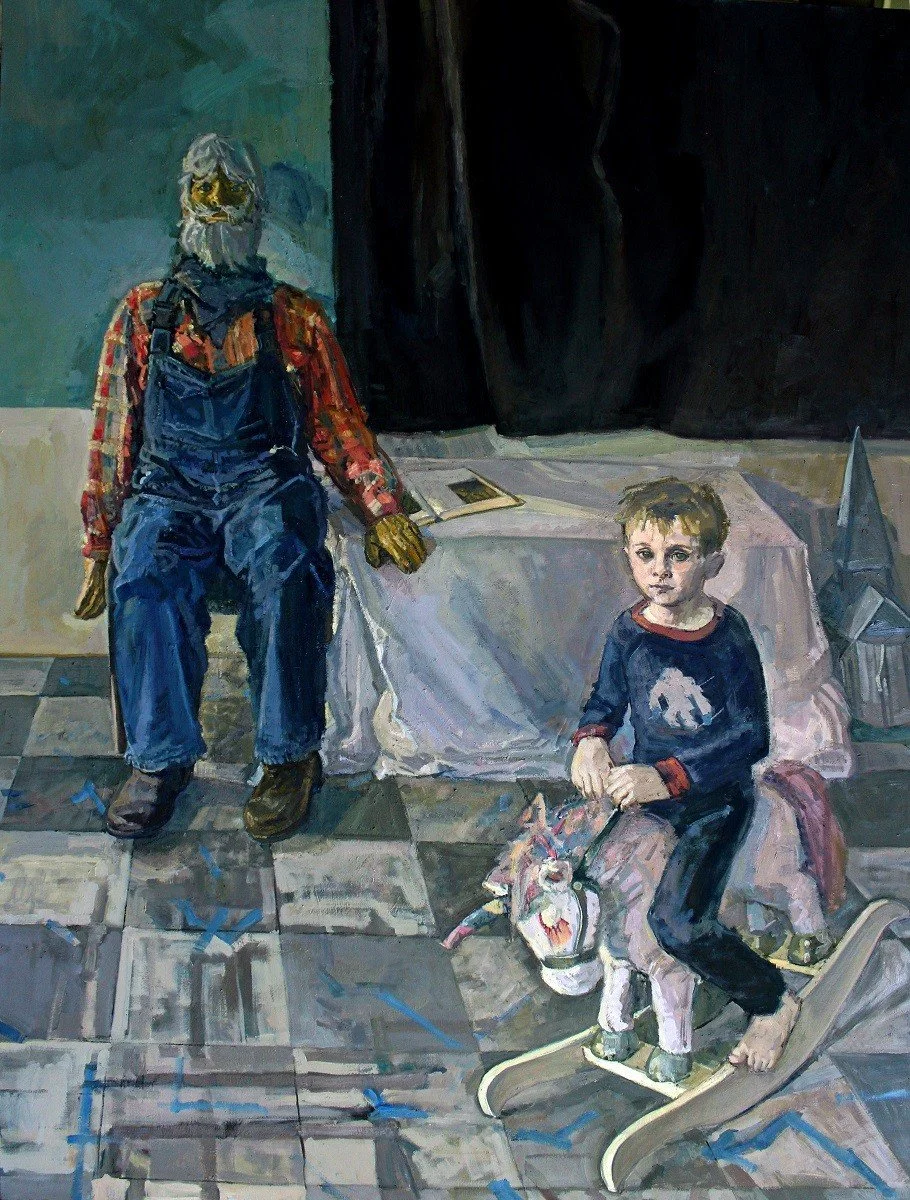
At first glance, Brian Kreydatus’s Tell Me a Story appears to be a family scene. A young boy sits astride a small rocking horse, one bare foot slipping free, while an older bearded figure in overalls occupies the opposite side of the room. Between them is an improvised domestic stage of fabric, toys, an architectural model, and strips of blue tape crossing the floor. Yet the longer the painting is considered, the less stable its apparent story becomes. The figures inhabit the same space without explaining their relationship. Familiar objects begin to function like clues. Childhood, memory, observation, and invention converge.
The ambiguity is not incidental. It emerged through the process of making the painting itself. Kreydatus explains that the composition changed substantially as he worked. An earlier version contained a female figure where the mannequin now sits, while the position occupied by his son James originally held a plastic sculpture. After working on the painting for some time, Kreydatus felt that it had not yet found its subject. He replaced the sculpture with James, then approximately five or six years old, drawing him, photographing him, and painting him directly from life. When James was not present, Kreydatus placed his clothing over a doll form in the studio so that he could continue observing the garments.
The resulting painting is deeply specific, yet it does not behave like a simple record of a particular afternoon. Instead, observed things gradually become participants in an imagined world.
The story that changes hands
The painting’s title comes from an exchange familiar to Kreydatus from raising his children. When they were young, they repeatedly asked him to tell them a story. But the stories rarely remained his for long. At some point, the children would interrupt and begin constructing the story themselves, creating increasingly elaborate and sometimes dark narratives. James could remember these invented worlds from one storytelling session to another, sometimes correcting his father if Kreydatus failed to remember precisely where the previous installment had ended.
That experience provides a way into Tell Me a Story. The painting does not illustrate one of those childhood tales. It presents the conditions under which a story might be invented.
The boy faces outward while the mannequin sits at the opposite side of the room like a character whose role has not yet been assigned. The rocking horse, dark curtain, architectural model, fabric, and tape remain recognizable objects, but their relationships are unresolved. They can belong to ordinary domestic life or become components of an imagined drama.
Kreydatus considers Tell Me a Story more overtly narrative than most of his paintings. Importantly, however, he does not begin by imposing a predetermined narrative. He has said that narrative must arrive naturally in the course of making the work, rather than feeling forced onto the painting. Pasted markdown
That distinction is essential. The painting provides enough information to suggest a world, but not enough to close it. The viewer encounters a situation rather than an explanation.
A child remembers the objects
James’s own recollection of the painting adds another layer. He remembers relatively little about posing for it. What he remembers are the things.
He recalls playing on the rocking horse. He remembers being somewhat frightened by the old man mannequin. The small architectural structure in the background was a school project made by his sister. The blue tape crossing the floor had another personal history: James used tape on walls to make temporary images and designs.
These memories are revealing because they shift our understanding of the composition. What might initially appear to be a group of symbolic props was also the visual environment of the artist’s family. Kreydatus did not need to invent an elaborate symbolic vocabulary. The strange associations were already present in ordinary life.
The mannequin is particularly important. It had belonged to Kreydatus’s mother, who dressed it for holidays such as Christmas and Halloween. When Kreydatus brought the figure into the painting, he began to sense a visual conversation between it and James.
This creates one of the painting’s most compelling tensions. The mannequin belongs to an earlier generation, James to a younger one. One is animate, the other inanimate. One belongs to childhood experience, the other to family memory. Yet Kreydatus gives both figures comparable physical presence.
The room consequently begins to operate less like a literal interior and more like a space in which different kinds of memory can coexist.
Observation and memory
Kreydatus describes himself primarily as an observational painter. Even when an image begins with an idea formed internally, he frequently constructs the situation physically so that he can work from what is actually in front of him. He values what he calls the specificity of looking, believing direct observation gives the image a kind of particularity that invention alone cannot provide. Tell Me a Story developed over approximately four or five months. d markdown
Yet Kreydatus does not regard observation and invention as opposites. Looking itself contains memory. The painter looks at the subject, turns back toward the canvas, and paints from what remains in the mind. Even direct observation therefore involves remembering, selecting, adjusting, and transforming.
This idea seems especially significant in Tell Me a Story. The painting was made from observed people and objects, but its final structure does not simply reproduce the physical world. A child, an inherited mannequin, a sibling’s school project, a rocking horse, discarded fabric, and temporary tape drawings are brought together until they acquire a new psychological relationship.
The specificity of observation allows the strangeness of the painting to remain convincing.
A painter’s formation
Kreydatus’s commitment to observation belongs to a much larger history of figurative painting. One of the formative figures in his development was Jerome Witkin, whom Kreydatus identifies as his principal undergraduate teacher. He began studying with Witkin when he was a nineteen year old sophomore.
The influence extended beyond learning how to paint and draw. Kreydatus remembers observing the seriousness with which Witkin approached being an artist, the intensity of the studio practice itself. That commitment became a model for Kreydatus’s own understanding of what a sustained life in art might require.
His broader constellation of influences places him firmly within a tradition of psychologically and materially engaged figurative art. Kreydatus cites Courbet, Rembrandt, Goya, Käthe Kollwitz, the German Expressionists, Max Beckmann, the School of London painters, and particularly Lucian Freud among the artists who have mattered to him.
Beckmann offers a particularly revealing connection to Tell Me a Story. Kreydatus is drawn to the mystery of Beckmann’s large compositions, especially the way they establish the strong presence of narrative while withholding a complete explanation. The viewer receives fragments and suggestions, but must enter the image and construct relationships independently.
Something comparable occurs in Tell Me a Story. Kreydatus gives the viewer a remarkably concrete collection of things, yet their ultimate meaning remains unsettled. The painting’s narrative exists not as a fixed sequence of events but as a field of possibilities.
The discipline of color
Around the period in which Tell Me a Story was painted, Kreydatus began restricting his palette significantly. He generally works with approximately four colors, introducing others only when necessary. The limitation forces him to mix rather than simply reach for another pigment and to think carefully about how colors change through their relationships with one another.
That restraint is visible throughout the painting. Blues migrate through James’s clothing, the mannequin’s overalls, the painted floor, and the surrounding architecture of the room. Muted reds and ochres recur across clothing, flesh, and scattered objects. The large black curtain creates an almost theatrical void behind the figures.
Rather than separating each element through local color, Kreydatus builds a visual environment in which the parts remain connected. The palette contributes to the psychological unity of a composition assembled from objects with very different personal histories.
Studio Community and Teaching at William & Mary
Kreydatus’s studio practice also develops within the close working environment of the Department of Art & Art History at William & Mary. In the Lake Matoaka Fine Arts building, faculty members maintain individual studios in close proximity to one another. Kreydatus describes John Lee as working directly next door to him, with Nicole Santiago nearby, and speaks with admiration about both painters. The arrangement allows for an informal but continuing exchange: he can look at their work as it develops, and they can respond to his.
Kreydatus sees similarities among their practices while emphasizing that each approaches painting differently. Rather than suggesting a single departmental style, the proximity of the three painters creates an environment in which differing approaches to observation, figuration, color, and image making can remain in conversation with one another. For Kreydatus, that kind of sustained studio exchange is part of the larger context in which his own paintings continue to develop.
Teaching has become equally central to his life as an artist. At William & Mary, Kreydatus works within a liberal arts program that brings him into contact both with students preparing for sustained work in art and with students taking studio courses as part of a broader education. He describes encountering students at the moment when they are beginning to determine what their work, and perhaps their lives, might become as particularly energizing for his own practice.
Kreydatus teaches life drawing and the department’s printmaking courses, extending the same emphasis on looking, making, and sustained practice into another medium. Painting, printmaking, teaching, and the exchange with artists working around him consequently remain interconnected parts of his life at William & Mary.
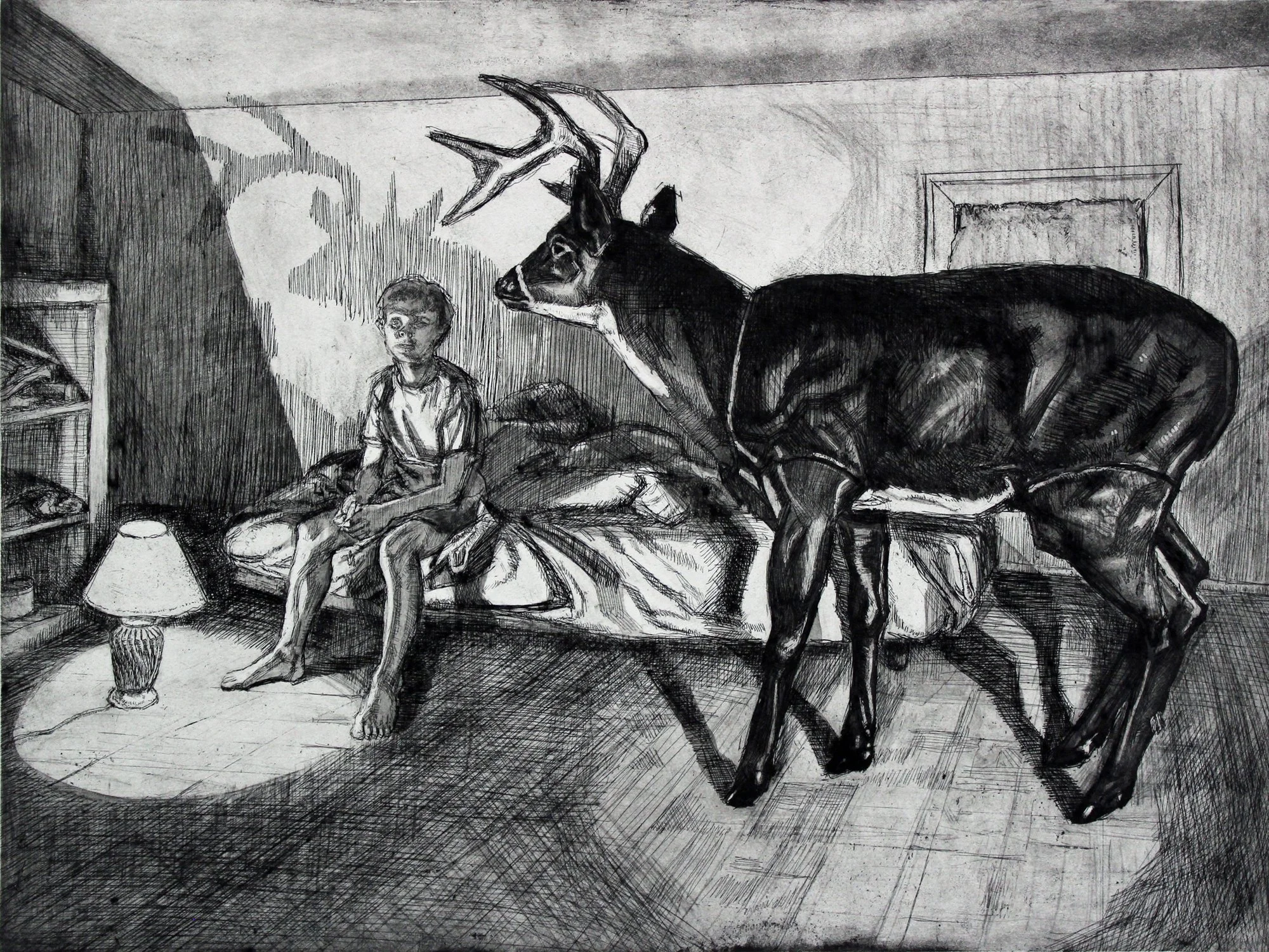
Brian Kreydatus, "James, 13th Birthday," 2025, Etching, aquatint, roulette, burin, spit-bite.
2026 Taiwan Internation Print Biennial, National Tiawan Museum of Fine Arts, Taichung City, Taiwan.
Childhood and Becoming
Kreydatus has painted both of his children repeatedly. He acknowledges that becoming a parent changed the subjects he wanted to explore, making the relationships and interactions surrounding childhood increasingly important to his work.
James appears again in a later large scale etching centered on his thirteenth birthday. In that work, James sits at one end of a bed while a life sized deer decoy occupies the other. Kreydatus connected the image to adolescence as a threshold, simultaneously the culmination of childhood and the beginning of entry into an adult world. The deer carried additional meaning from Kreydatus’s own upbringing in a relatively rural environment, where hunting could serve as an important rite of passage. The etching was later exhibited at the Chrysler Museum of Art in conjunction with a printmaking initiative. https://chrysler.org/exhibition/infinite-editions-printmaking-for-connection-and-exchange/
Considered beside that later image, Tell Me a Story captures an earlier stage of childhood, one in which imagination can still transform the ordinary world almost instantaneously. A rocking horse can become transportation. A mannequin can become a character. Tape on a floor can become drawing. The boundary between object and story remains open.
Kreydatus’s printmaking practice has also created opportunities for exchange beyond the studio. At William & Mary, he has worked with Steve Prince on printmaking initiatives associated with the Muscarelle Museum of Art, encouraging students to participate in visiting artist projects and other opportunities that connect artistic practice with the museum. He describes the Muscarelle as an important partner in both faculty exhibitions and educational activity.
For Kreydatus, exhibition itself is part of this larger process. He speaks of exhibiting as a form of public accountability, the moment when a work leaves the possibility of endless revision in the studio and enters into communication with others.
The space before the story is finished
Kreydatus has worked as a painter and printmaker for roughly thirty five years, yet he describes the practice in terms that remain deliberately unfinished. The recurring question is what the next painting will be and whether it can bring him closer to what he is seeking.
That attitude is already present within Tell Me a Story. Its importance may lie precisely in the fact that the painting does not resolve itself into a single interpretation. It preserves a child at a particular age, but it is not simply a portrait of James. It contains family objects, but it is not simply autobiography. It presents a recognizable room, but its emotional logic belongs equally to imagination and memory.
The painting instead occupies the moment when observation begins to become story. A child waits on a rocking horse while an old mannequin sits across the room. Around them are the remnants of play, family history, studio practice, and ordinary domestic life. Kreydatus has made each element specific enough to be believed, then left their relationship open enough to be imagined.
In Tell Me a Story, storytelling is therefore not something the painter completes for us. It is something that passes from parent to child, from memory to image, and finally from the painting to the viewer.