
Jayson Lowery: Weight, Fracture, and Release
Matney Gallery | September 2026
Jayson Lowery’s sculptures often begin with materials that carry their own histories. Steel, limestone, rubber, wood, copper, feathers, and cast compounds enter the work not as neutral substances but as materials marked by use, labor, deterioration, and memory. Across three works now at Matney Gallery, Onekin with Cast Pod from 2012 and the more recent Molt Break and Jay, Let Go the Things That Are Not, both from 2024, those materials trace a movement between growth, fracture, reflection, and release.
The sculptures are modest in scale, but their physical presence suggests something larger. Lowery has long been drawn to industrial and architectural forms, including utility structures, radiators, channels, stacked plates, and the unfamiliar logic of things built for a purpose that may not immediately be apparent. He describes being interested not only in what such structures do, but in how they are put together. That attention to construction remains visible throughout these works. They seem engineered, but their functions remain uncertain.
In Onekin with Cast Pod, made in 2012, the form turns toward the organic. The elongated sculpture brings together water putty, gesso, stained wood, galvanized steel, gasket rubber, and artificial sinew. The materials pull in different directions. The white cast section appears irregular and almost bodily, while the stitched rubber section is darker and more industrial. Neither fully explains the other.
Lowery developed this body of work after moving from an industrial studio, where he had access to equipment capable of handling large and heavy objects, into a backyard shed. The change in scale and working conditions required a different approach. He began experimenting with foam, milk protein resin, acrylic paint, and other materials that could be manipulated without welding or heavy equipment. That shift also opened greater attention to surface and color.
The pod forms were connected for Lowery to fatherhood and to a change in the way he was thinking about time. Rather than concentrating on things breaking down, he began thinking about “growing and dispersing and going out,” an association he connected to children eventually moving into lives of their own.
The act of stitching also carries a family history. Lowery’s mother sewed professionally, making pillows, furniture covers, and window treatments before developing her own interior design business. In Onekin with Cast Pod, industrial gasket rubber is sewn over a metal framework. Lowery later connected the material and process to memories of his mother’s sewing and to an antique leather-topped desk she kept in her business. The sculpture therefore brings domestic making and industrial fabrication into the same object without resolving the distinction between them.
Twelve years later, Jay, Let Go the Things That Are Not and Molt Break turn toward a different stage of Lowery’s life.
Both works were made during a period of separation and divorce. Lowery describes that time as one in which regret, reflection, and questions about past choices repeatedly surfaced. He began thinking about the ancient Egyptian weighing of the soul, in which the heart of the deceased was measured against the feather of truth. For Lowery, the connection was never intended as a direct symbolic code. Instead, the ancient image became a point of departure for thinking about judgment, memory, and the process of taking stock of one’s life.
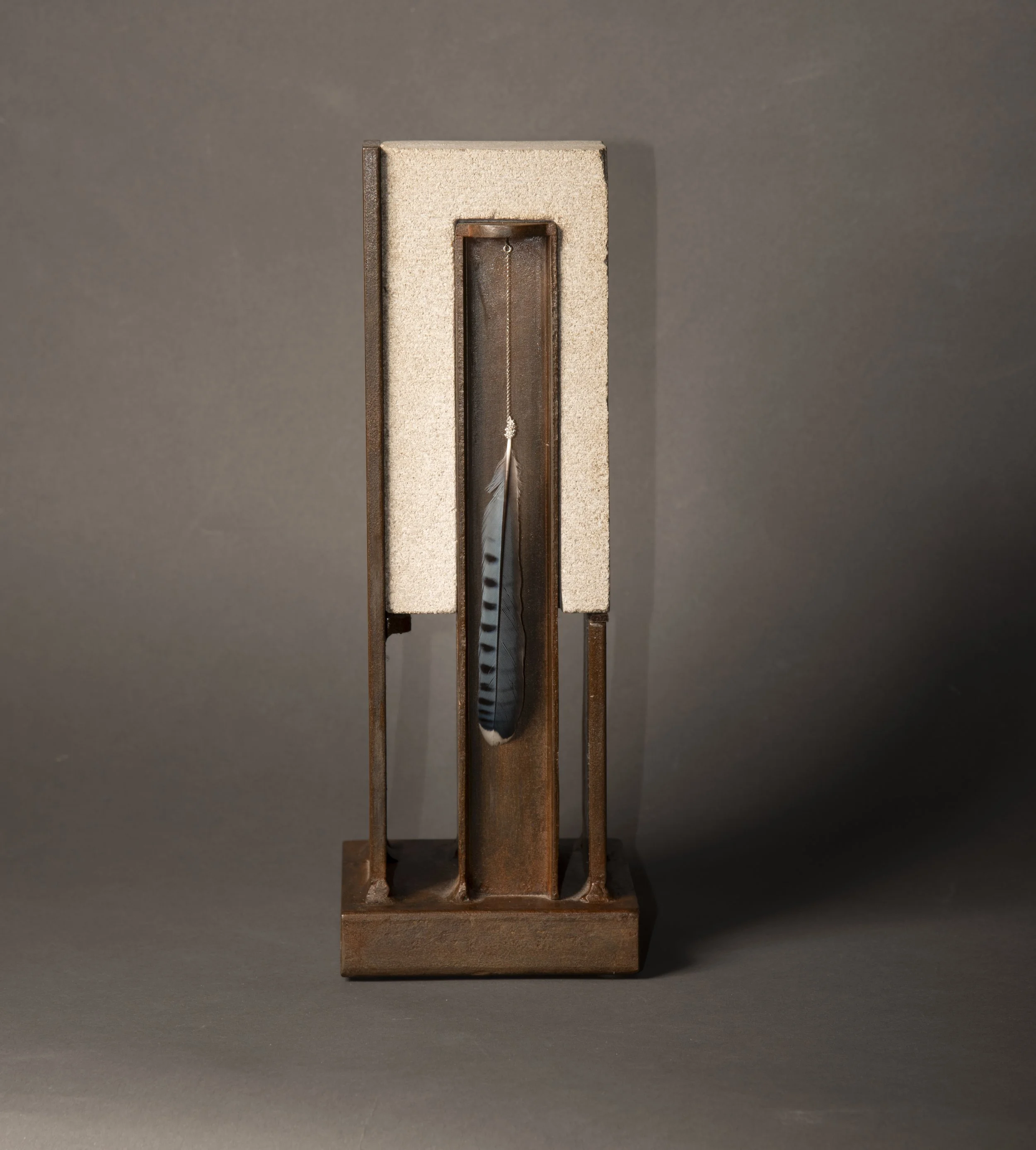
In Jay, Let Go the Things That Are Not, a blue jay feather hangs from a fine chain within a narrow steel channel beneath a substantial block of limestone. The work is upright and tightly constructed. The limestone reads as weight, while the suspended feather seems almost impossibly light within the dark enclosure.
Lowery chose the jay feather partly because of its personal association with the nickname “J,” a name he had never particularly liked. Yet the work resists becoming autobiographical illustration. Its meaning emerges through structure. The feather is not merely attached to the sculpture. It is suspended within it, held in a space defined by steel and stone.
The resulting tension between weight and suspension gives the Egyptian reference a physical rather than explanatory role. The sculpture seems to establish its own system of measure. Heavy materials surround something fragile, while the feather remains free enough to retain its delicacy.
Lowery has described looking backward during this period and thinking about things he wished he had done differently or pursued more fully. The title, Jay, Let Go the Things That Are Not, introduces the possibility that reflection is not only an act of accounting. It may also be a form of release.
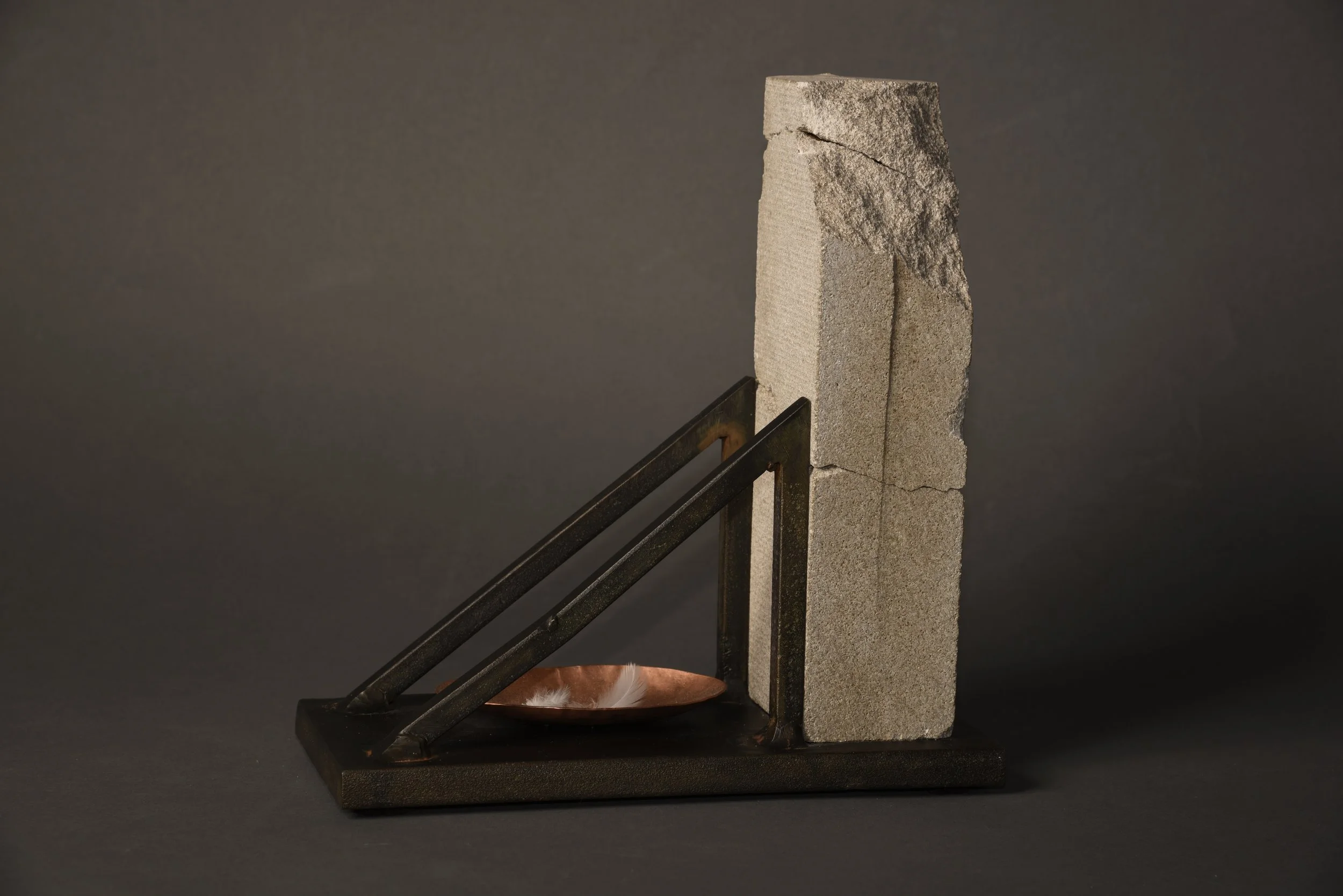
Molt Break, 2024
Steel, limestone, copper, and hen feather.
9 × 4 × 8 1/2 in | 22.9 × 10.2 × 21.6 cm. VIEW ON ARTSY
Molt Break shares the architectural language of Jay, but its physical character is markedly different. Limestone appears fractured into sections around a vertical steel structure. A small copper element sits lower within the composition, and the feather is more fragile, associated with molting rather than the intact blue jay feather of its companion work.
Lowery connected this feather to chickens his family raised during the pandemic and described the work as more broken than Jay. He also incorporated copper forged from a pipe removed from the house in which he and his former wife had lived together for a decade. Here the history of the material becomes inseparable from the history of the work.
The fractures in Molt Break are important because Lowery has long been interested in the apparent permanence of materials that are, in fact, temporary. Limestone breaks. Steel rusts. Surfaces corrode. He has previously allowed deterioration to become part of the content of his sculpture, while these more recent works represent an increased attention to finishing and preservation, including experiments with gun bluing and other metal treatments.
The tension is therefore not simply between permanence and decay. It is between the desire to preserve and the knowledge that change remains unavoidable.
Seen together, Jay and Molt Break behave almost like two states of the same architectural language. Jay is ordered, vertical, and suspended. Molt Break is fractured and visibly under strain. One holds its fragile element within an intact structure. The other incorporates breakage into the structure itself.
Lowery once described these recent sculptures as “small monuments to regrets.” The phrase is revealing, but the works reach beyond regret. They are also about what materials carry forward and what they cannot preserve.
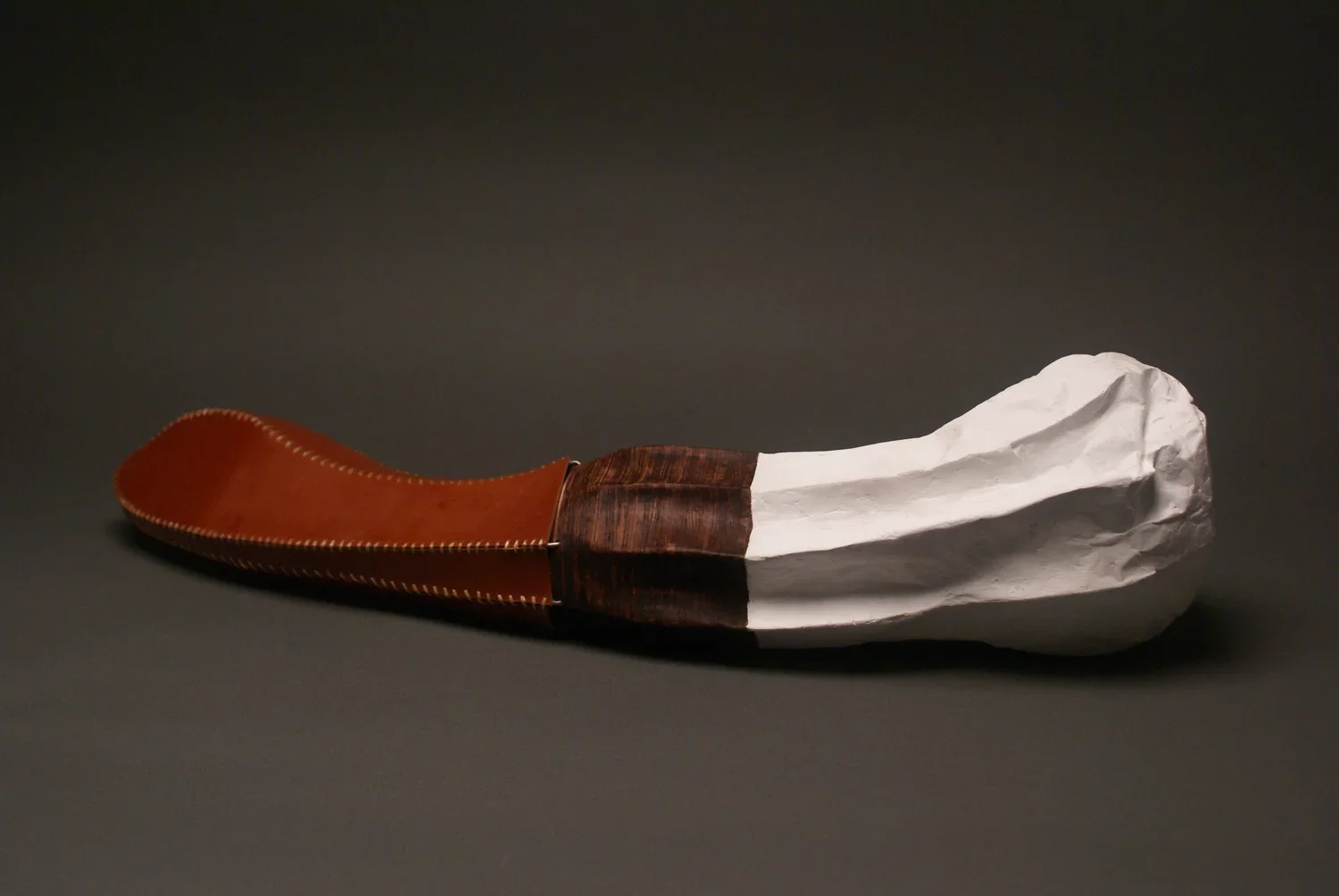
Onekin with Cast Pod, 2012
6" x 5.5" x 19"
Mixed media: Water putty, gesso, plywood, galvanized steel, gasket rubber, and artificial sinew.
That idea connects them unexpectedly to Onekin with Cast Pod. The earlier sculpture emerged from thoughts of growth and dispersal. The newer works emerge from reflection and separation. Across the three, Lowery’s materials record different stages of movement through time. Objects are built, held together, altered, broken, and carried forward.
The sculptures remain quiet in scale, but not in consequence. Their strength lies in the way personal history enters the work without overwhelming it. Memory is carried through limestone, steel, rubber, copper, and feather, while the forms retain enough distance to remain open.
Lowery’s sculptures do not offer conclusions about what should be preserved or released. Instead, they give physical form to the process of measuring what rema