
The Stories Spaces Hold
Mia Katrina Guile in Conversation with Lee Matney
Mia Katrina Guile’s recent paintings mark a significant development in her practice. Moving from abstraction toward architectural and domestic spaces, she has begun exploring how a person may be understood through the environments they inhabit, shape, and leave behind.
Her paintings are immediately distinguished by their bold color, matte surfaces, and carefully constructed viewpoints. Yet their deeper narratives emerge gradually. Rooms, porches, pathways, chairs, windows, plants, and ordinary household objects become carriers of memory and indications of lives that remain just outside the frame.
In the following conversation with Matney Gallery director Lee Matney, Guile discusses the encounter that inspired Do It Right, the relationship between architecture and portraiture, and the stories embedded within works including Electric Terrace, Before the Step, and Arrival Scene.
This conversation has been edited for clarity, continuity, and length.
Lee Matney: What first prompted the image or setting for Do It Right?
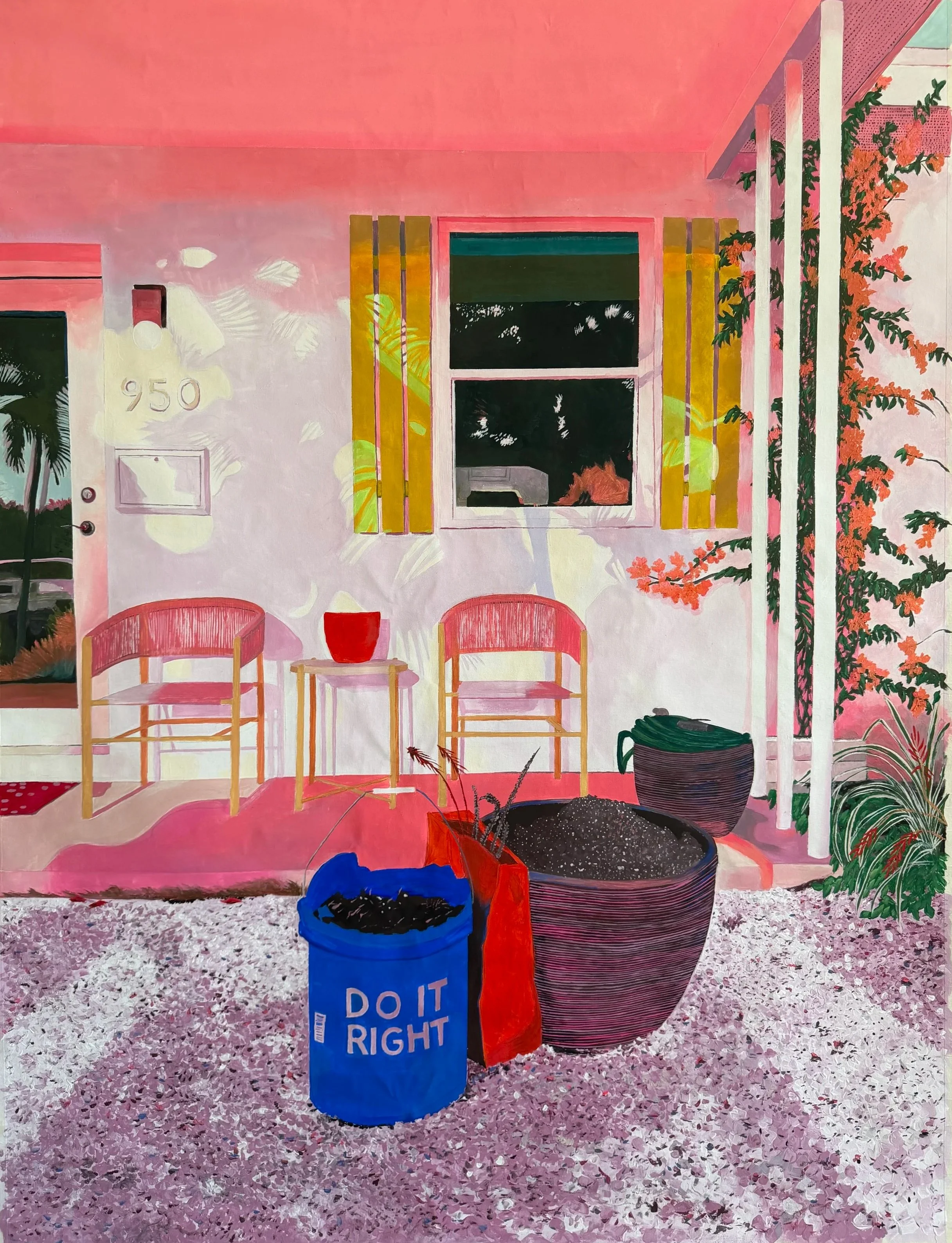
Mia Katrina Guile: I was driving through a neighborhood in Naples, Florida, looking for something that struck me—something I might want to photograph. I came upon this house and was immediately drawn to the porch. There was something delightful about it.
I parked and started taking pictures, but then I thought, “Maybe I should talk to the owner.” I knocked on the door and explained that I was an artist in the area taking photographs of interiors, exteriors, and landscapes. I asked whether I could see more of the space, and she invited me inside.
What began as taking a few photographs became at least a two-hour conversation. We formed a wonderful connection. I was really in awe of her—who she was as a woman and the things she had been involved in.
Matney: So the painting came not only from seeing the house, but from meeting the person who had shaped it.
Guile: Exactly. It happened to be her front porch, but once I met her, the space became much more significant.
I liked that it wasn’t a perfect porch. It was a porch under care, undergoing maintenance. I loved the lighting and the way the sunlight was dappled across the house.
I’m also obsessed with painting chairs, so I loved the chairs sitting there. And I was drawn to the empty pot. Empty pots are waiting to have something planted in them. There is an opportunity for growth in them.
Those things began to suggest something about her life without requiring me to paint her figure.
Matney: The title, Do It Right, appears within the scene. What does that phrase mean to you, and how does it change the way we read the painting?
Guile: As humans, I think we’re always trying to do things the right way, but there is no perfect way to do anything.
The words appear on this worn, imperfect bucket with soil in it. It is ready to produce something and ready for something to happen, even though the container itself isn’t perfect.
I think we become befuddled by the idea that we have to do things perfectly. But the painting isn’t really about perfection. It is about showing up and tending to the life you are trying to create.
Matney: Is the painting about trying to do something correctly, or does it also question who defines what “right” means?
Guile: I think we all struggle with that. “Do it right” is a philosophy and an idea. Doing something right requires attention, patience, and intention. We have to understand what motivates us.
It is something we strive for, but it may not mean the same thing for everyone. It becomes a question: What does doing it right mean in this particular life?
Matney: No figure appears in the painting, yet it feels inhabited. Who—or what—is present?
Guile: I almost want to say that the sunlight is its own character because of the way it dapples across the house. It brings a sense of warmth and presence. You can feel the sunlight there as its own presence.
The chairs are also waiting. Chairs suggest sitting, reflecting, and pausing. They imply that someone has been there or may return.
Everything communicates through the space. The chairs communicate with the bucket. The window communicates with the objects outside it. The light communicates with the architecture.
I think the main character may actually be the sun because it casts these wonderful shadows and beams of light. When you stand in front of the painting, I want you to be able to feel that warmth.
Matney: I keep returning to the sewing machine visible through the window. It could almost be overlooked.
Guile: The sewing machine is very important in this painting.
Most people can identify sewing machines with fixing things, mending things, repairing things, or creating things. In our lives, we have to do all of those things, and we have to have the patience to do them.
A sewing machine represents the patience and diligence required to create something or to mend something. It quietly reinforces the meaning of Do It Right, but it doesn’t announce itself immediately.
A viewer may first respond to the color and only later notice that it is there.
Matney: That delayed recognition seems important. There are details in your paintings that gradually reveal themselves.
Guile: I think of them almost as hidden gems. Some people will create meaning from them, and some people may simply enjoy them visually. Both responses are valid.
I think people are often drawn to the colors first. Then they begin noticing the other things that are present in the painting.
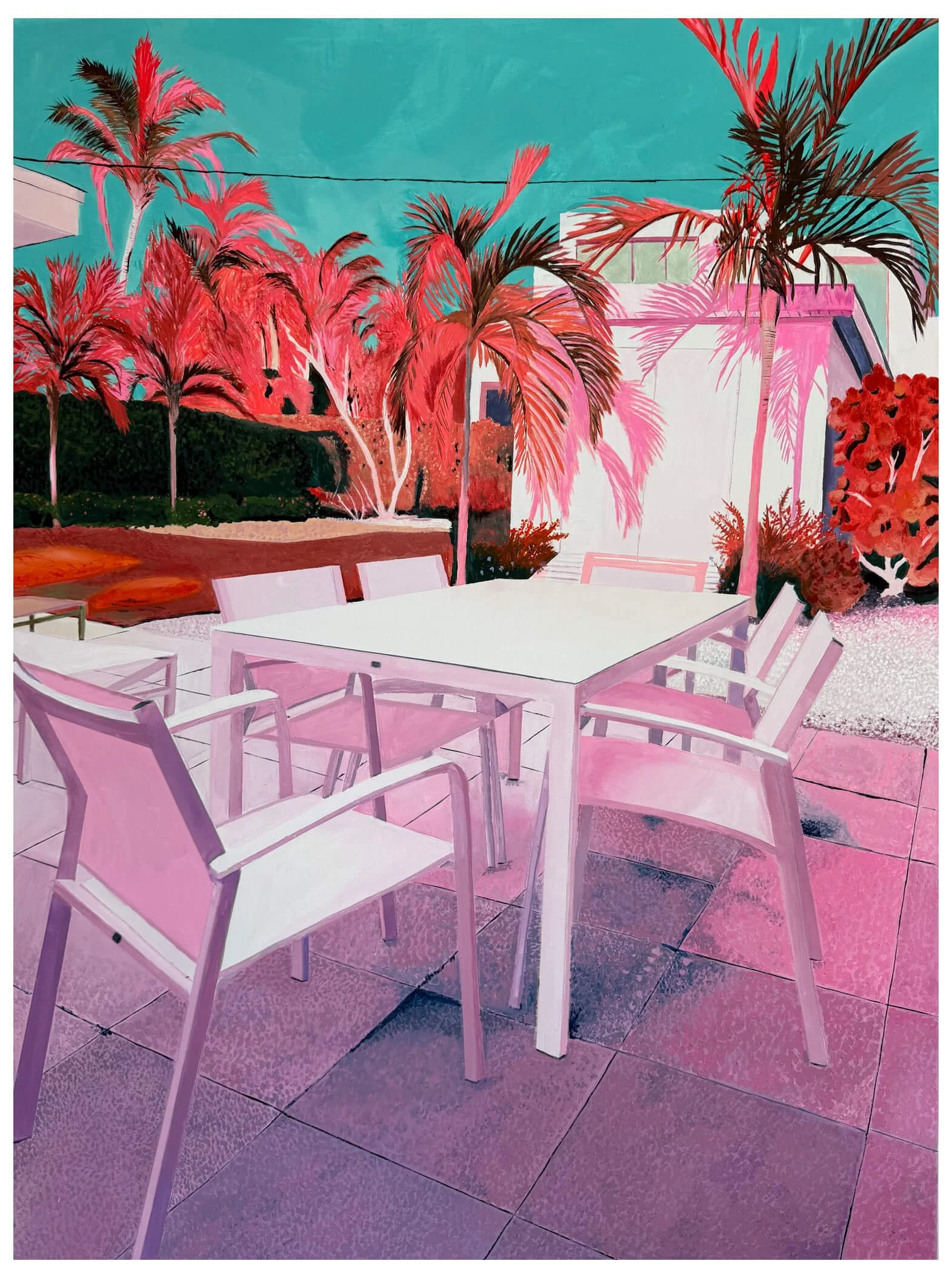
Matney: Electric Terrace depicts the back of the same property seen in Do It Right, correct?
Guile: Yes. Electric Terrace is the backyard of Do It Right.
I had such a connection with the woman who lived there that I felt I needed to paint more than one painting about her life—not through figures, but through her existence. I wanted to paint the things she had touched, the things she had taken care of, and the things she had tended.
The table in Electric Terrace is empty now, but the space still carries the history of a woman who had taken care of everybody. That felt significant to me, but also very beautiful.
Matney: The electrical wire is an important detail in that painting.
Guile: Yes. I don’t think people would necessarily think twice about why I painted that wire into the scene.
Electricity flows through all of our houses. It is one of the ways we are all connected. Electricity is also energy, and energy shapes us. Every person comes into a space with their own energy.
The title Electric Terrace is a kind of double meaning. The colors are very electric and alive, almost like a live wire, but the electrical wire is also physically present in the painting.
The detail can operate literally and metaphorically at the same time.
Matney: You have described these works as portraits, even though the subjects are not physically represented.
Guile: What I’m looking for in my paintings is to create an emotional atmosphere—almost like a portrait of somebody without the figure.
I’m very drawn to people’s stories. I like being in communication with the person so I can begin to understand who that person is. Then I make a painting that I feel reflects something about them.
A person is a body, but simply looking at someone’s body doesn’t necessarily tell you very much about who they are. You may be able to understand more from someone’s environment, their home, and the space they keep.
These paintings may reveal people more than figures would. They are almost portraits of absence with presence.
Matney: Your experience as a social worker seems connected to the way you understand those environments.
Guile: In one of my prior lives, I worked as a social worker, so I understand the impact that an environment can have on a person—and the impact that a person can have on an environment.
I’m interested in understanding people through what they show and through how they live. Physically, many of us may wear similar things—jeans, a T-shirt, shoes. But the physical manifestation of where someone lives can be much more interesting.
Everybody has a story. I love stories, and I think I’m a good storyteller through my paintings.
Matney: You are not simply documenting the rooms. You are interpreting what the environments may reveal.
Guile: Yes. I’m responding to the evidence of a person’s life and to the feeling I have when I enter their space.
There was a joyfulness about this woman’s home. I was drawn to that. I wanted the paintings to carry some of that warmth while also leaving room for the viewer’s own interpretation.
I haven’t painted a self-portrait of my own home yet, which I find interesting. I seem to enjoy getting to know other people and discovering what makes them who they are.
Matney: Your earlier work was more abstract. When did architecture begin to take on this central role?
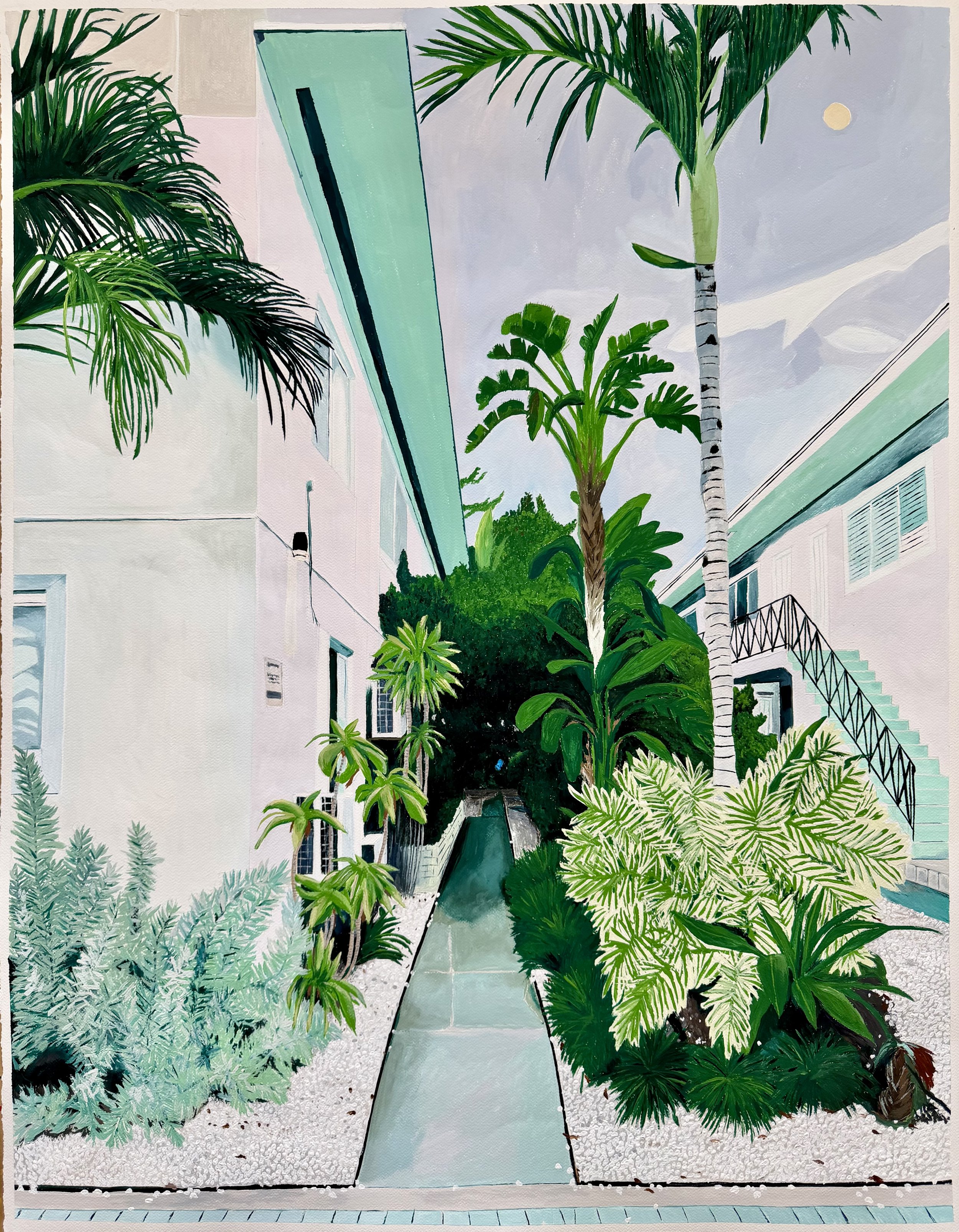
Guile: In January. Before the Step was my first painting in this newer series and my first real attempt to use architecture to create an emotional atmosphere.
Before that, I moved between abstraction, abstract expressionism, and work focused primarily on color. Then, in January, I felt finished with that direction.
I began looking around, walking, taking photographs, and talking to people.
With Before the Step, my curiosity led me to the image. There was a path leading somewhere that looked intriguing. Some paths in life are intriguing and some are not.
I began imagining the people passing through that path each day. Who passes through it? How do they feel as they move through it?
Matney: Nature and human intervention seem to coexist within that painting.
Guile: Yes. You can tell that people live there because of the shrubbery and the greens. Nature makes the plants, but people decide where to place them.
Nature and humans coexist. The plants are organic, but once people place and tend them, the space becomes more controlled.
I like depicting some of that relationship in my paintings.
Matney: How does architecture create atmosphere rather than merely describe a location?
Guile: There is a process of peering in and peering out—going into the painting and then coming back out.
What catches your eye as you go into the painting? What brings you back out?
The architecture can create an effect of pulling you in and then pushing you back. You zoom in and zoom out. That creates distance and space for pondering.
The colors also contribute to the emotional atmosphere. Architecture gives the painting its structure, but color and light shape how that structure feels.
Matney: Color draws us into Do It Right immediately. How did you establish its emotional atmosphere?
Guile: I mix all of my colors, and I’m obsessed with how colors sit beside one another.
I love the way the greens play against the purples, the pinks against the greens, and the reds against the dark and light areas.
Had the painting been entirely pink, it might simply have become a pretty painting. The blue bucket interrupts that. It makes you curious. You begin to wonder why it is there and what it might mean.
The darker window also makes you want to peer inside. There is something slightly voyeuristic about it. You wonder, “What is going on in there?”
Matney: You work with matte Flashe paint rather than conventional acrylic or oil.
Guile: I use Flashe throughout the paintings, and I mix every color myself. I don’t combine it with acrylic. I focus entirely on the Flashe.
It is a matte paint, so it absorbs light rather than reflecting it. There is no sheen breaking up the surface.
The paintings remain visually flat, but the colors can still feel incredibly bold. I was especially proud that I was able to make the flat paint appear to glow in Do It Right.
There is no reflection creating that sensation. The light has to come through the relationships between the colors themselves.
Matney: How does Do It Right connect with works such as Before the Step, Arrival Scene, Off Side, and Electric Terrace?
Guile: They are all concerned with creating atmosphere through architecture, but I feel that the newer paintings are going deeper into the relationship between people and their environments.
I’m looking more closely at people and at the idea of a self-portrait through absence and presence.
The spaces people create can sometimes tell us more about them than a direct image of the person would.
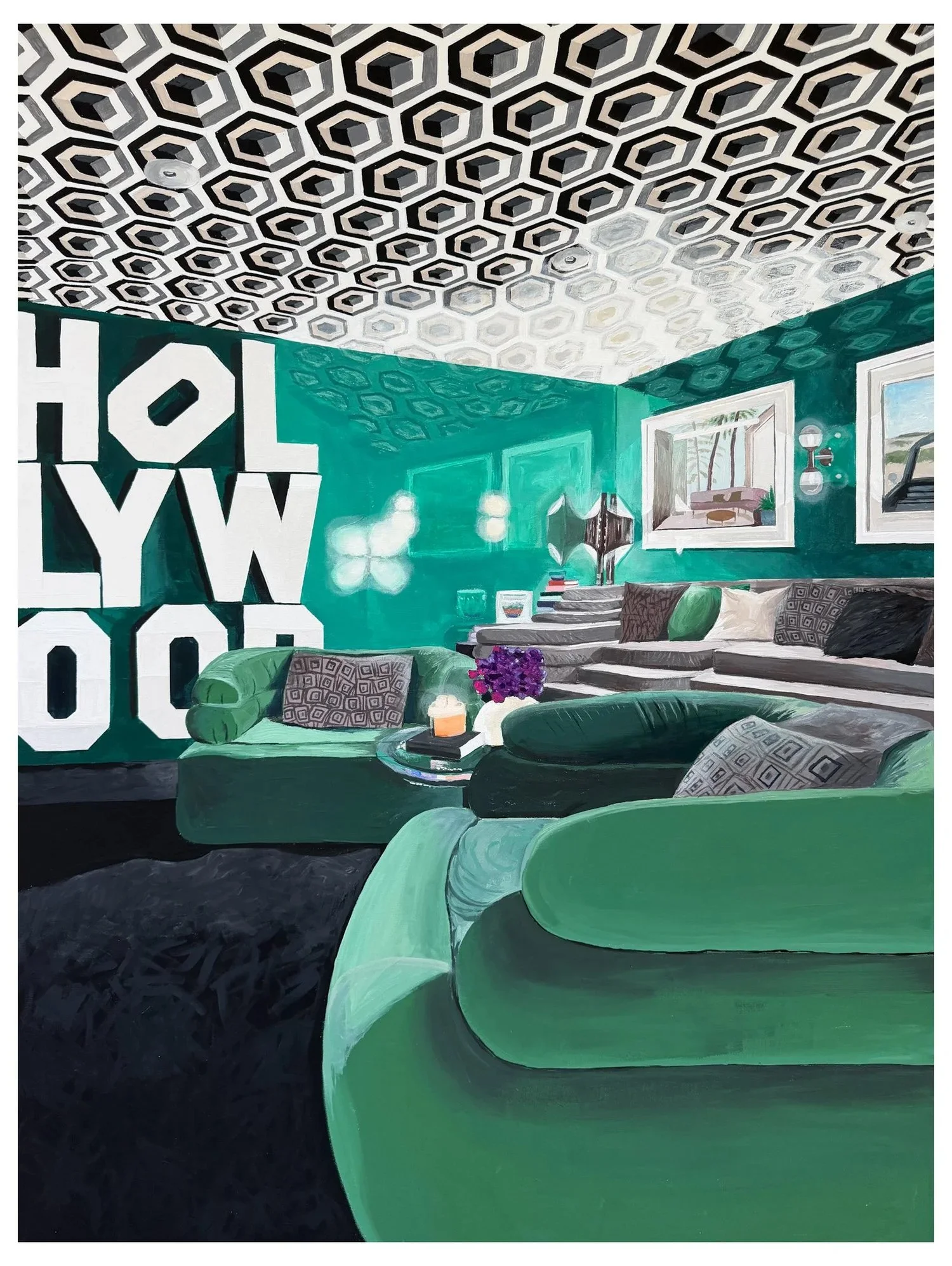
Matney: Tell me more about Arrival Scene.
Guile: Arrival Scene depicts a movie room in a Palm Springs house that was once owned by Hugh Hefner and, at another time, by Roger Moore.
Palm Springs was a place where actors could go for respite while they were filming. I kept imagining all the people who had passed through the doorway and entered that room.
Each person who enters a space becomes their own character. It is as though they have arrived somewhere where they can sit back and watch.
The room itself is devoted to movies, and movies are stories. So there is the story being shown in the room, the story of the room itself, and the story of the person who enters it.
There are all these layers of storytelling happening at once.
Matney: The title suggests the moment of crossing the threshold.
Guile: Yes. I think about who came through that door, the history of the people who sat in the room, and the conversations that may have taken place there.
The people are not visible anymore, but the room still seems to retain something of them.
That is part of what interests me throughout this series. A doorway can suggest an arrival. A chair can suggest a conversation. An empty room can remain full of human experience.
Matney: Arrival Scene was also especially challenging technically.
Guile: Yes. It was probably one of the most technically challenging paintings I have made, although every painting presents its own challenge.
The ceiling was particularly difficult. At times I almost felt dizzy while painting it.
I love expanding my skill set with every new challenge that comes my way. With Arrival Scene, the difficulty was creating the architecture and perspective while preserving the atmosphere and story of the room.
Matney: Chairs appear repeatedly throughout this body of work.
Guile: I love chairs. I’m obsessed with seating, although I’m not entirely sure what the psychology behind that is.
They may be connected to sitting, resting, or reflecting. A chair is an invitation, but an empty chair also indicates absence.
It suggests that someone has just left or that someone may be about to arrive.
In Arrival Scene, I imagine the people who sat in those chairs, the movies they watched, and the conversations they had.
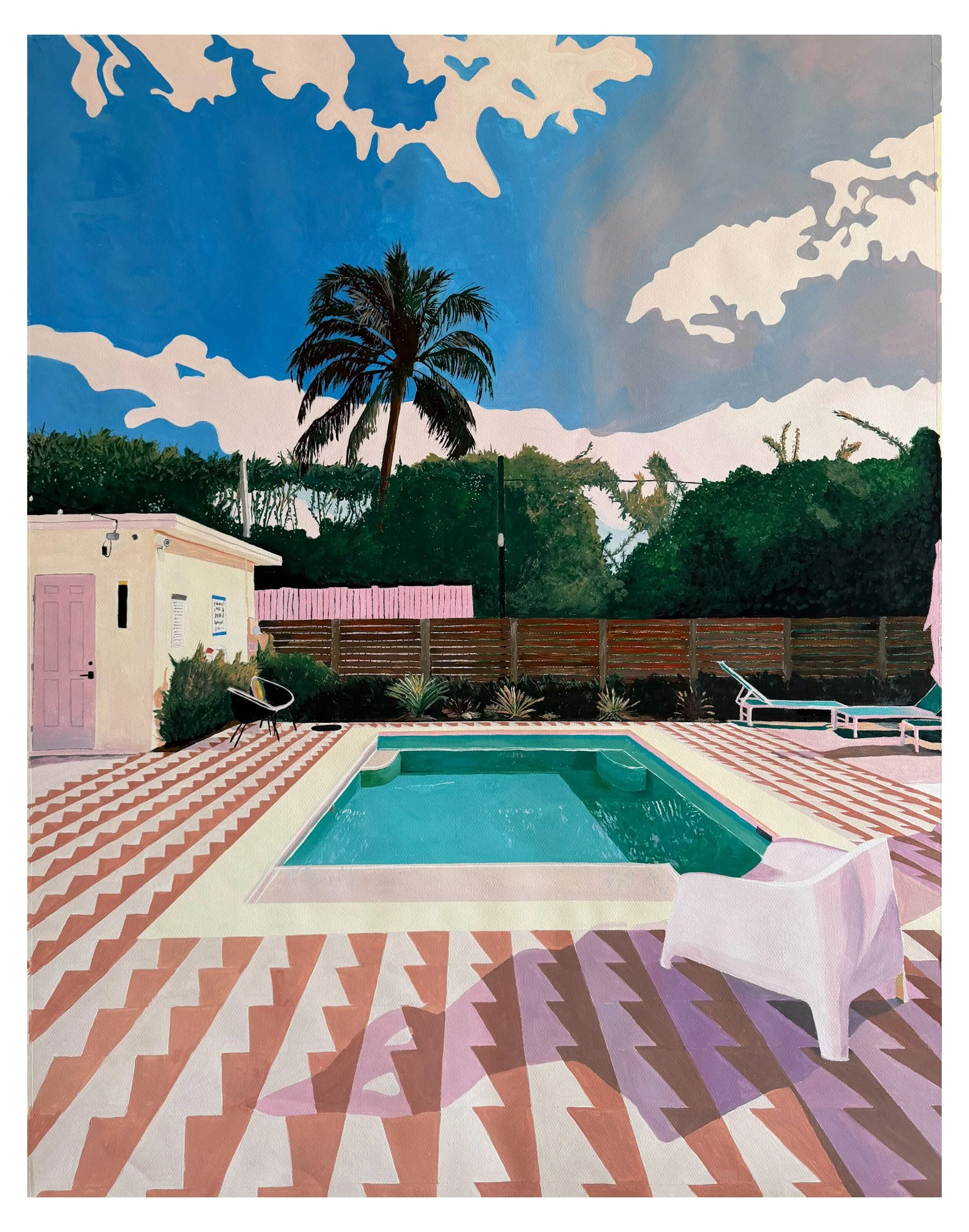
Flashe on pape
50 × 42 in | 127 × 106.7 cm with frame included
Matney: Water and pools are another recurring subject in your work. What draws you to them?
Guile: Water holds memories for me.
I was a swimmer. My children swam, and I grew up on different continents where water, pools, and beaches were always part of my life.
I learned to swim when I was very young. I was afraid of jumping into the deep end, and my mother threw me in and told me to swim. You might think that would have made me afraid of water, but it didn’t.
I later swam on a swim team and continued swimming in my adult life.
Pools can be contemplative, relaxing, and exhilarating at the same time. I’m also drawn to reflections in water and to the visual challenge of painting them.
Matney: Does this body of work mark a shift in your practice?
Guile: I think the entire architectural series marks a shift. It began with Before the Step, but I feel that the work is developing rapidly.
I paint every day, and with every painting I want to become better. I’m obsessed with it, so that helps.
The paintings are becoming more closely connected to people’s stories and to my conversations with them. I’m trying to understand how a person can be represented through the life surrounding them.
Matney: What are you working on next?
Guile: I’m completing a commissioned painting connected with Happy Valley Farm. It depicts a greenhouse in the early evening, with the moon visible.
I keep thinking about how things grow even when we are not watching them. Things grow even in the dark.
The greenhouse becomes a protective structure surrounding fragile life while still allowing the light to enter.
It is about patience, growth, and protection. The architecture is protecting the fragile life inside.
Matney: What do you hope a viewer notices only after spending time with these paintings?
Guile: I hope viewers move beyond their first response to the color and begin discovering the quieter relationships—the sewing machine in the window, the empty pot, the electrical wire, the placement of a chair, or the way light enters a space.
But I also want people to notice how they themselves react. I don’t want to prescribe a single response.
Come see the paintings in person, when they are stretched and hanging in the gallery, and see how you respond to them.
The paintings are in full bloom when they are given the space where they should be seen.