
Weaving a Legacy: Dennis Harper, Art Rosenbaum, and the Work of Cultural Memory
Artists leave behind more than objects. They leave ways of looking, habits of attention, relationships with other artists, and structures through which knowledge moves from one generation to another. The relationship between Dennis Harper and Art Rosenbaum offers an unusually rich example of that process because it unfolded across several different roles and over several decades.
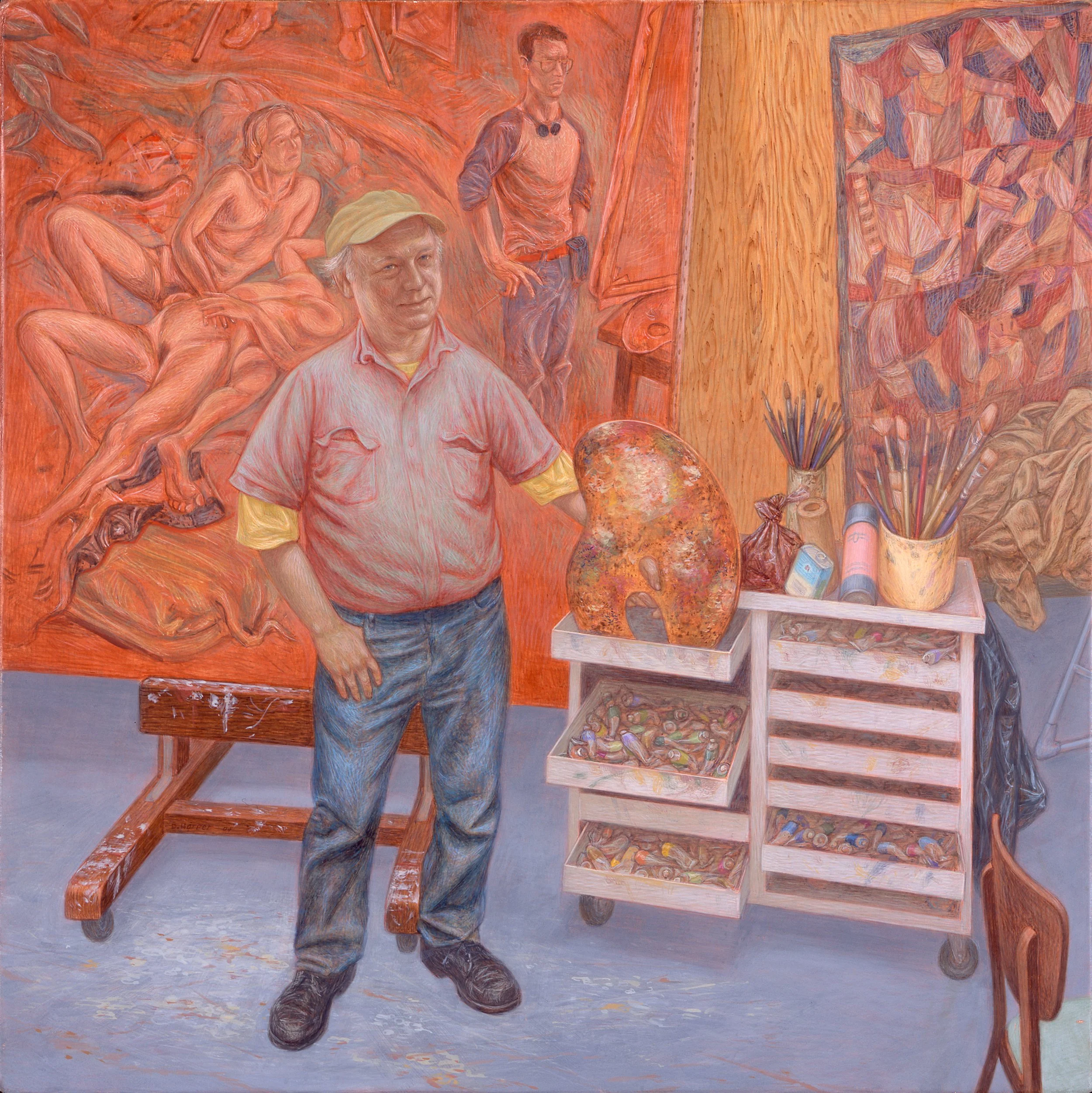
Harper first knew Rosenbaum as a graduate student at the University of Georgia, where Rosenbaum served as his major professor. Years later, Harper became curator of exhibitions at the Georgia Museum of Art and organized Rosenbaum’s first major retrospective. At roughly the same moment, Harper was also looking at Rosenbaum through his own practice as a painter, producing the intimate egg tempera Art Rosenbaum in his Studio in 2005. Still later, Harper returned to Rosenbaum as a writer, reflecting upon his former professor’s life after Rosenbaum’s death in 2022.
The story is therefore more complicated than a conventional account of artistic influence. Harper did not simply absorb Rosenbaum’s style, and their mature paintings can look markedly different. What connects them more deeply is a sustained attention to subjects, histories and environments, and an understanding that the life surrounding an artist can itself become material for art.
Graduate Study and a Larger Field of Attention
Art Rosenbaum taught drawing and painting at the University of Georgia from 1976 until 2006 and became the university’s first Wheatley Professor in Fine Arts. His career, however, was never confined to the studio or classroom. Alongside painting, drawing and mural work, he performed and collected traditional American music, made field recordings, wrote about folk traditions and documented musicians throughout the South and beyond. In 2008, his field-recording collection Art of Field Recording Vol. I: Fifty Years of American Traditional Music Documented by Art Rosenbaum received a Grammy Award.
These pursuits continually overlapped. Rosenbaum painted musicians he knew, recorded performers whose traditions interested him and embedded friends, artists, storytellers and observers within densely populated compositions. In his paintings, distinctions between personal experience, historical memory, folklore and contemporary life frequently collapse.
Harper later described the relationship with unusual precision. Writing in the Athens Historian in 2023, he placed himself among Rosenbaum’s grateful former students and recalled having Rosenbaum serve as his “major professor in graduate school” at the University of Georgia. In the same account, Harper moved from that graduate relationship to the retrospective he later organized, linking his experience of Rosenbaum as a professor with his later responsibility for interpreting Rosenbaum as a curator.
Years earlier, Harper had described Rosenbaum’s work as something larger than straightforward narrative painting, calling it “poetry, maybe even epic poetry.” The observation helps distinguish Rosenbaum’s paintings from simple illustrations of Southern life. They gather people, places and episodes without necessarily resolving them into a single chronology. Different moments can coexist within one field, allowing memory and observation to operate simultaneously.
For a graduate artist studying with Rosenbaum, the lasting lesson need not have been stylistic. Rosenbaum demonstrated a way of treating the material immediately surrounding an artist with intellectual seriousness: local musicians, friends, vernacular traditions, remembered events and everyday encounters could all enter ambitious contemporary painting.
From Graduate Student to Curator
That relationship changed dramatically by 2006. Harper was then curator of exhibitions at the Georgia Museum of Art, and in that role he organized Weaving His Art on Golden Looms: Paintings and Drawings by Art Rosenbaum. Presented from October 21, 2006 through January 7, 2007, it was Rosenbaum’s first major retrospective and included 51 works, among them large-scale multipanel paintings, easel paintings and preparatory drawings.
The former graduate student was now responsible for placing the work of his former major professor within a museum and art-historical context. This required another form of sustained attention. A retrospective asks a curator to move beyond individual works and identify the structures running through an entire career: recurrent subjects, formal changes, relationships between works and the historical circumstances in which the work developed.
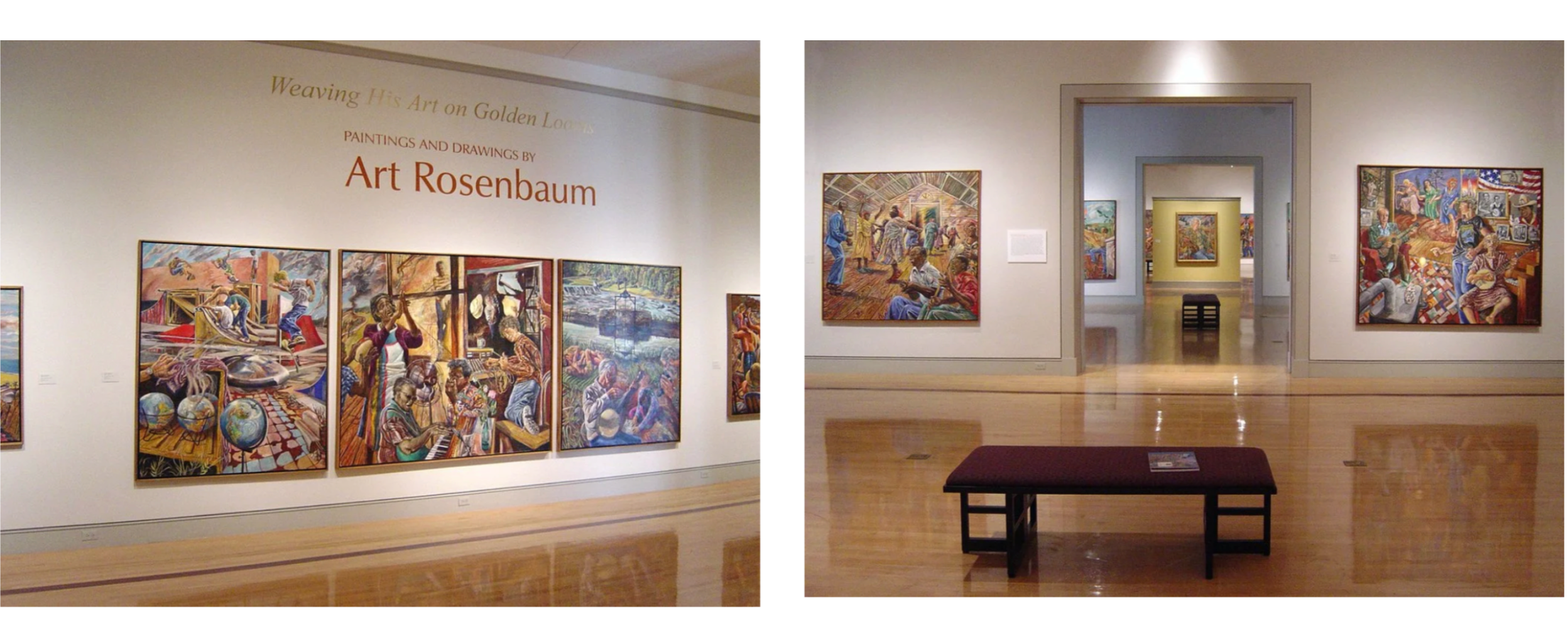
Installation views, Weaving His Art on Golden Looms: Paintings and Drawings by Art Rosenbaum, Georgia Museum of Art, October 2006–January 2007. Exhibition organized by Dennis Harper.
Installation view, Weaving His Art on Golden Looms: Paintings and Drawings by Art Rosenbaum, Georgia Museum of Art, October 2006–January 2007. Exhibition organized by Dennis Harper.
Harper’s accompanying essay, Telling Tales: A Portrait of Art Rosenbaum, makes clear that he understood Rosenbaum’s visual art within the larger ecology of his life. He described paintings filled with vernacular artists, musicians, storytellers and observers and emphasized Rosenbaum’s sustained attention to people and traditions that frequently existed beyond the artistic mainstream. Harper pointed to Rosenbaum’s portrayals and recordings of African American ring shout participants on the Georgia coast, North Georgia musicians and folk artists as examples of this larger commitment to documentation.
That idea brings the question of cultural memory into sharper focus. Rosenbaum was not merely depicting traditions as remnants of an earlier South. He encountered them through living people. Painting, playing music, interviewing, recording and writing became different means of acknowledging experiences that were continuing in the present even as they carried histories within them.
There is another revealing connection embedded in the retrospective itself. Its title came from a song by Howard Finster, whom Rosenbaum knew personally. Harper explained that Finster had supplied Rosenbaum with an inventive list of possible exhibition titles years earlier, including the phrase about “weaving his art on golden looms.” The retrospective title therefore originated not in detached art-historical terminology but within Rosenbaum’s own network of friendships and artistic exchange.
This matters because Rosenbaum’s history is difficult to understand through the isolated figure of the individual artist. His life and work continually formed around communities of painters, musicians, folk artists, writers, students and collaborators. Harper’s retrospective recognized that network while placing Rosenbaum firmly at its center.
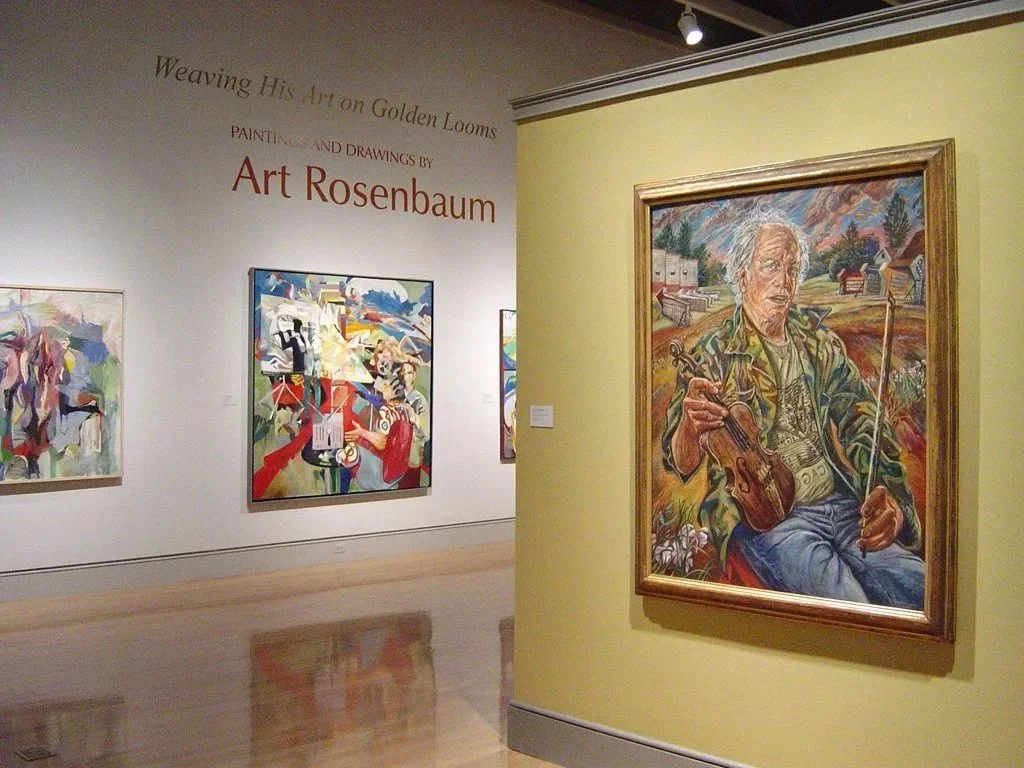
Installation view, Weaving His Art on Golden Looms: Paintings and Drawings by Art Rosenbaum, Georgia Museum of Art, October 2006–January 2007.
Painting the Mentor
A year before the retrospective opened, Harper made Art Rosenbaum in his Studio, an egg tempera painting on panel measuring only fifteen by fifteen inches. The scale is intimate, particularly in relation to Rosenbaum’s own frequently monumental canvases.
The painting adds another dimension to their relationship because Harper was no longer looking at Rosenbaum primarily as professor or curator. He was looking at him as another painter.
Harper’s broader series of artist portraits places artists within the environments where they work. He has explained that he became interested not simply in likeness but in the artist’s immersion in a studio and in the solitary nature of making. His egg tempera technique reinforces that concentration. Harper describes his method as deliberately slow and incremental, allowing one decision to be addressed at a time. The process, he says, effectively “slows down time.”
That slowness is important when considering the Rosenbaum portrait. Rosenbaum’s own paintings often move toward abundance, filling large surfaces with figures, incidents and overlapping visual information. Harper’s portrait moves in almost the opposite direction. The former graduate student concentrates upon a single person within the contained space of the studio.
Yet the studio prevents the portrait from becoming an isolated likeness. Rosenbaum appears surrounded by his work and the materials of painting, so that artistic practice becomes part of the subject’s identity. The painting records not only what Rosenbaum looked like but something of the physical world within which his art was being made.
The chronology makes the work even more suggestive. Harper painted Rosenbaum in 2005 and organized the museum retrospective the following year. Painting and curating were therefore occurring in close proximity. In one practice Harper interpreted Rosenbaum through pigment and observation; in the other he interpreted him through selection, scholarship, exhibition design and writing.
Harper himself has resisted suggesting that one of these activities simply determines the other. In discussing his studio practice, he has instead observed that painting and curating share aspects of his own working method: deliberation, incremental development and an accumulation of decisions that eventually form a larger structure.
Seen in this context, Art Rosenbaum in his Studio becomes more than an affectionate portrait of a former professor. It sits at a point where graduate mentorship, artistic friendship and curatorial interpretation meet.
Different Languages of Attention
The differences between Harper and Rosenbaum are as important as their affinities. Rosenbaum’s paintings frequently expand outward. Figures multiply, stories collide, and different kinds of experience occupy the same pictorial space. Harper often works through concentration and stillness. His small egg tempera paintings require proximity, slowing the viewer down in much the same way that the technique slows the painter.
Harper’s understanding of portraiture also extends beyond human subjects. He has described damaged trees, broken trunks and stumps in his paintings as portraits, seeing their twisted growth and cuts as evidence of lives shaped by adversity. He paints these forms with the dignity he associates with the best human portraiture.
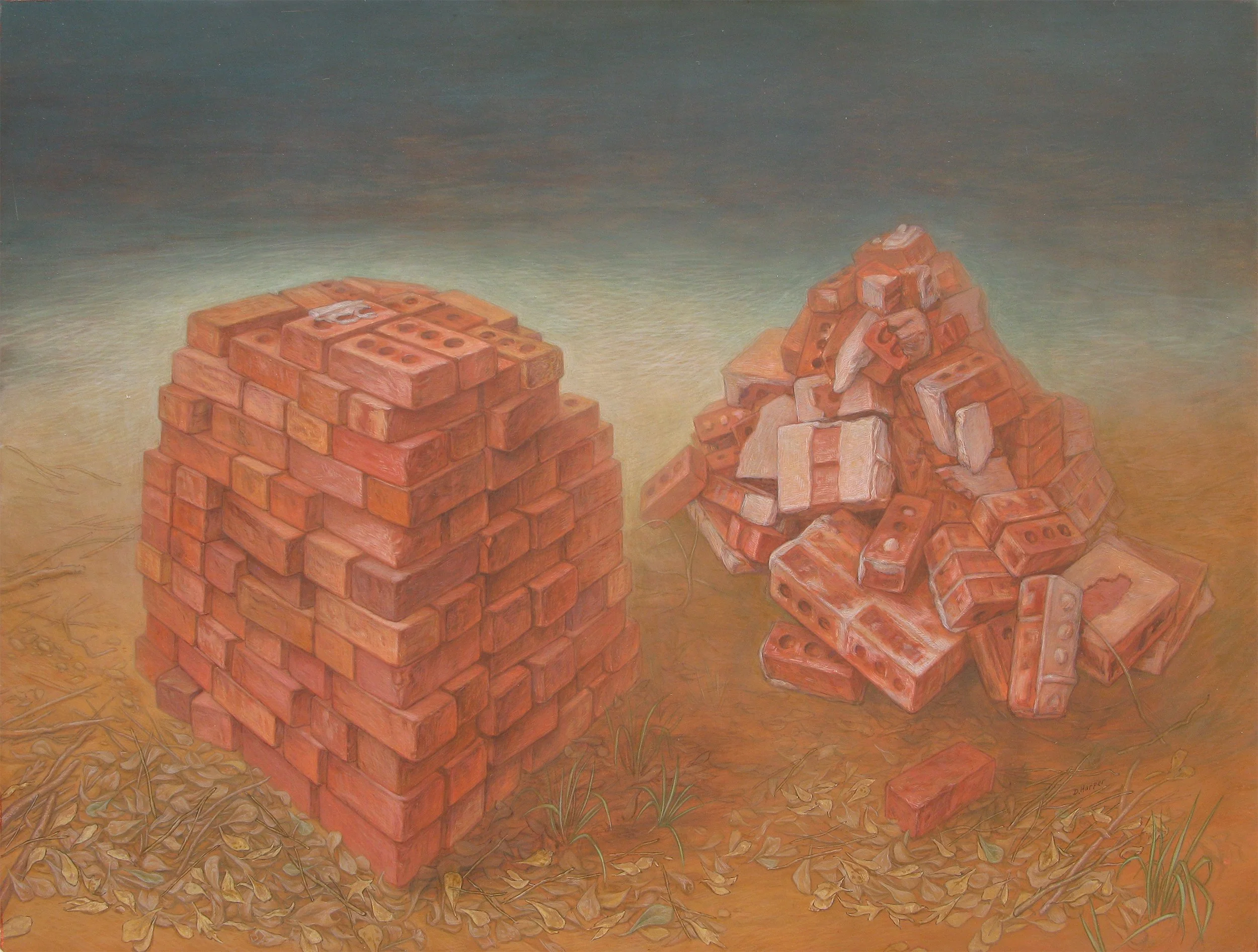
Dennis Harper, Sticks and Stones 4, 2012, egg tempera over casein on panel, 18 × 24 inches.
This provides a useful way of understanding what may actually have passed between Rosenbaum and Harper. Influence need not be measured by whether one artist adopts another artist’s surface appearance. It can reside in a more fundamental conviction that close observation matters and that subjects overlooked by conventional hierarchies can reward sustained attention.
Rosenbaum turned repeatedly toward musicians, vernacular artists, regional histories, friends and communities. Harper concentrates upon artists in their studios, weathered natural forms and subjects whose histories become visible only through careful scrutiny. One practice accumulates while the other often distills, but both depend upon the belief that prolonged attention can reveal something that casual looking misses.
A Continuing Institutional History
The relationship between Rosenbaum and Harper later became visible within another museum context. In the fall of 2022, the Pearl Fincher Museum of Fine Arts presented Three Excellences of Culture: Painting, Poetry and Music, the Work of Art Rosenbaum and Friends in cooperation with Matney Gallery.
The presentation grew from a body of work, relationships and programming that had already been developed through Matney Gallery. It brought Rosenbaum into conversation with artists and figures from a broader cultural network that included Dennis Harper, Margo Newmark Rosenbaum, Howard Finster, Kent Knowles and others. In this setting, Rosenbaum’s practice appeared not as an isolated career but within the community of artists, musicians, students and collaborators that had long surrounded it.
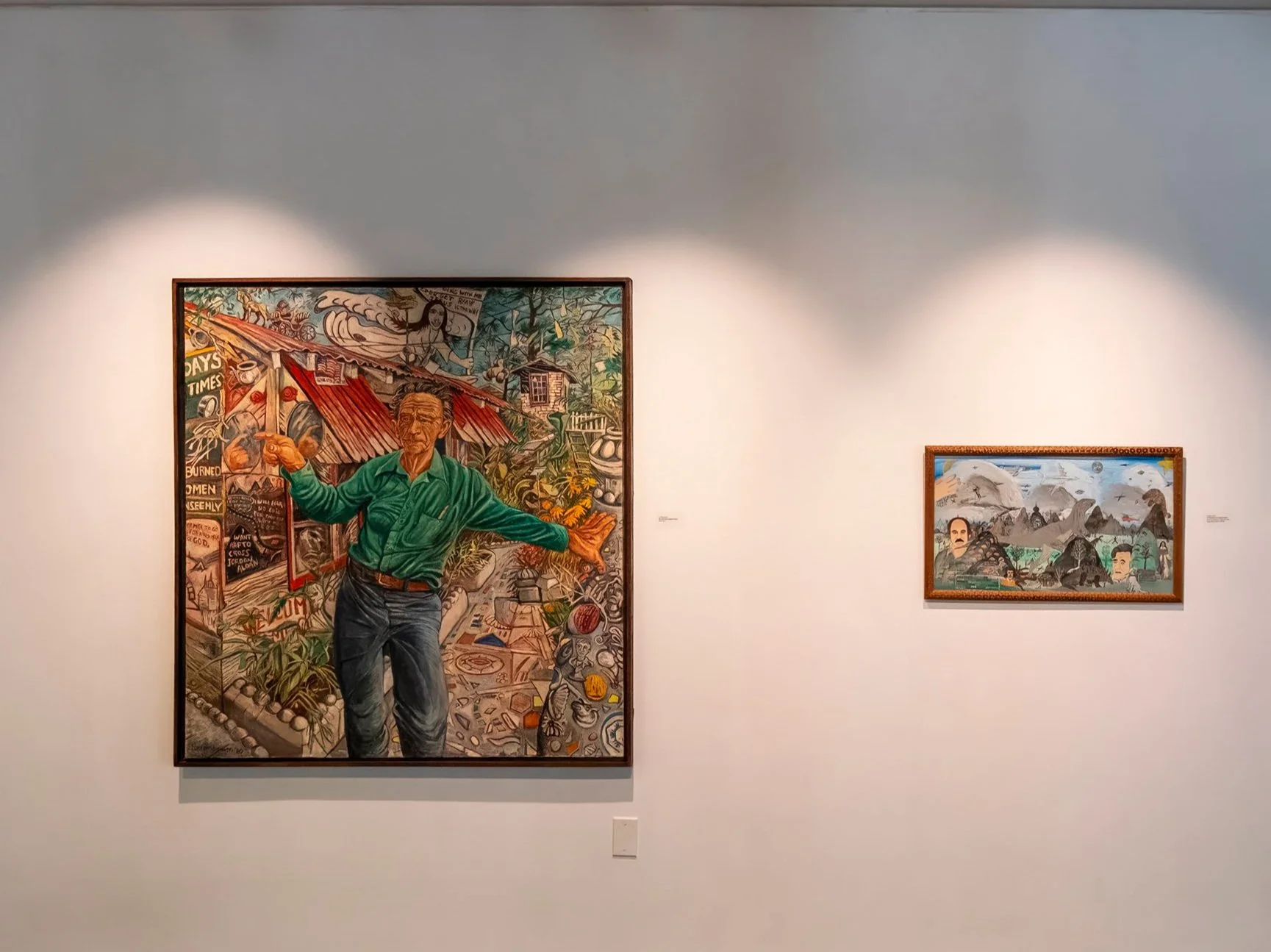
Installation view, Three Excellences of Culture: Painting, Poetry and Music, the Work of Art Rosenbaum and Friends, Pearl Fincher Museum of Fine Arts, 2022. Rosenbaum’s work shown in relation to Howard Finster and the wider artistic network surrounding the exhibition.
Harper’s presence carried a particularly long history. He had encountered Rosenbaum as his major professor in graduate school, later painted him, organized his retrospective and wrote about him. Their inclusion within the same museum presentation allowed that history to become part of a wider account of the artistic community surrounding Rosenbaum.
Finster’s presence created another thread of continuity. The artist who had supplied the phrase that eventually became the title of Harper’s 2006 retrospective appeared within this later museum context as well. What might otherwise look like separate episodes in Rosenbaum’s exhibition history instead reveals an interconnected network recurring across different moments and institutions.
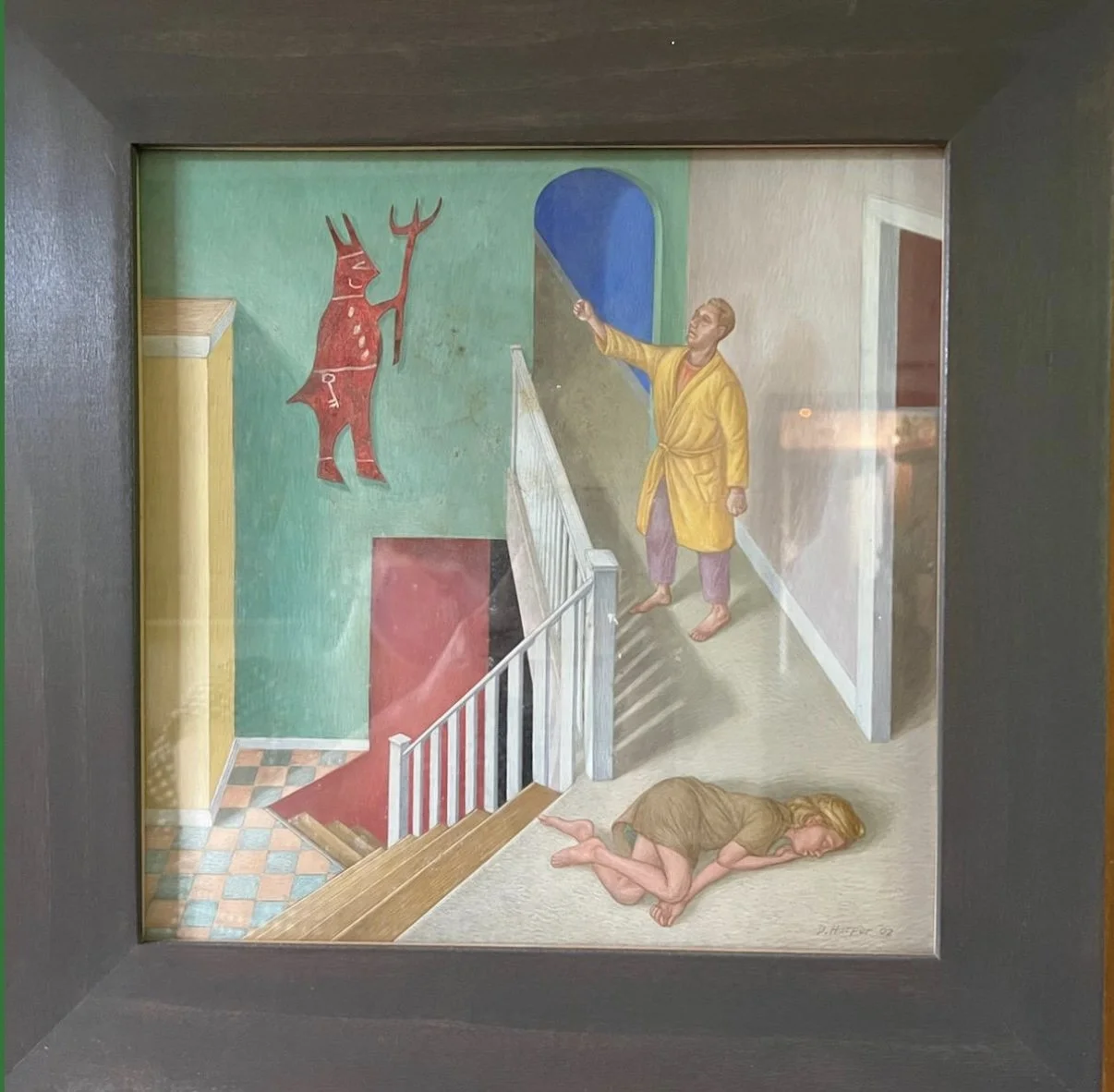
Dennis Harper, Demon Driver, 2002, Egg tempera, 13 × 13 inches, Included in Three Excellences of Culture: Painting, Poetry and Music, the Work of Art Rosenbaum and Friends, Pearl Fincher Museum of Fine Arts, 2022.
The Pearl Fincher presentation therefore matters here not as a separate chapter in Rosenbaum’s exhibition history, but as evidence that relationships first formed through teaching, artistic exchange and curatorial scholarship continued to generate new institutional contexts decades later.
What Is Carried Forward
After Rosenbaum’s death, Harper returned to his former professor once more, this time through writing. His 2023 essay Art’s Spark—Remembering the Life and Art of Art Rosenbaum is especially valuable because Harper writes from several positions simultaneously. He had been Rosenbaum’s graduate student, had known him personally, had researched his career as a curator and had spent decades making art himself.
Harper recalled that research for the retrospective had revealed the breadth of Rosenbaum’s “experience, expertise, and influence.” He described a figure whose interests ranged across historic painting techniques, new technologies, traditional music and visual art, but he ultimately returned to the paintings and to Rosenbaum’s ability to combine place, time, companionship, mystery and revelation within them.
That later essay completes a remarkable progression. Rosenbaum first looked at Harper’s work as his major professor in graduate school. Harper later looked at Rosenbaum through the concentrated discipline of portraiture. He then looked across Rosenbaum’s career through the museum retrospective and ultimately looked back upon the life as a writer after Rosenbaum was gone.
This reciprocity gives the relationship significance beyond biography. Rosenbaum devoted much of his life to noticing, recording and depicting people whose voices and traditions might otherwise receive less attention. Harper eventually performed a related act for Rosenbaum himself, helping to place his paintings within a museum framework, recording his life through portraiture and scholarship, and carrying his memory into another generation.
Artistic legacy in this sense is not a matter of imitation. It is a process of transmission. A professor can alter what a graduate student believes deserves attention. A former student can later become the curator who gives a professor’s work new historical visibility. Galleries, museums, exhibitions and scholarship can then carry those relationships into new contexts and before new audiences.
The relationship between Art Rosenbaum and Dennis Harper demonstrates how cultural memory is actually made: through teaching, looking, painting, listening, curating, writing and the repeated willingness to return to a subject with attention. What survives is not simply an image or an object, but a way of seeing that continues to move between people and institutions long after the original encounter.