
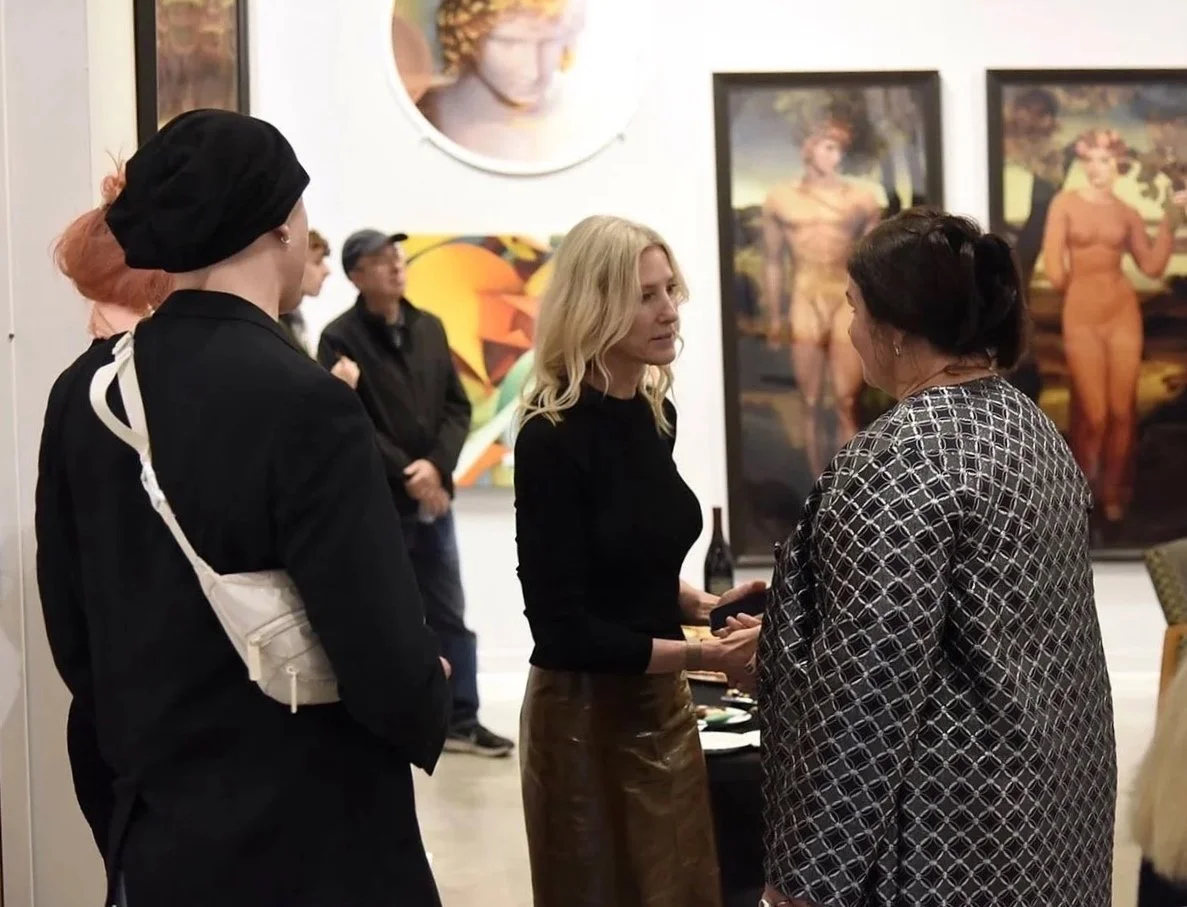
Olga Tobreluts on Painting the Digital World
Across oil paintings and lenticular works, classical faces and constructed spaces become a way to think about how we see.
In Olga Tobreluts’s Diana (2022), a classical profile seems to come apart in pale facets.
Blue and silver forms gather around the head; sharp planes interrupt the curves of the face. The image suggests the shaded surfaces of a computer model. It is painted in oil on a canvas more than three feet across.
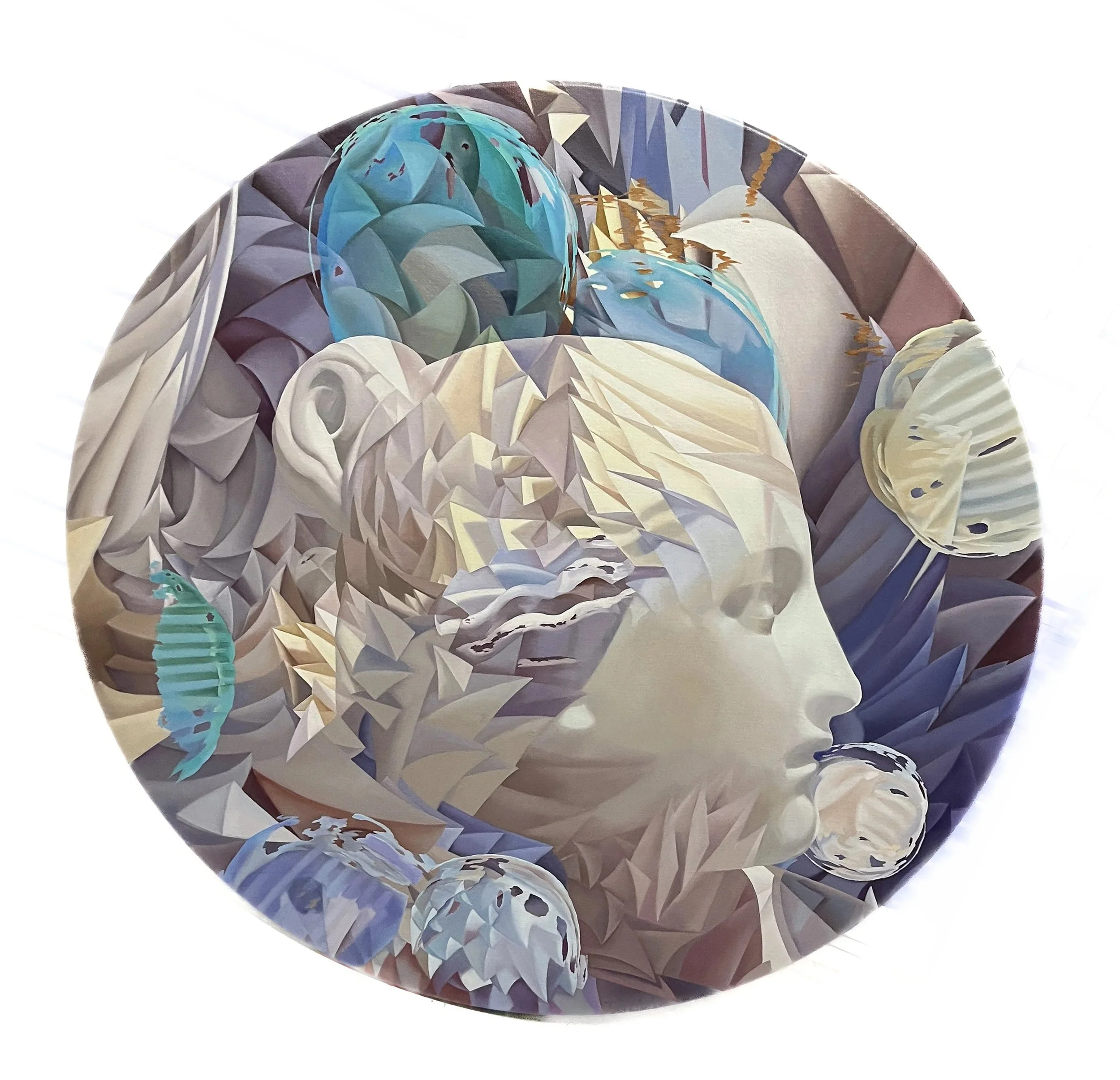
Olga Tobreluts, Diana, 2022. Oil on canvas, 39 in. diameter.
The faceted surface turns a recognizable portrait into a study of planes and light.
“The screen became my plein air,” she says in her edited account for Matney Gallery. The phrase borrows from the practice of painting outdoors, with a landscape before the artist. For Tobreluts, an image developed on a computer can supply that field of observation. She looks at it, works through its forms, and translates it by hand.
Following that process gives a way into a practice that ranges from photographs of ballet dancers battling monsters to classical faces that change as the viewer moves. Across these works, an image carries traces of its earlier lives. A pose, a face, or a fragment of a historical painting can survive a change of medium and acquire another meaning along the way.
BUILDING AN IMAGE
Tobreluts began with architecture and an interest in ornament. In her recollections of St. Petersburg, the ordered life of study and office work gives way to a circle of musicians and artists experimenting with ways of living and making. She painted abstractions, dressed performers in patterns for a film, and made headpieces to explore how ornament could dissolve the figure into its surroundings.
She dates her encounter with computer technology at ART+COM in Berlin to 1991. It brought an uncomfortable discovery: effects she had struggled to achieve were already possible. Yet the human figure and the possibilities of academic art remained central to what she wanted to make. The new tools offered a means of constructing a world around them.
That interest belonged to the setting of Timur Novikov’s New Academy. The Ludwig Museum’s history of the movement describes a pursuit of classical beauty that also made vigorous use of new media, music, and fashion. Tobreluts remembers its institutional roles with a sense of play: she became a professor in a group that was, in her words, “playing at being an official organization.”
In her Models series, ancient sculptural figures appear in contemporary designer clothes. The Ludwig Museum’s collection record describes this meeting of classical portraits and fashion brands. A goddess takes on a modern social identity through what she wears. MoMA’s 1998 online project InterNyetdocumented Tobreluts’s computer collages and these transformations of ancient figures into fashion icons.
In Adam and Eve (2006, printed 2010), Adam bears Elvis Presley’s face and Eve bears Madonna’s. Beneath the foliage, their familiar features join idealized bodies in a landscape that recalls older images of paradise. The combination places two modern celebrities within a biblical story, extending Tobreluts’s interest in how recognizable faces acquire new meanings as they pass between cultures and periods.
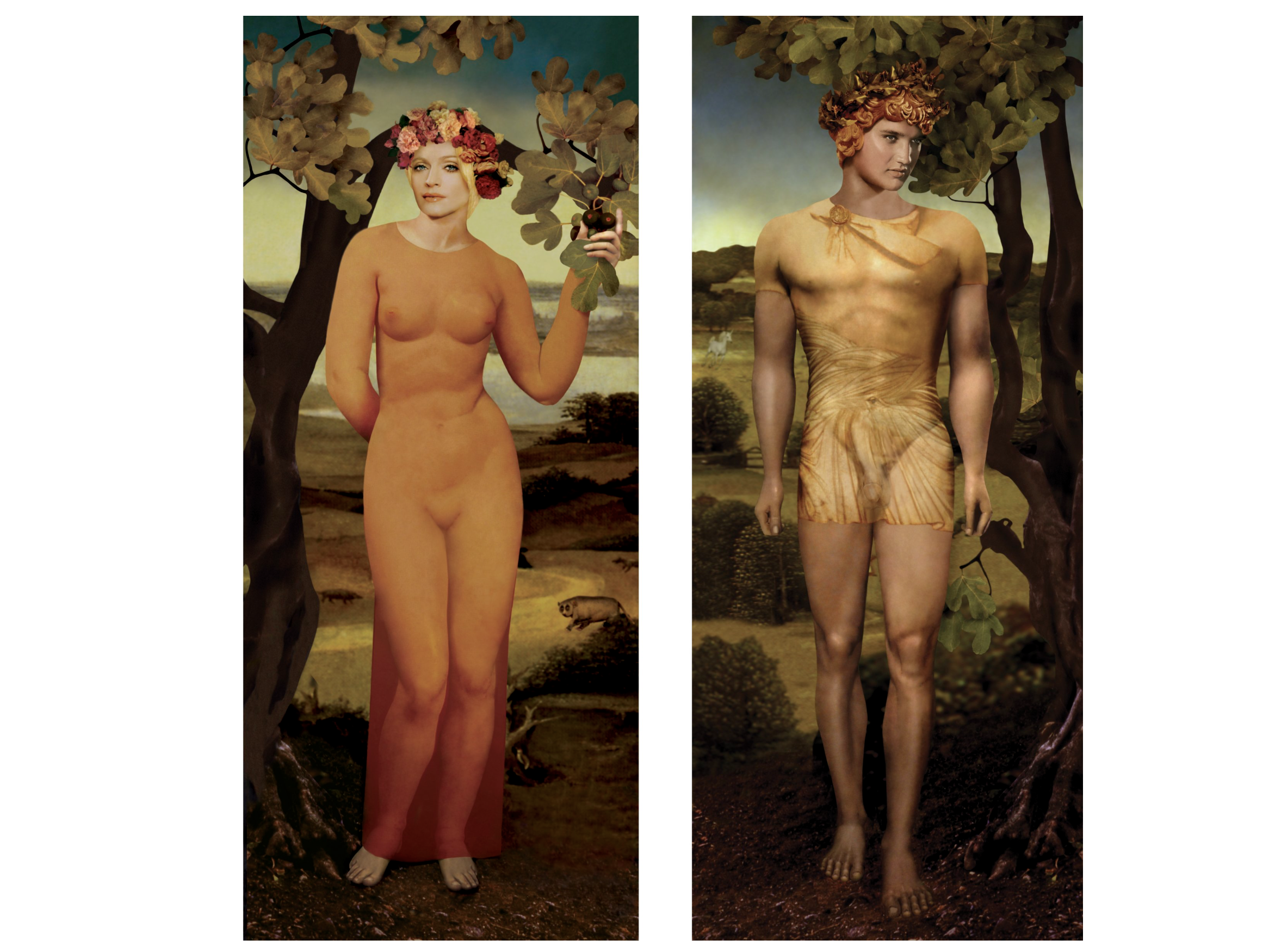
Olga Tobreluts, Adam and Eve, 2006, printed 2010. Kodak Metallic Prints, two panels, 71 × 28 in. each.
Eve, at left, bears Madonna’s face; Adam, at right, bears Elvis Presley’s.
In Modernization, the stage expands into a battle. Tobreluts photographed ballet dancers and placed them among creatures whose bodies sometimes reveal the wireframe structures of digital modeling. The dancers’ gestures supply physical conviction to the invented scene. Their trained bodies also connect it to the theatrical poses of historical painting.
She recalls thinking about Joseph Kosuth’s One and Three Chairs, which brings together a chair, its photograph, and a dictionary definition. Her own question was how a word, modernization, might become an image. “I used rays of light as weapons,” she explains. The result gives technological change a bodily form, with the past and an imagined future meeting in combat. M HKA in Antwerp holds Modernisation (Part II), dated 2002–2003.
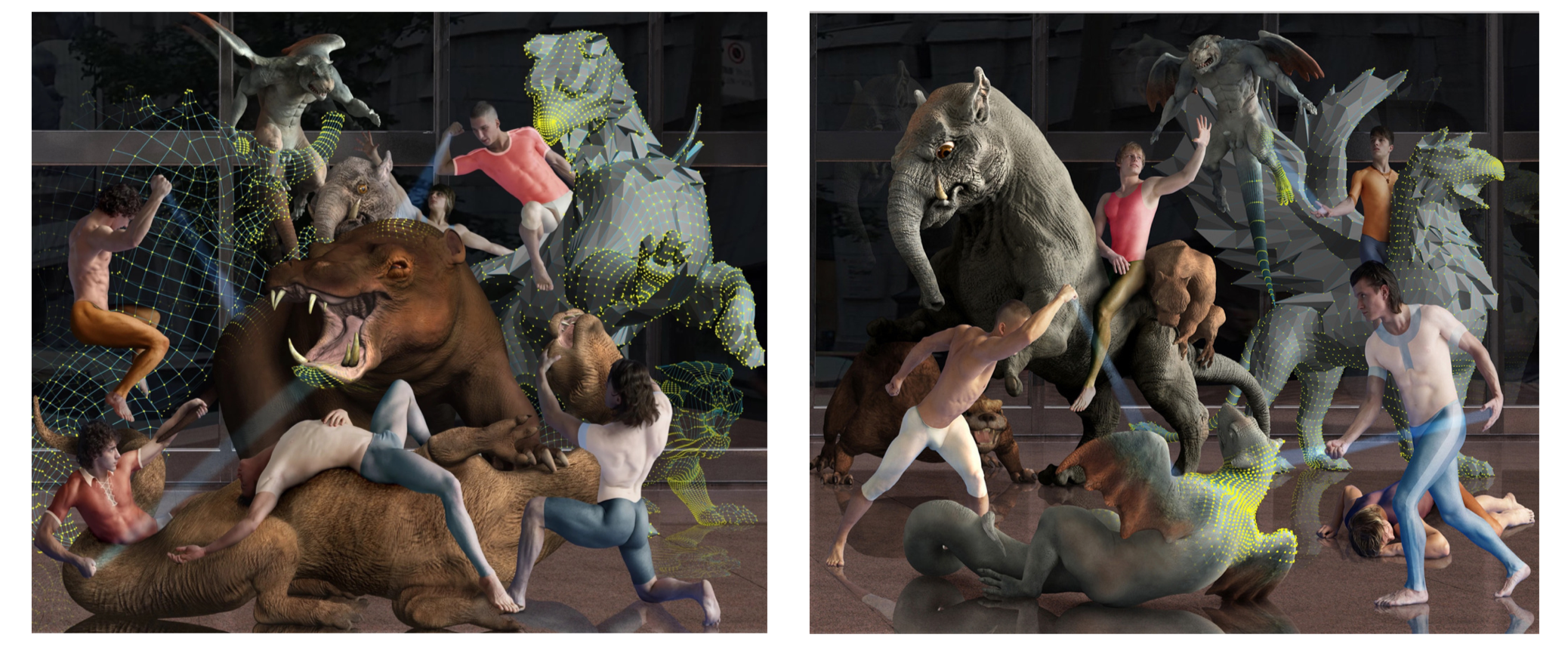
Olga Tobreluts, two works from the Modernization series.
The photographs preserve the dancers’ bodily gestures as surrounding forms reveal their digital construction.
PAINTING FROM THE SCREEN
Tobreluts’s return to oil painting grew partly from dissatisfaction with the quality of printed images. She describes studying the techniques of older paintings and taking lessons so that she could produce the surfaces she wanted. The computer remained part of the process. “Usually, I develop an image or a sketch on the computer and then transfer it by hand to the canvas.”
In Untitled (2026), curves and pointed planes suggest objects modeled in a space that has no obvious physical counterpart. Yellow and orange forms overlap pale blue and green, while gradations give the planes a sense of depth. Looking moves between the shape of an invented object and the painted surface that holds it.
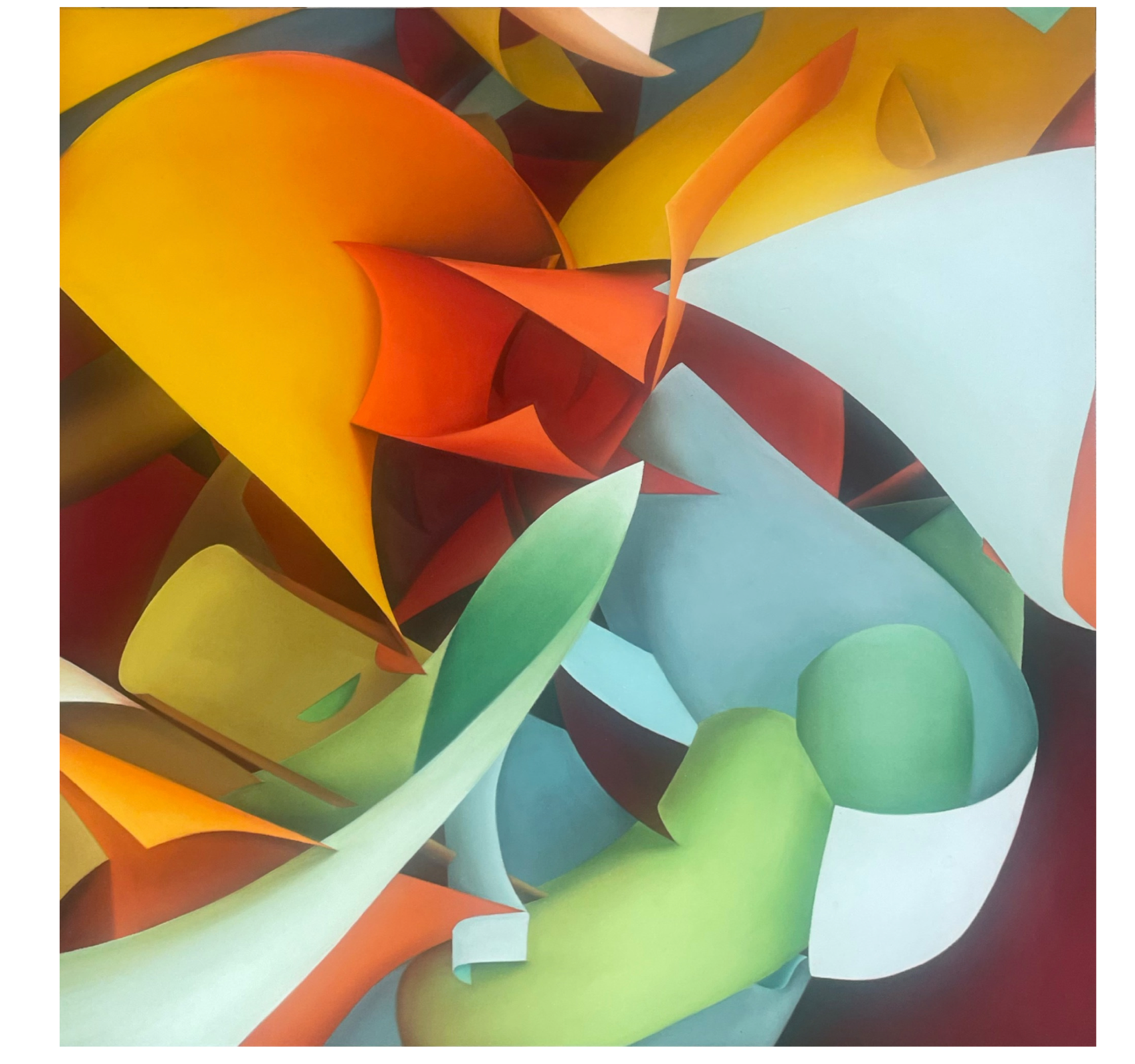
Olga Tobreluts, Untitled, 2026. Oil on canvas, 36 × 36 in.
Painted gradations give the overlapping planes depth and hold traces of their digital source.
A photograph of her son helped sharpen her thinking about that movement. Standing before one of her large paintings, he seemed flat in the photograph, while the painted forms behind him appeared three-dimensional. Tobreluts describes this as a striking visual experience. It led her to experiment with transforming an image from art history, such as Pontormo’s Deposition, into pyramidal forms and then painting the result.
“I felt as though I had become a biological computer, transferring the digital world by hand,” she recalls. The phrase puts physical labor at the center of the process: an image must pass through the painter’s decisions about edge, light, and color. Her later dialogue with Ivan Plusch extended the question into a shared exploration of abstraction, presented at the Pearl Fincher Museum of Fine Arts in Where Meanings Collide: A Conversation on Abstraction in 2026.
A FACE THAT CHANGES
With the lenticular works, the viewer’s movement becomes part of the image. Tobreluts describes developing a three-dimensional construction with programmer Egor Korotkov and dividing it into multiple views. A surface of small lenses makes different appearances visible from different positions. A photograph records one view of a work that unfolds as someone moves in front of it.
The pale bust in Nimfa is surrounded by blue spheres and radiating gold lines. The recognizable face gives the eye a point of return amid the shifting space. Seeing the work over time involves remembering one appearance while another comes into view.
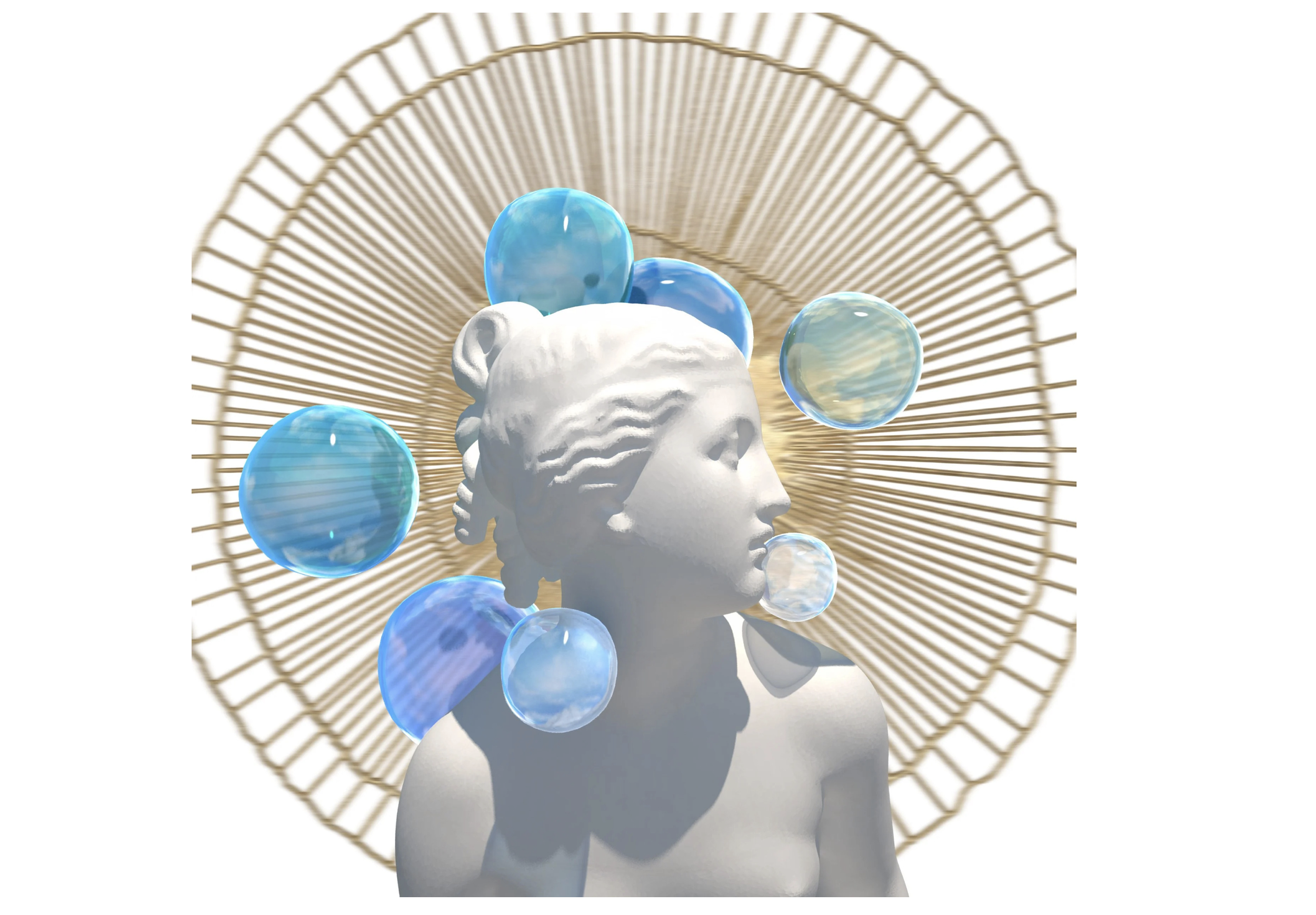
Olga Tobreluts, Nimfa, 2018. Stereo-Vario lenticular work. Still view.
This still records one appearance of a work that changes with the viewer’s position.
Dollar gives the transformation a sharper conceptual turn. A spiked green form changes into an inflated gold one. Tobreluts relates that change to the dollar’s separation from gold. The familiar sign carries competing suggestions of danger, attraction, and buoyancy; its changing appearance makes the value attached to a symbol seem less settled.
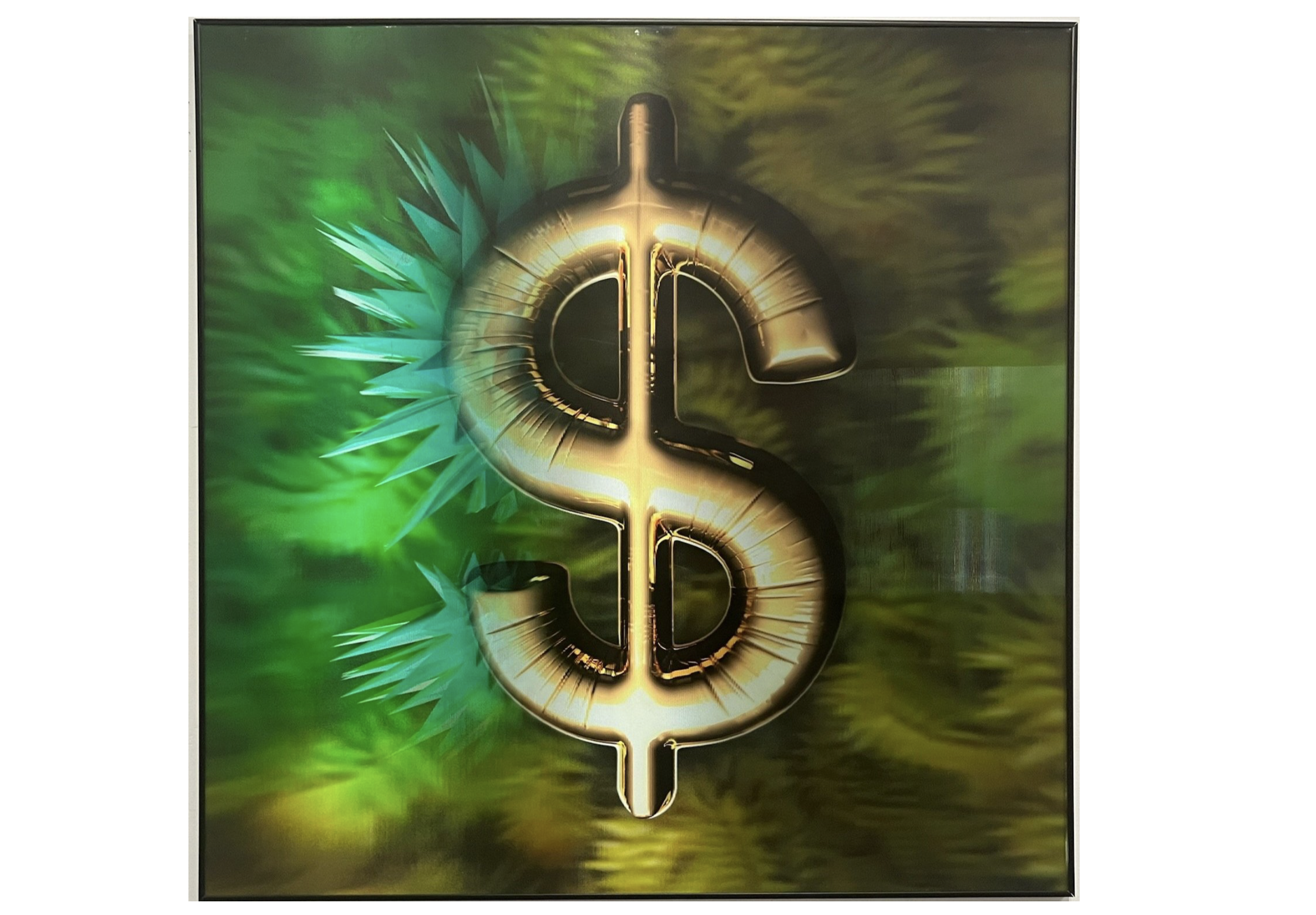
Olga Tobreluts, Dollar, 2018. Lenticular panel, 39 × 39 in. Still view.
The spiked and inflated forms give contrasting appearances to the same emblem of value.
In Antinous, an idealized classical face passes from the appearance of marble to gold. The historical Antinous, loved by Emperor Hadrian, was commemorated in numerous sculptures after his death. “It is as though time itself has transformed him,” Tobreluts says. Her interest extends to the repeated life of a face: she describes placing Antinous over a photograph of Elvis Presley and recognizing features they seemed to share. She sees a connection between an ancient ideal and the later circulation of a celebrity’s image.
That comparison gives the work a longer timescale than the moment of its optical change. The features endure while their apparent material and associations shift. The visitor’s small change of position becomes a way of approaching a larger question about how an image remains recognizable as successive audiences invest it with meaning.
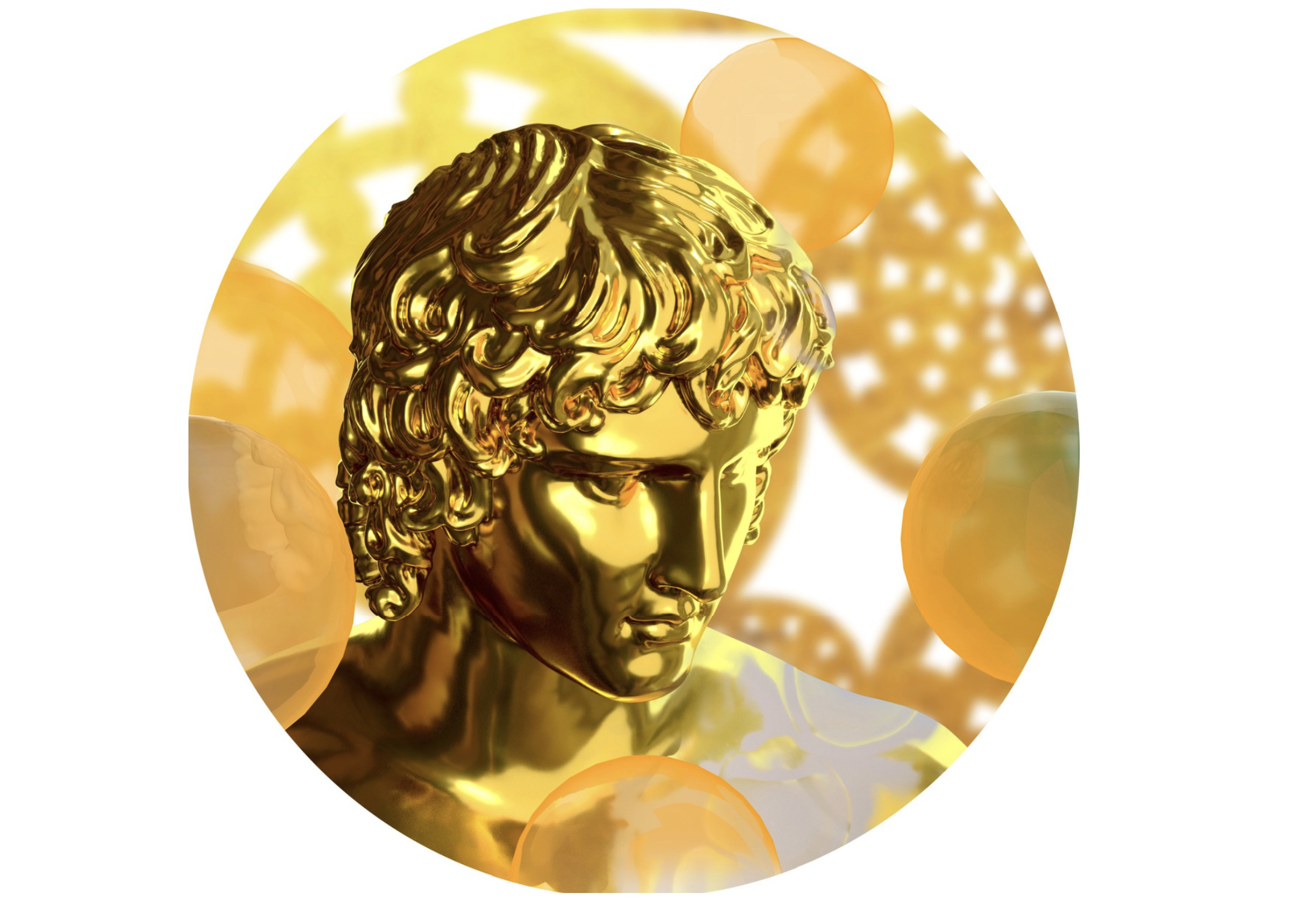
Olga Tobreluts, Antinous, 2019. Stereo-Vario lenticular work. Still view.
The idealized features endure while their apparent substance changes from marble to gold.
HISTORY ENTERS THE PICTURE
In Armageddon (2022), Tobreluts connects the imagery of battle to an immediate family history. Her account connects the war in Ukraine to relatives whose lives cross several countries. “My family comes from territories whose borders have changed, places that have belonged first to one country and then to another.”
The Estonian National Museum’s record of New Mythology, shown in 2023, identifies the work and preserves Tobreluts’s explanation of its dialogue with Picasso’s Guernica. In the broad monochrome field, twisting bodies and angular fragments compress the space around a central creature. The forms used elsewhere to construct imagined worlds become a means of addressing violence in the present.
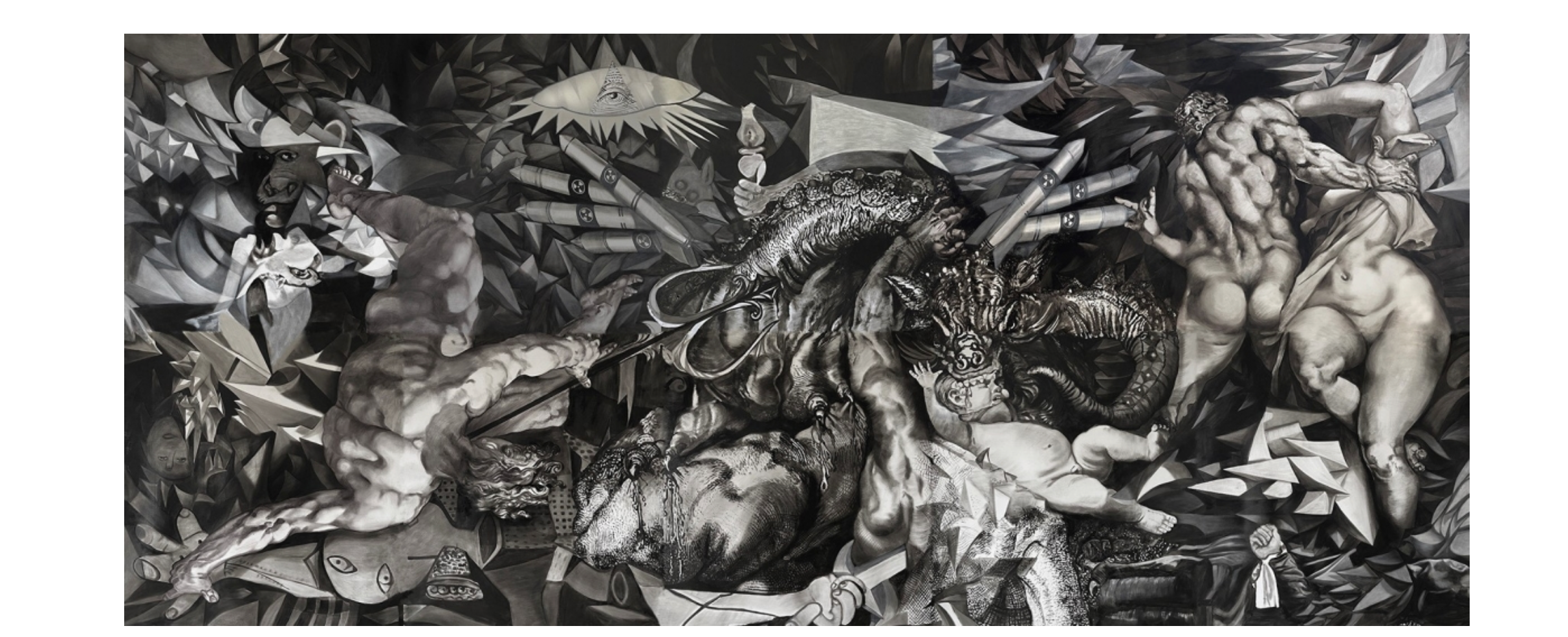
Olga Tobreluts, Armageddon, 2022. Oil on canvas, 350 × 775 cm.
The crowded monochrome field brings the language of historical battle painting into a response to present war.
Image source: Estonian National Museum.
In another recollection from Estonia, she describes a family image on a more intimate scale. A two-headed juniper tree became an emblem that she returned to in works showing different times of day. In a video, she formed the tree from letters exchanged among relatives. Family members who lived far apart could see their correspondence gathered into a shared form. Words sent between people become the image that brings them together.
Artist quotations are drawn from Olga Tobreluts In Her Own Words, the edited account prepared for Matney Gallery. Historical context comes from the museum records linked in the text; descriptions and interpretations are by Matney Gallery.
Related reading Matney Gallery’s 2022 interview with Olga Tobreluts and the gallery’s 2025 expanded version.
Artwork illustrations from Matney Gallery’s exhibition materials. Armageddon image source: Estonian National Museum.
5435 Richmond Road, Suite A
Williamsburg, Virginia 23188