
AWAKENING II
The Image in Transformation
Olga Tobreluts, Ivan Plusch, and Oleg Dou
Matney Gallery, Williamsburg, Virginia | October 2026 through January 3, 2027
Curated by John Lee Matney
A classical profile remains recognizable even as its surface breaks into facets. A building retains the measured order of its windows and doors while dark forms move across its façade. A photographed face meets the viewer with unusual directness, although its apparent perfection makes the presence behind it difficult to read. These are different encounters with an image, and the differences matter. In Awakening II, Olga Tobreluts, Ivan Plusch, and Oleg Dou each reconsider the means through which familiar subjects become visible. Rather than illustrating a single account of technology or abstraction, their works establish a conversation about the persistence of historical forms and the capacity of images to change.
Presented at Matney Gallery in Williamsburg, Virginia, the exhibition combines works from established bodies of practice with recent developments, including abstract paintings by Tobreluts and Plusch that relate to their 2026 dialogue at the Pearl Fincher Museum of Fine Arts. The earlier works are not merely precedents for the new ones. They allow viewers to trace artistic questions that persist across shifts in medium and appearance. Tobreluts brings classical imagery into contact with digital construction, photography, lenticular techniques, and oil painting. Plusch examines the relationship between figures, objects, and built environments through an unconventional treatment of painterly space. Dou uses the authority of photography to investigate the conventions of portraiture and the social construction of identity.
What joins these practices is not a uniform visual language, but a sustained attention to the terms of representation. An image may borrow authority from antiquity, from architecture, or from the seeming factuality of a photograph, only to reveal that its coherence has been carefully made. The artists do not simply abandon their subjects in favor of abstraction. They test how much a subject can change, what remains recognizable, and what new possibilities emerge when an established mode of seeing is reconsidered. The recent paintings make these questions newly visible without turning the earlier work into a stage that has simply been left behind.
Olga Tobreluts: Classical Form and the Contemporary Image
Olga Tobreluts’s work considers how inherited images acquire a contemporary presence. Classical figures enter a visual culture shaped by photography, fashion, and digital construction, retaining their historical associations while taking on new identities. The Museum of Modern Art’s 1998 online project InterNyet documented this approach through her computer collages and her recasting of figures from antiquity as contemporary fashion icons. The relationship between an ancient ideal and a newly constructed appearance becomes a subject in itself.
Tate Liverpool subsequently included her Sacred Figures series in Heaven: An Exhibition That Will Break Your Heart, presented in 1999 and 2000. There, the faces of supermodels were recast within imagery associated with sacred figures. These early presentations provide an international context for considering her continuing interest in the authority of images and the ways familiar forms acquire new meanings.
Her involvement with the New Academy in Saint Petersburg provides another important context. Associated with Timur Novikov, the movement reconsidered classical beauty and historical form rather than simply restoring the conventions of academic painting. The Ludwig Museum in Budapest examined this history in its 2015 exhibition Absolute Beauty, which included Tobreluts’s work. Her use of digital construction within this setting unsettles the assumption that a classical subject must be represented through a traditionally classical technique. Historical imagery becomes material for experiment, capable of carrying different meanings as its methods of presentation change.
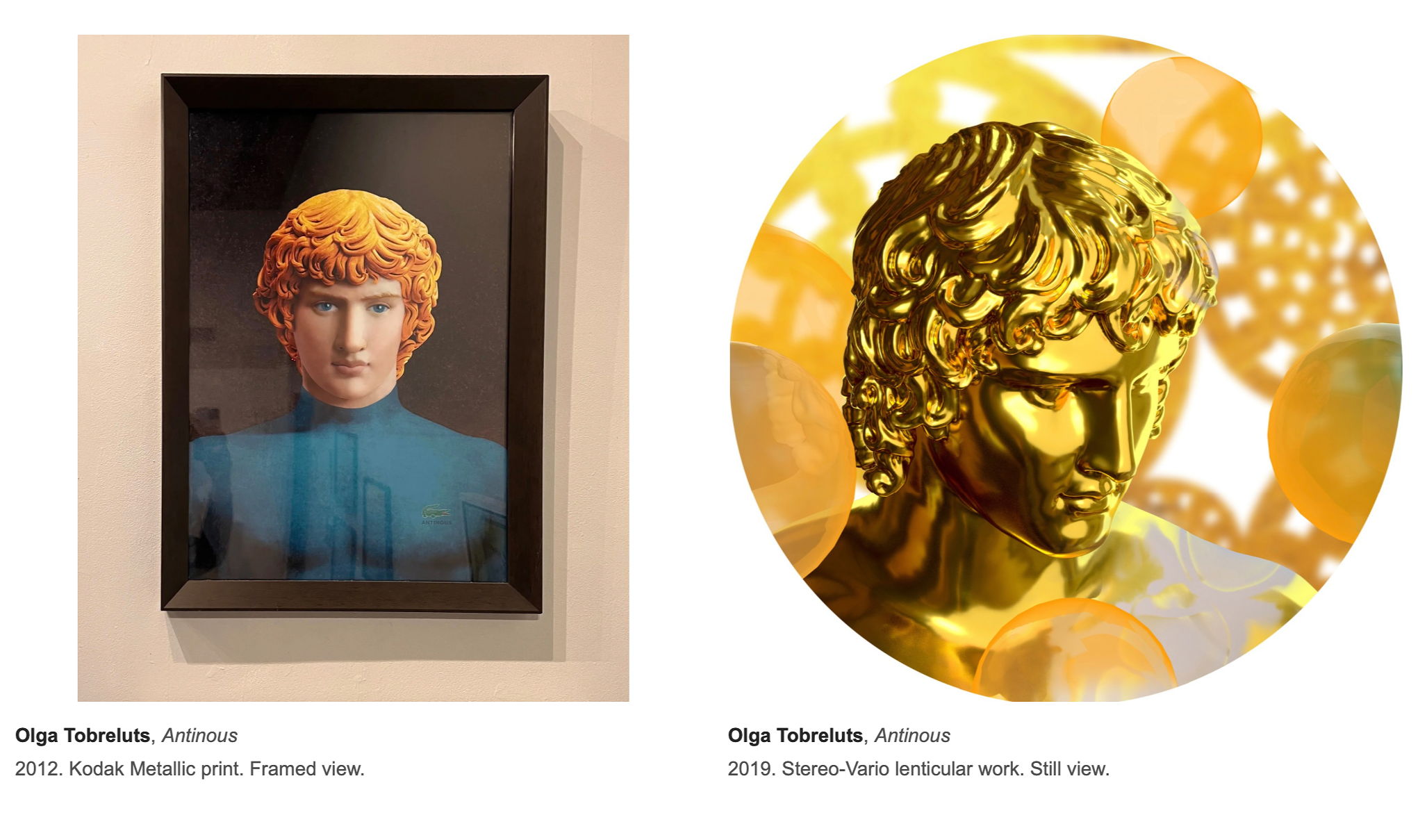
Antinous provides a particularly revealing subject because the name carries an established history of idealized portraiture. In Tobreluts's 2012 Kodak Metallic print, the tightly modeled head and carefully arranged curls evoke a sculptural prototype, while the intense color and contemporary blue garment place the figure in another world of presentation. The image does not ask the viewer to choose between an ancient body and a modern style. Its interest lies in the persistence of the classical prototype within an image that openly belongs to contemporary visual culture. Matney Gallery’s documentation records another impression of this photographic image in the Victoria and Albert Museum’s collection in London.
The later circular Antinous of 2019, made using the Stereo-Vario optical process, reopens the same subject through an altered viewing experience. The head assumes a luminous, metallic appearance, but the decisive change is structural: a lenticular image cannot be entirely apprehended from one fixed position. What the spectator sees changes with movement. The classical figure becomes a point of continuity between a photographic object and an optical one, and the viewer's physical position becomes part of the work's meaning. Tobreluts has not simply updated the earlier portrait. She has made the experience of seeing it a more explicit subject.
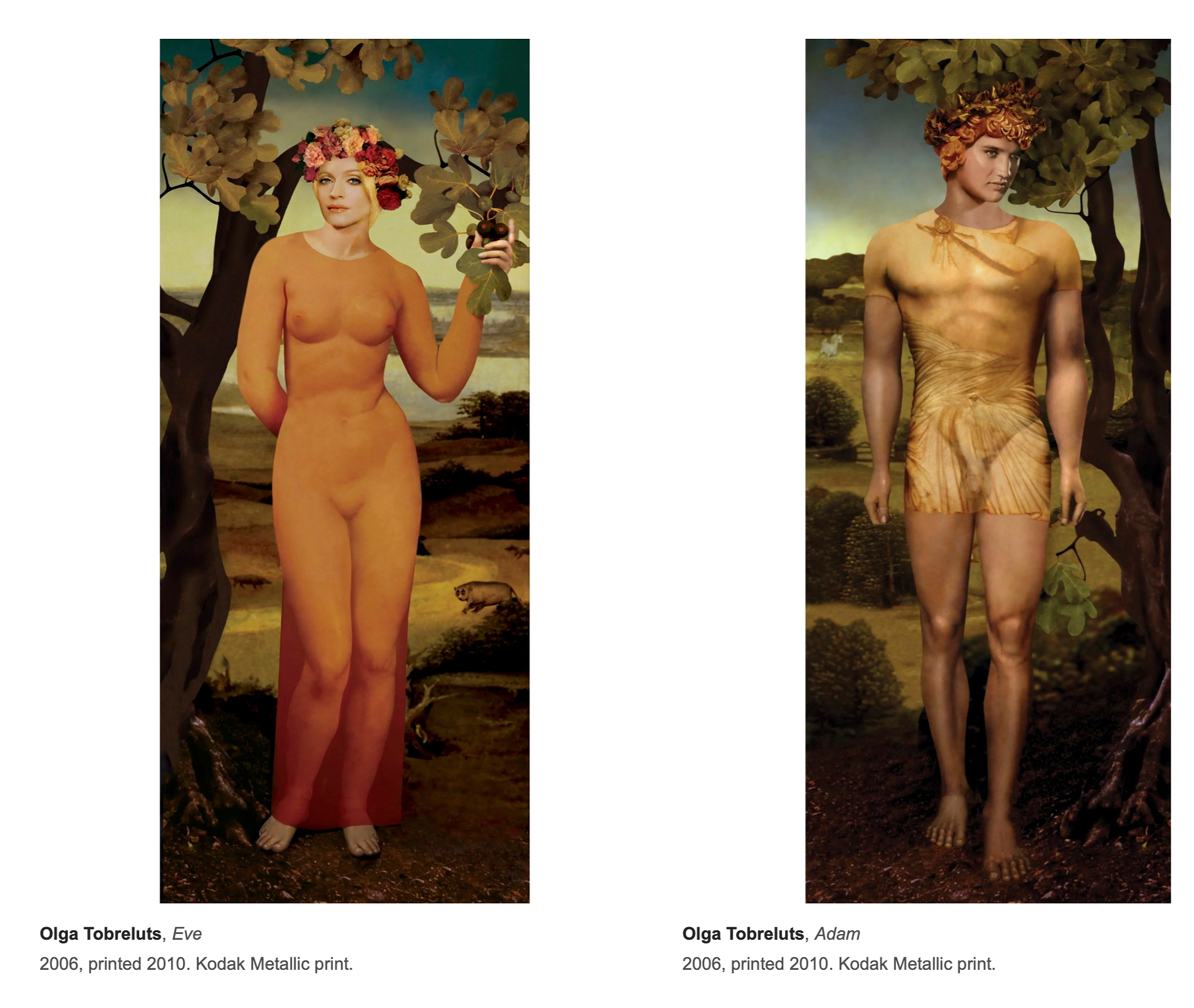
A corresponding relationship between inherited imagery and contemporary construction appears in Adam and Eve. Presented as separate tall prints, the figures inhabit carefully organized landscapes that recall the staged spaces of historical painting. Their poses and ornamented surfaces invite an art-historical reading, while the evidently composed scene prevents the viewer from treating them as a return to an original, innocent world. The foundational figures of a familiar narrative have themselves been remade. Their physical scale matters: the pairing asks for an encounter with two complete bodies, each occupying a pictorial setting designed to hold it in view.
Modernization II and Modernization III are both on view in the exhibition. In Modernization II, the mechanisms of image production become particularly visible. Photographed figures and fantastical creatures occupy a crowded, theatrical environment in which convincing surfaces coexist with exposed geometric frameworks. Some creatures seem fully modeled, while others reveal the angular structures of their digital construction. What might elsewhere remain hidden as a stage in production becomes an active part of the composition. The photographed body, the modeled creature, and the visible framework share a pictorial space without becoming equivalent. The viewer encounters both a scene and the different means through which it has been assembled. This is a way of reconsidering the authority of pictorial illusion rather than treating technology as a matter of novelty.
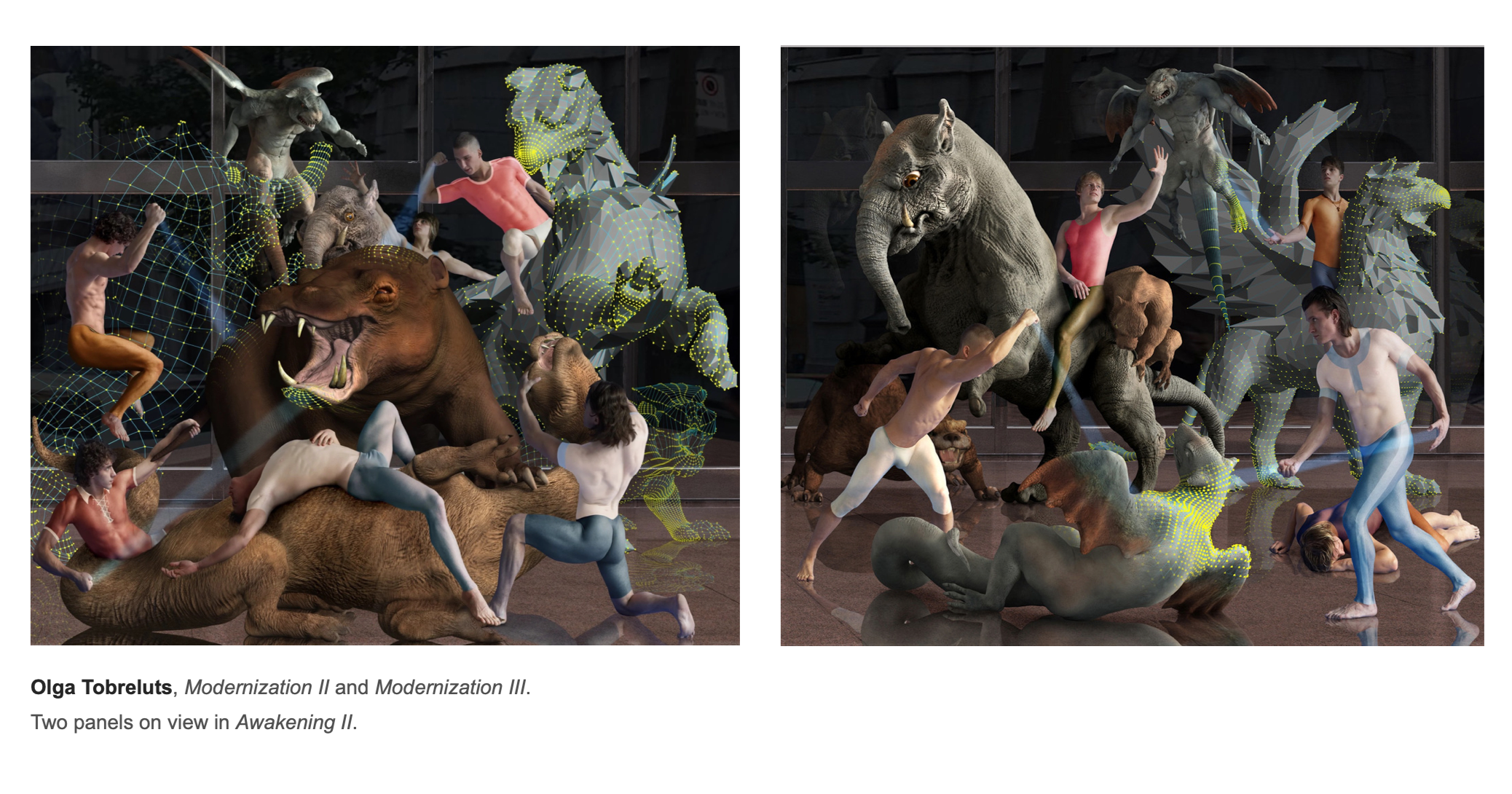
Olga Tobreluts, Modernization II and Modernization III.Two panels on view in Awakening II.
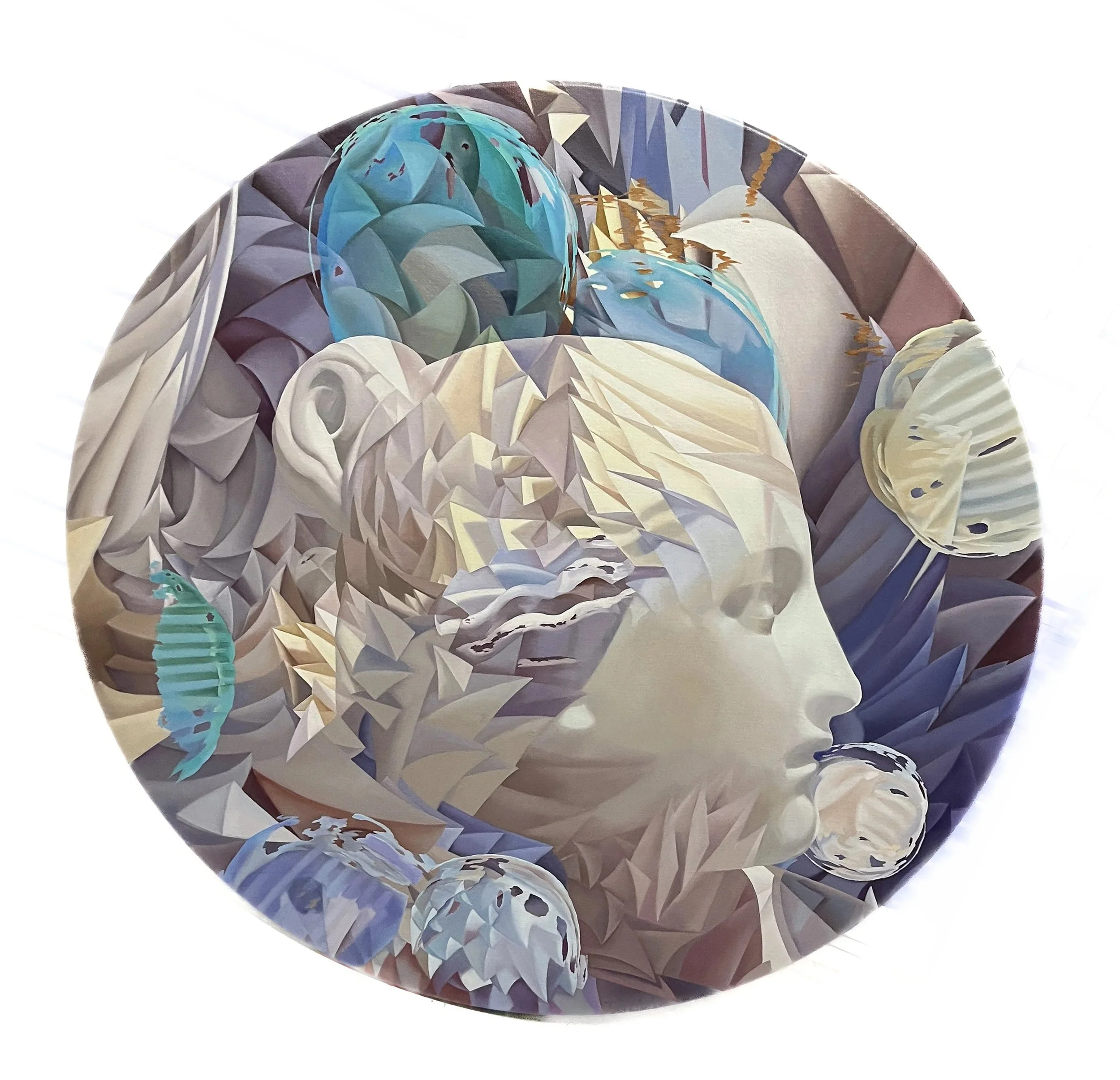
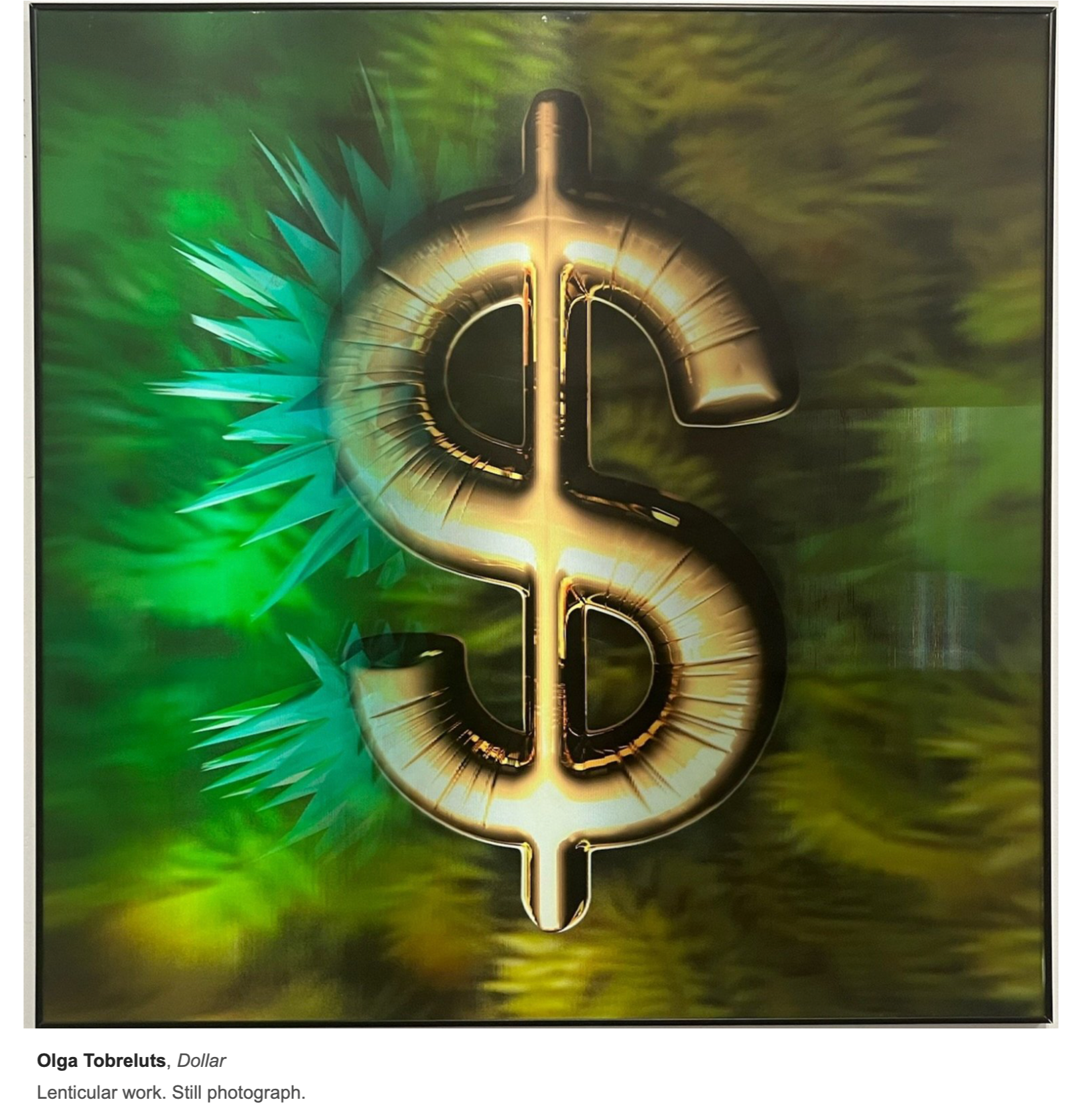
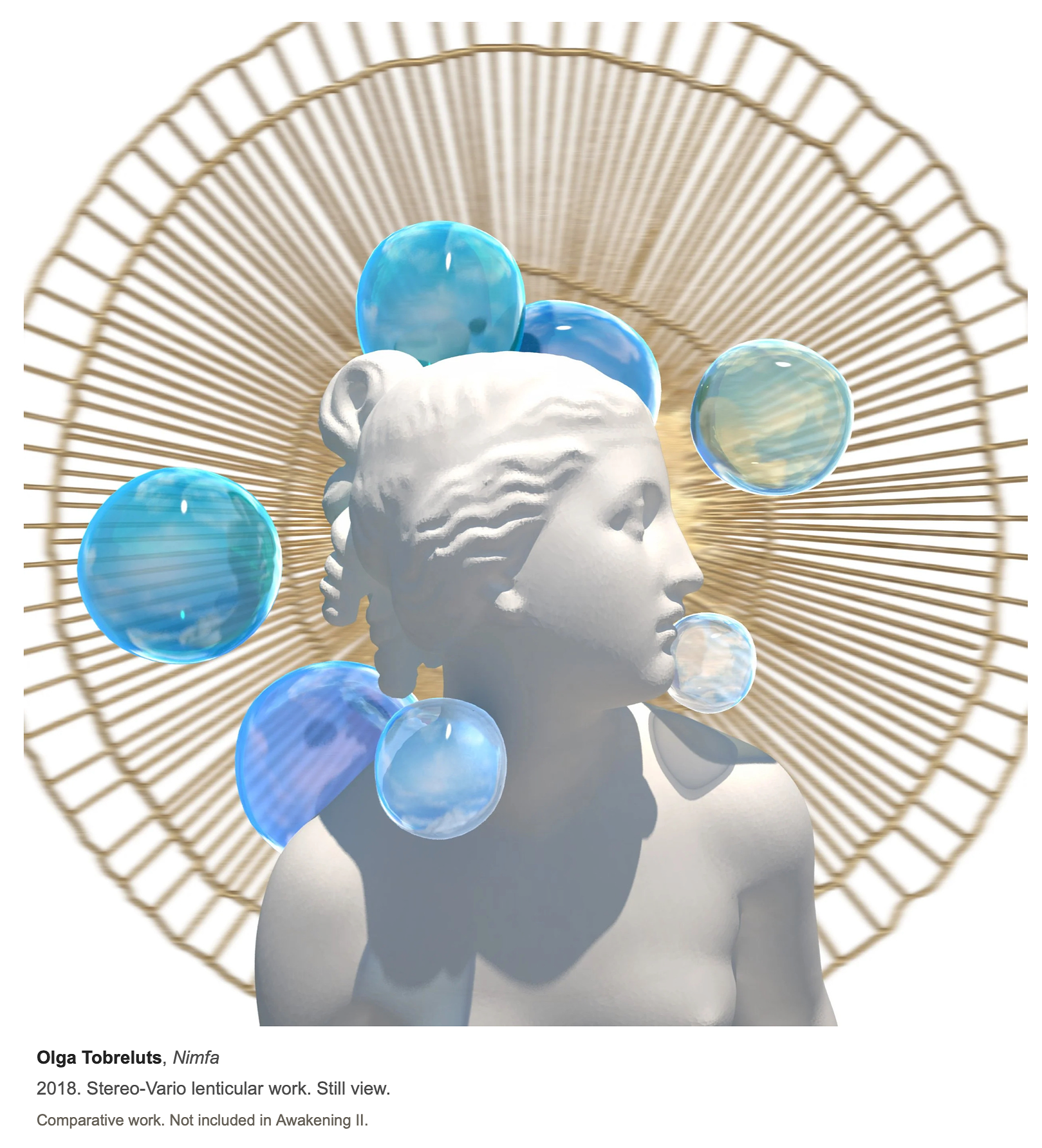
With Diana, completed in oil on canvas in 2022, Tobreluts returns to the classical figure through the painted surface. The circular format recalls the tondo, while the profile breaks into faceted and folded passages whose edges compete with its smoother modeling. The head is never entirely lost, yet neither can it be understood through the conventions of a continuous portrait. This tension is particularly productive beside Dollar, the lenticular work included in the exhibition. Dianaremains materially fixed; its spatial ambiguity is generated within painting. Dollarchanges with the viewer's movement, making perception dependent on the relationship between body and lens. These works show how Tobreluts can reconsider a related problem through different materials and viewing experiences. The related lenticular Nimfa, not on view here, provides another example of this relationship between the image and the viewer's position.
Tobreluts’s 2023 exhibition New Mythology at the Estonian National Museum gives this engagement with historical imagery a different urgency. In the museum’s accompanying statement, she connected the ten-part painting Armageddon with the tragedy unfolding in Ukraine and with Picasso’s Guernica. Historical reference here becomes a means of confronting violence in the present. Although Armageddon is not included in Awakening II, this context reveals how her return to earlier images can encompass ethical and emotional questions as well as problems of form.
A more recent dialogue between Tobreluts and Plusch took place in Where Meanings Collide: A Conversation on Abstraction, presented at the Pearl Fincher Museum of Fine Arts in Texas from January 31 through May 16, 2026. Its combination of painting and digital media examined the exchange of color, form, and motifs across their distinct practices. Tobreluts described the project as emerging from studio conversations and developing into an exchange across screens. The recent paintings at Matney extend that dialogue, bringing its questions into conversation with earlier works in each artist’s practice.
The artist’s newer abstraction belongs within this longer history. Tobreluts has worked with abstraction for years, and her recent statements describe a continuing dialogue with graphic software even when the software itself is no longer being used. Questions explored through classical heads, modeled bodies, and optical effects can enter a painting without an immediately identifiable figure. The newer works extend that inquiry into depth, surface, and visual meaning.
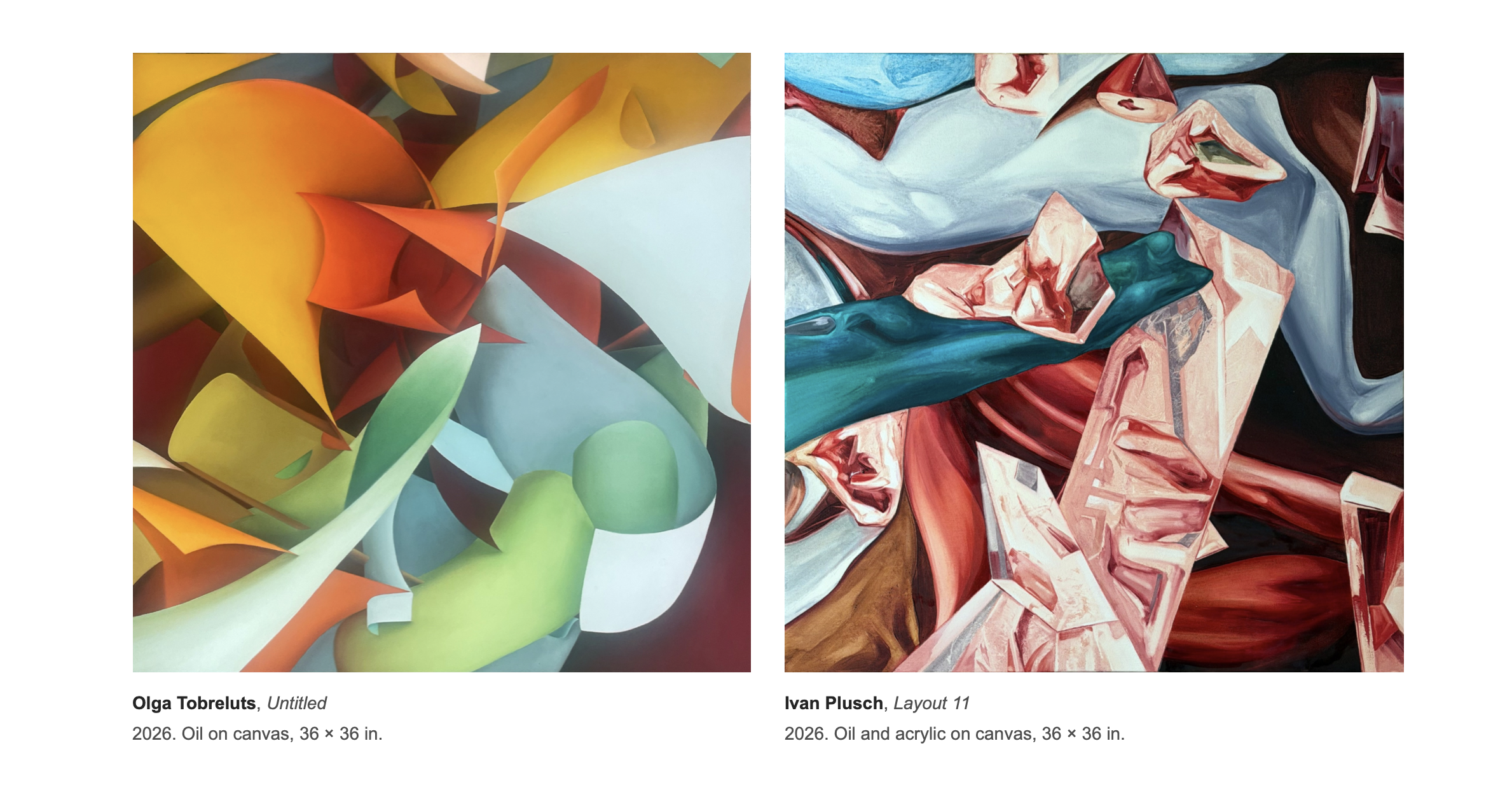
In Untitled (2026), an oil painting measuring 36 by 36 inches, the classical profile is absent, but the construction of volume remains central. Broad yellow and orange forms meet folded red passages, pale blue planes, and rounded green volumes. Gradual changes of tone give these forms curvature and weight, while their overlapping edges suggest a space that cannot be organized around a single identifiable subject. Some shapes seem to turn toward the viewer; others curl away or disappear behind an adjacent plane. Color gives the painting an immediate presence, but its spatial relationships carry the eye beyond that first impression.
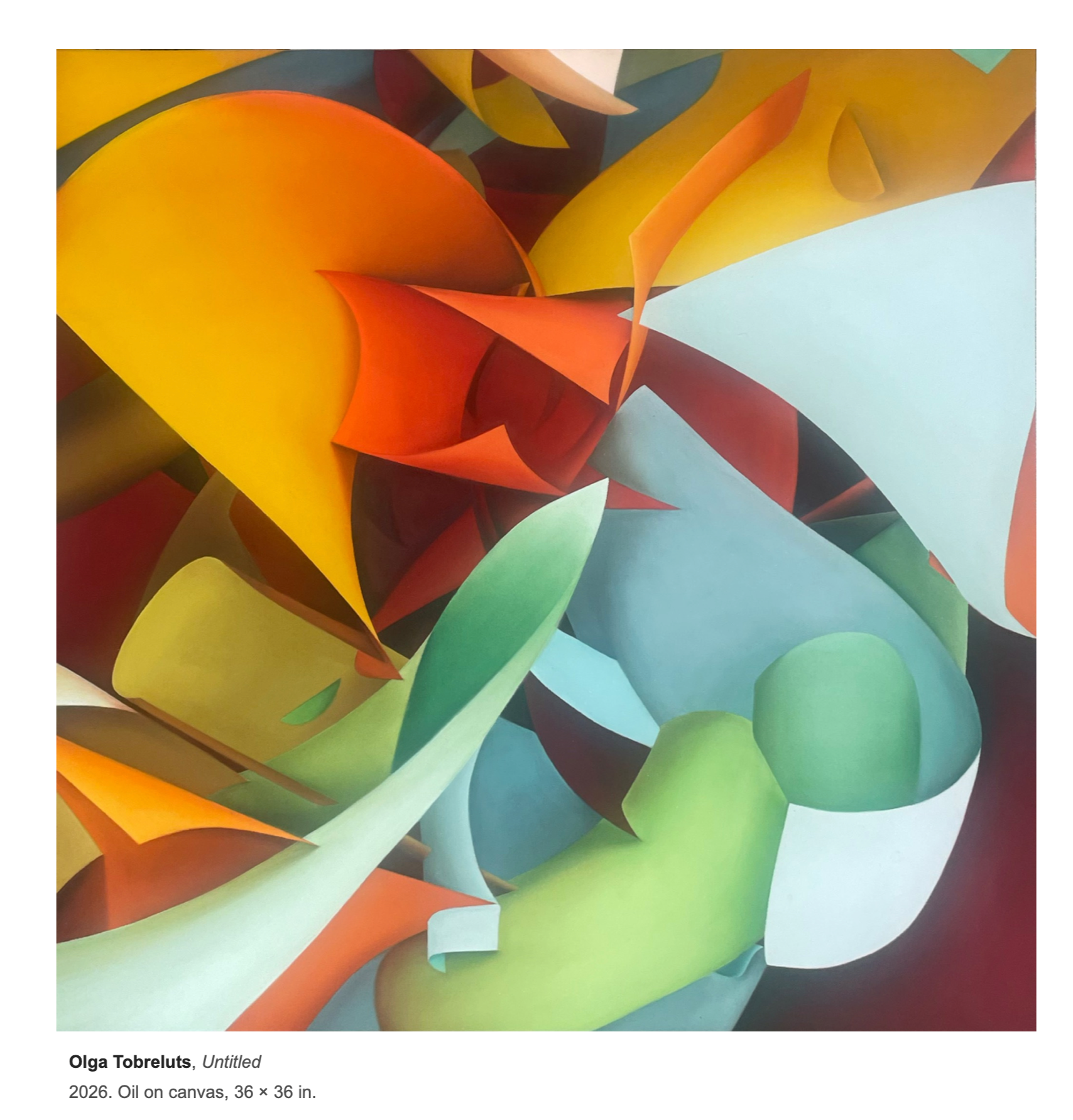
Seen beside Diana and Modernization II, Untitled makes continuity visible without repeating their subjects. The recognizable profile, the digitally modeled creature, and the abstract volume each depend on arrangements of surfaces that ask the viewer to imagine depth. In the newer painting, that activity no longer requires a named figure. The questions of construction and perception remain, while the associations opened by the forms become less prescribed. The painting does not present abstraction as the abandonment of an earlier practice. It gives that practice another way to unfold.
Ivan Plusch: The Figure, the Room, and the Painting
Ivan Plusch makes familiar spaces behave in unfamiliar ways. Rooms and buildings retain their architectural order while figures and forms stretch, flow, or slip beyond their apparent boundaries. The tension develops within painting itself, between the stability of a recognizable setting and the movement of the material through which it is made.
His interest in unstable images has a historical dimension. Having grown up during the social transformations surrounding the dissolution of the Soviet Union, Plusch has considered how inherited images shape an individual’s relationship to society. In his interview with Matney Gallery, he also identified affinities with surrealist and neo-surrealist approaches, through which a familiar world becomes the setting for an inexplicable event. These contexts inform his work without providing a single explanation for what happens within each painting
In his interview with Matney Gallery, Plusch speaks of the painting as a medium whose apparent relation to the artist can itself be questioned. He also describes the flow of pigment as a means of fixing a moment of time. These ideas illuminate the unusual behavior of his figures. A person may remain recognizable at one end of a painted form while dissolving into a horizontal extension at the other; a built environment may keep its architectural order while shapes traverse it as if another system of movement had entered the room. Neither the subject nor the material operation alone explains the image. Its force comes from their difficult coexistence.
Plusch’s investigation of form extends beyond the painted surface. In 2015, he participated in Glasstress Gotika, a collateral event of the 56th Venice Biennale. The exhibition’s international collaboration around glass offered another material context for his interest in transformation and instability. The works documented by Glasstress include Glass Malaise, combining glass and mannequins, and Illusion of Disappearance of Fullness, made in glass and wood.
In Illusion of Disappearance of Fullness, an ornate frame appears to dissolve into a dark, flowing mass. The structure that would ordinarily contain a picture becomes the subject of transformation itself. Considered alongside his paintings, the work suggests that fluidity is more than a recognizable technique: it is a means of testing the boundaries between an image, its material, and the space around it. The glass works are historical comparisons, not works included in Awakening II.
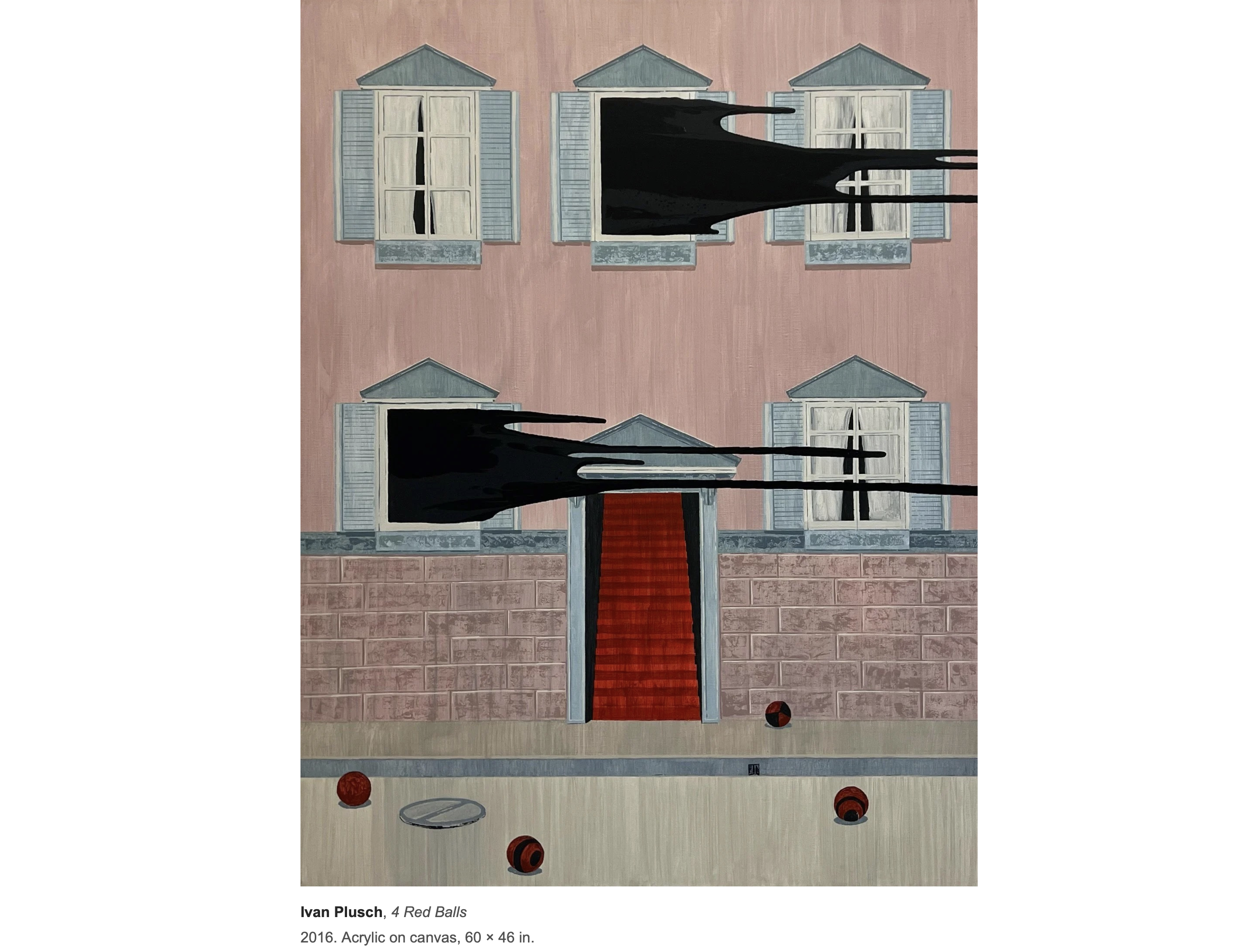
4 Red Balls offers a clear example. Pale shutters and a red doorway establish the measured geometry of a pink façade, while dark forms move outward from its windows and disrupt the otherwise regular arrangement. The four balls scattered along the ground supply small but insistent points of reference. The picture remains easy to identify as an architectural setting, and that legibility is essential to the effect. The disruptions would carry less force without a structure capable of resisting them. Plusch does not destroy the building; he makes its apparent stability newly questionable.
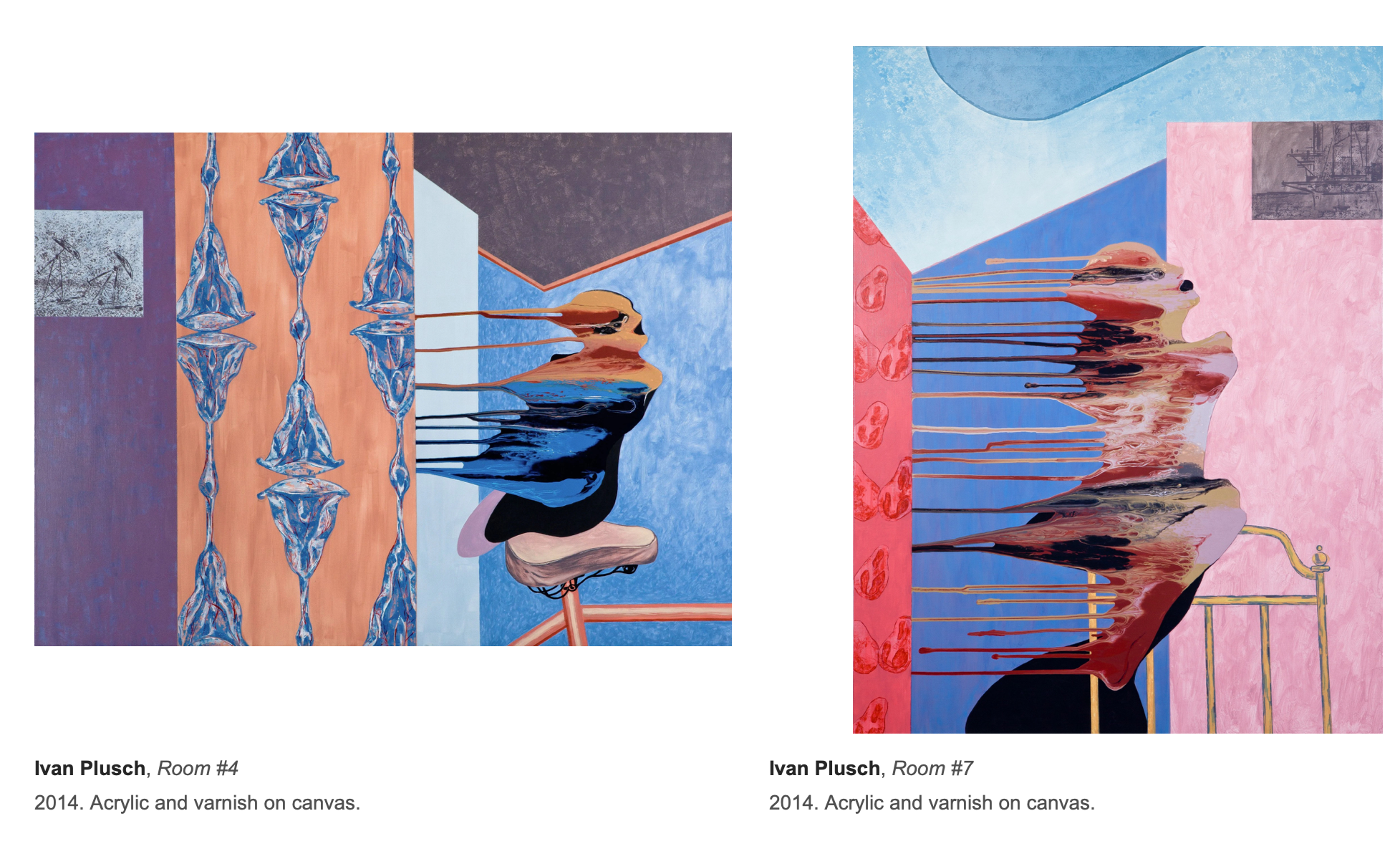
The exhibition includes both Room #4 and Room #7, bringing a related conflict into closer quarters. Rather than using architecture as a neutral backdrop, Plusch makes the divisions of an interior active elements of the painting's construction. In Room #4, the regularity of patterned surfaces and the perspectival suggestion of an interior contend with a figure-like form drawn into long lateral bands. The repetition of decorative motifs sharpens the distinction between a structure that appears held in place and a body whose image cannot remain contained. Room #7 invites a complementary consideration of how the relationship between a subject and its surroundings is organized within this series. Together, the paintings reveal that the so-called fluidity of Plusch's figures is not simply a mannerism imposed upon otherwise complete scenes. It is a way of reconsidering the scene itself.
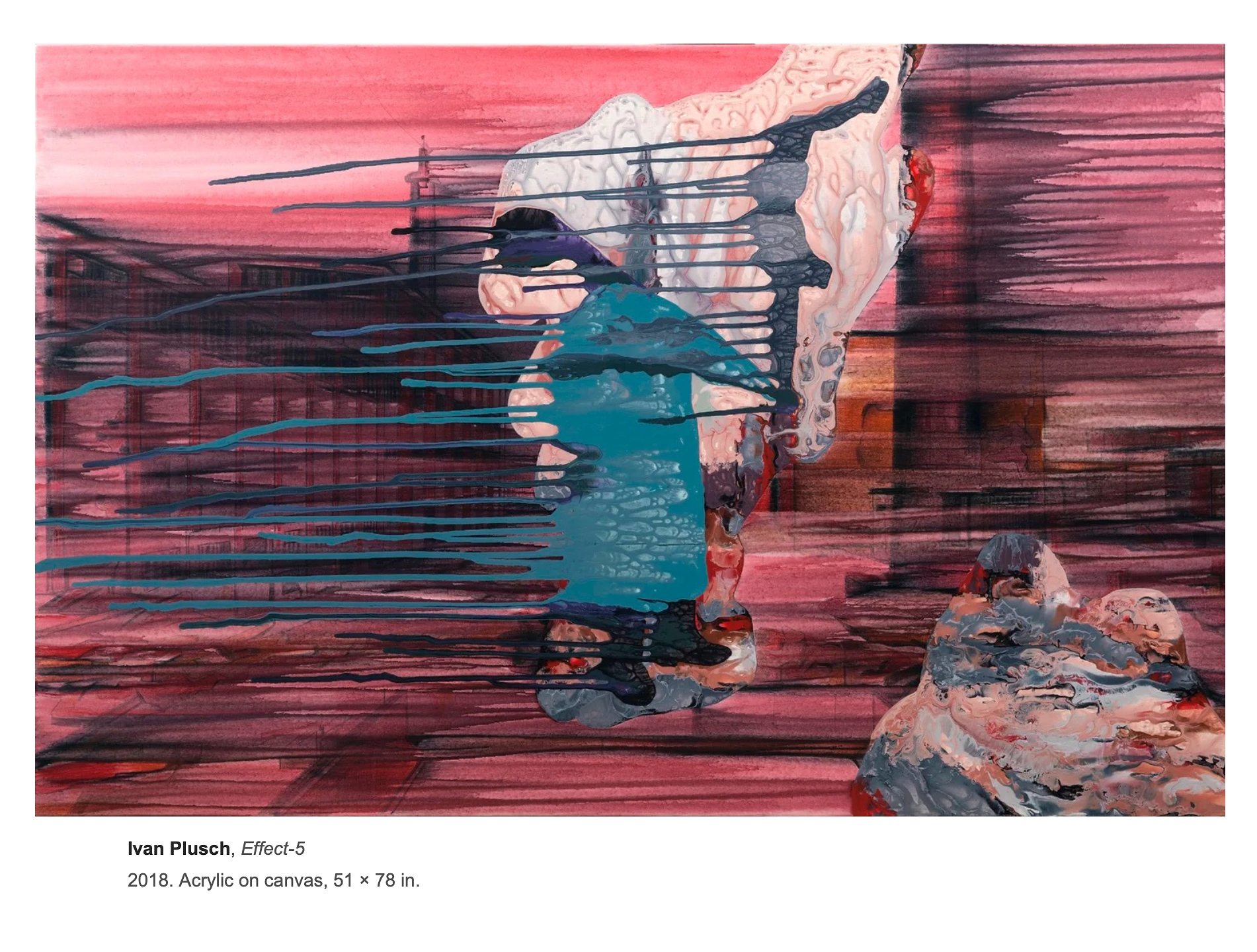
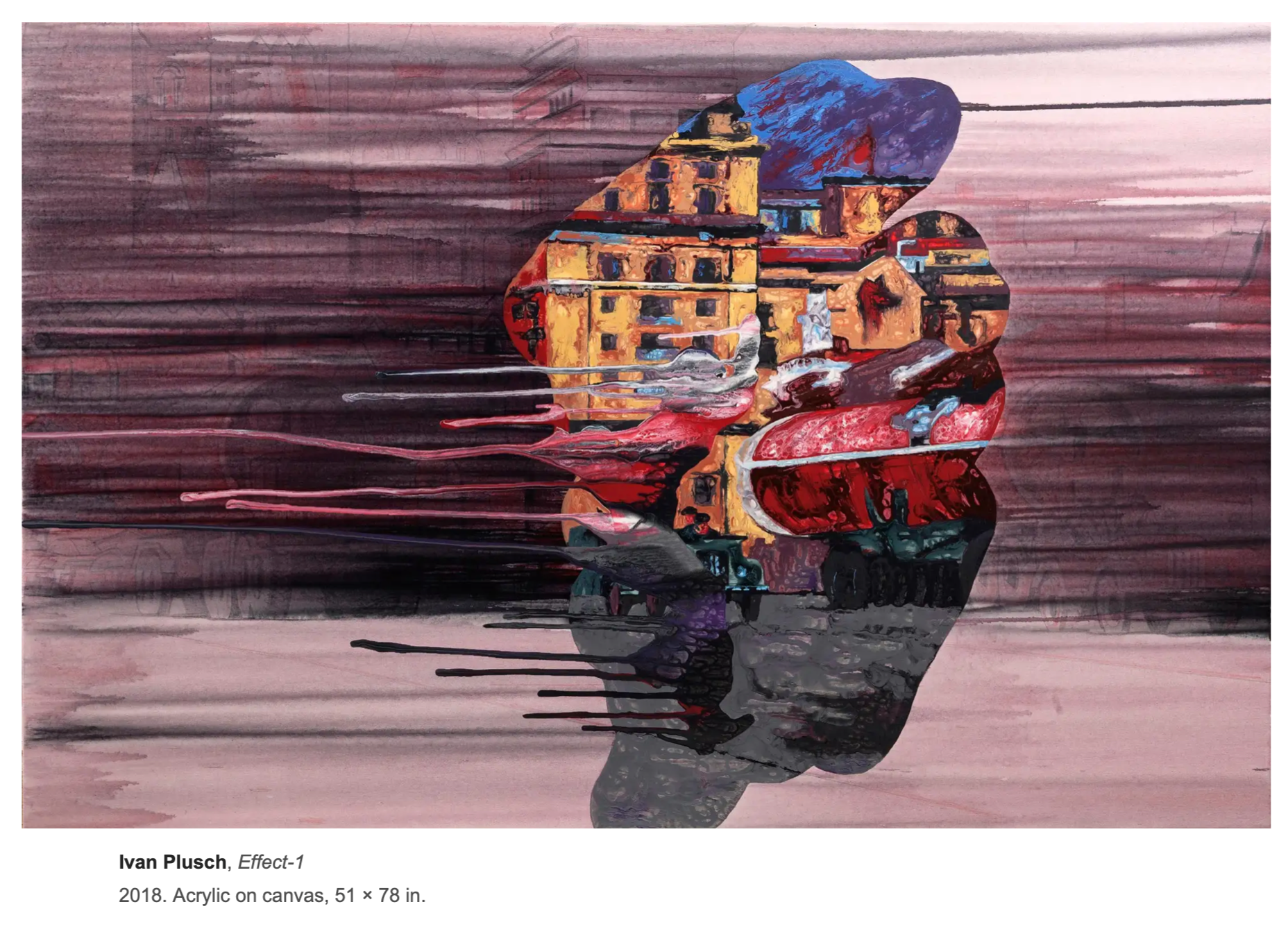
The large Effect paintings give this investigation a different physical scale. Effect-1and Effect-5, each documented at 51 by 78 inches, cannot be adequately understood as small illustrations of an eccentric painterly technique. Their broad horizontal formats require the viewer to negotiate a field that exceeds the limits of a single concentrated glance. At a distance, composition and direction may dominate; at closer range, the painted transitions and varying degrees of definition become more consequential. Repetition across the series creates a framework for comparison, allowing a spectator to see how related formal questions are worked through rather than merely repeated.
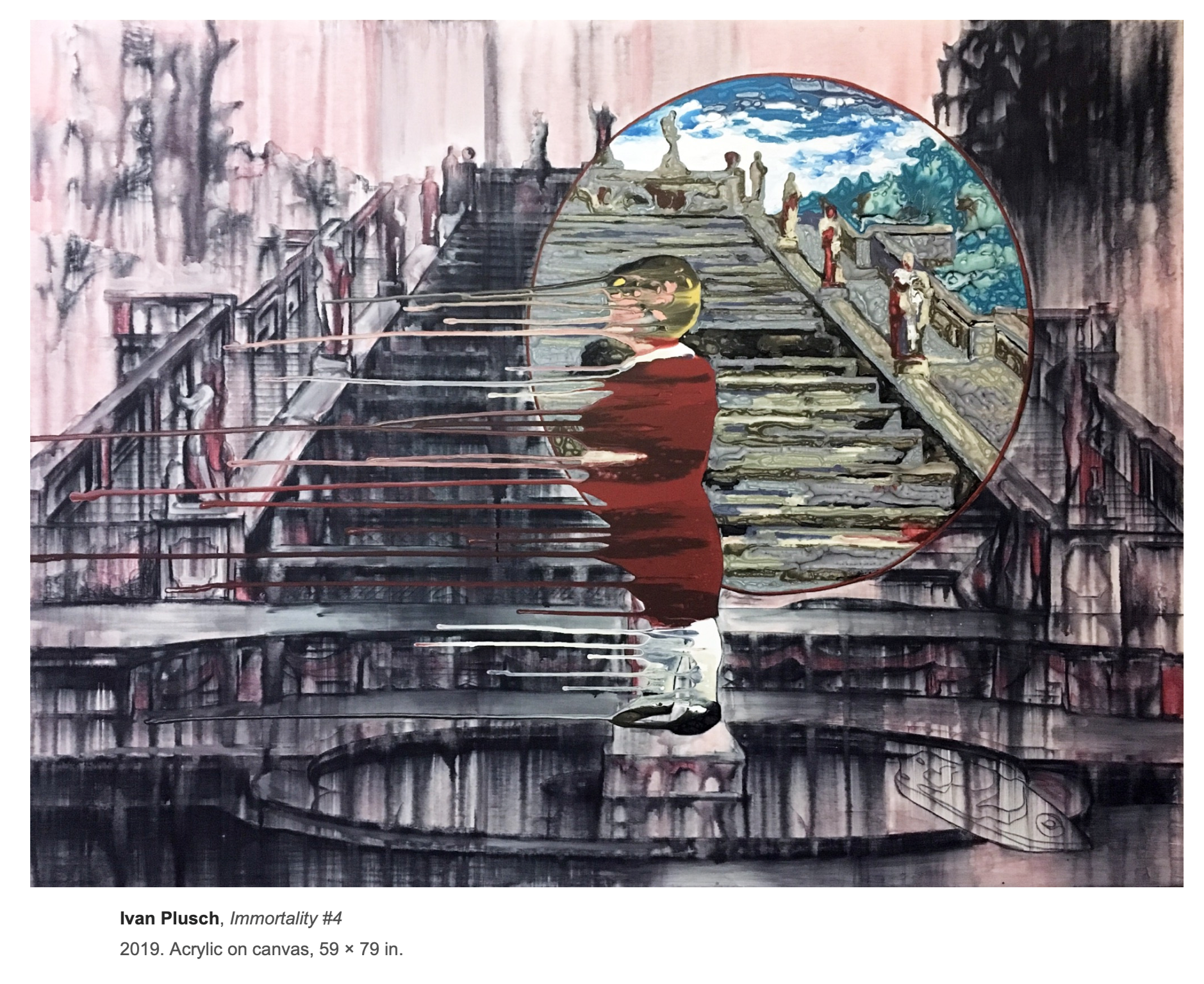
Immortality #4 further complicates the relation between a figure and a surrounding world. The work sets a horizontally extended body against a darkened architectural field, while an illuminated circular passage reveals a different spatial register. One form draws the eye across the picture; another opens toward a recession in depth. The painting is consequently held between incompatible directions of movement. Its title adds a conceptual pressure without supplying a simple answer. What persists in such an image: the figure, an idea of the figure, a trace of motion, or the larger setting that continues to receive it? The painting's importance lies in the simultaneous visibility of these possibilities, not in the resolution of any one of them.
Recent abstract paintings bring Plusch’s work beyond an identifiable room, figure, or architectural setting. His earlier paintings were already concerned with the autonomy of pigment and the relationship between the picture’s surface and the world it suggests. In the newer work, these relationships can be studied with greater independence from a named subject.
In Layout 11 (2026), painted in oil and acrylic on canvas and measuring 36 by 36 inches, flowing curves meet sharply folded planes. Pale blue passages move around pink and red structures, while a deep teal form crosses the foreground. Broad brushed areas and abrupt highlights give the surface different kinds of material suggestion. The forms recall flesh, fabric, and polished surfaces without becoming any one of them. A shape may momentarily appear graspable before another passage changes how it is understood.
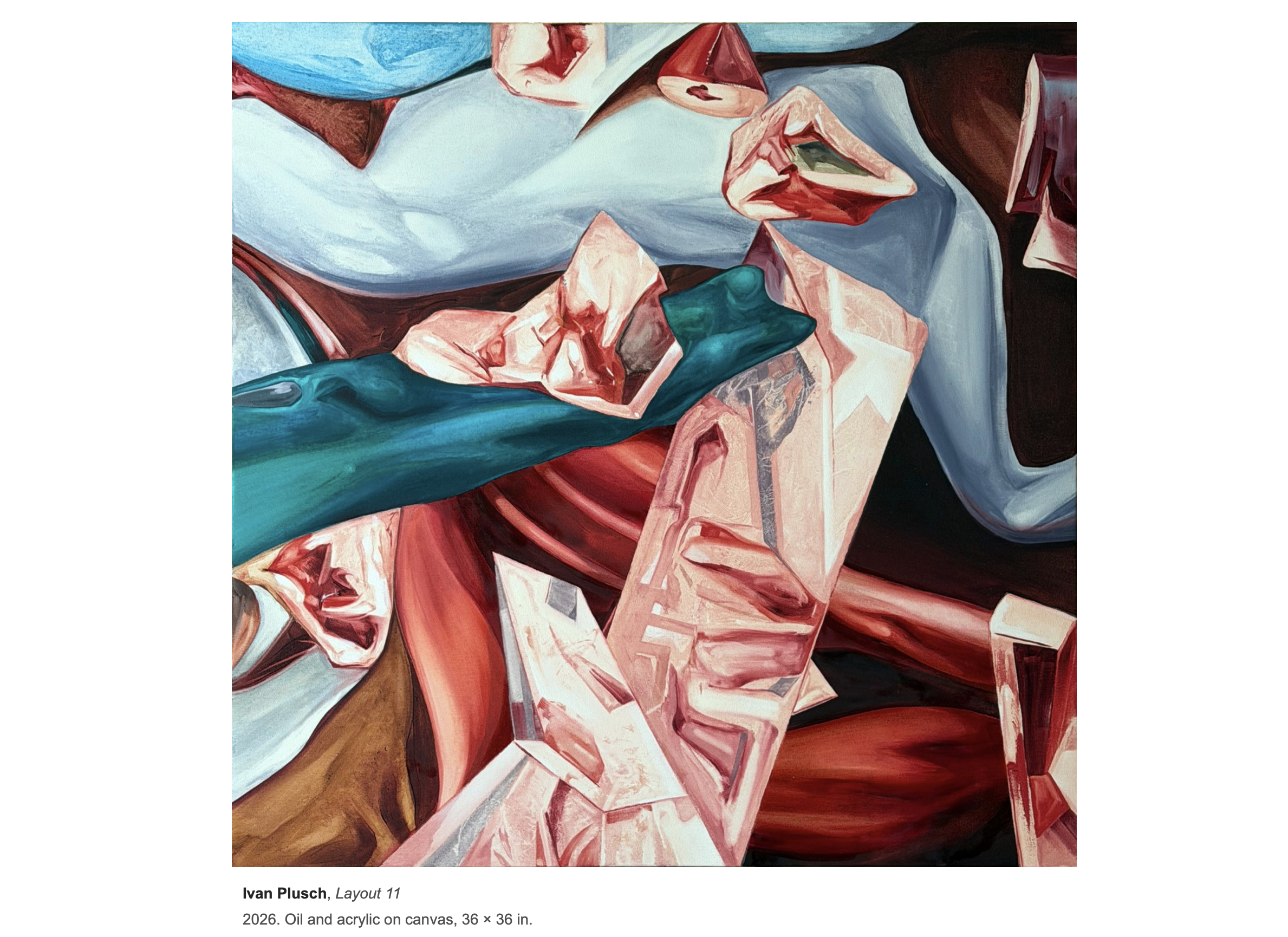
The painting’s movement is consequently more than a matter of direction. It also takes place between associations. The eye passes from a fold to a bodily curve, from an apparent reflection to a visibly painted edge. Familiarity is continually proposed and revised. In the earlier rooms, architecture gives a flowing interruption something to resist. In Layout 11, differences among the painted forms establish that tension themselves. A soft curve encounters a sharp edge; a luminous plane meets a dark recess. The painting retains bodily suggestions without requiring a complete body.
Tobreluts’s Untitled and Plusch’s Layout 11 share the same dimensions, giving their differences a direct basis for comparison. Both bring curved volumes into contact with forms that appear folded or cut, yet they build distinct experiences of space. Tobreluts develops broad, softly modeled volumes through gradual tonal changes. Plusch places brushed passages beside pronounced creases and highlights, sustaining tension among different possible materials. Their relationship rests on more than a resemblance between abstract shapes. Each painting carries forward questions developed through earlier figures and settings, while allowing those questions to be studied without a stable, named subject. Seen together, the paintings open a conversation within abstraction while preserving the specificity of each artist’s practice.
Oleg Dou: A Face That Remains a Question
Dou approaches the image through a medium frequently expected to secure identity. A photographic portrait can appear to preserve the visible evidence of a person with special fidelity, even though every portrait is shaped by lighting, pose, framing, and the expectations placed upon a face. Dou brings those processes to the surface. His photographs are elaborately constructed through digital manipulation, yet they preserve the direct address and exacting detail that encourage the viewer to respond to them as likenesses. The resulting difficulty is not whether the image is authentic or artificial in any simple sense. It is how the person and the constructed image become inseparable within the encounter.1
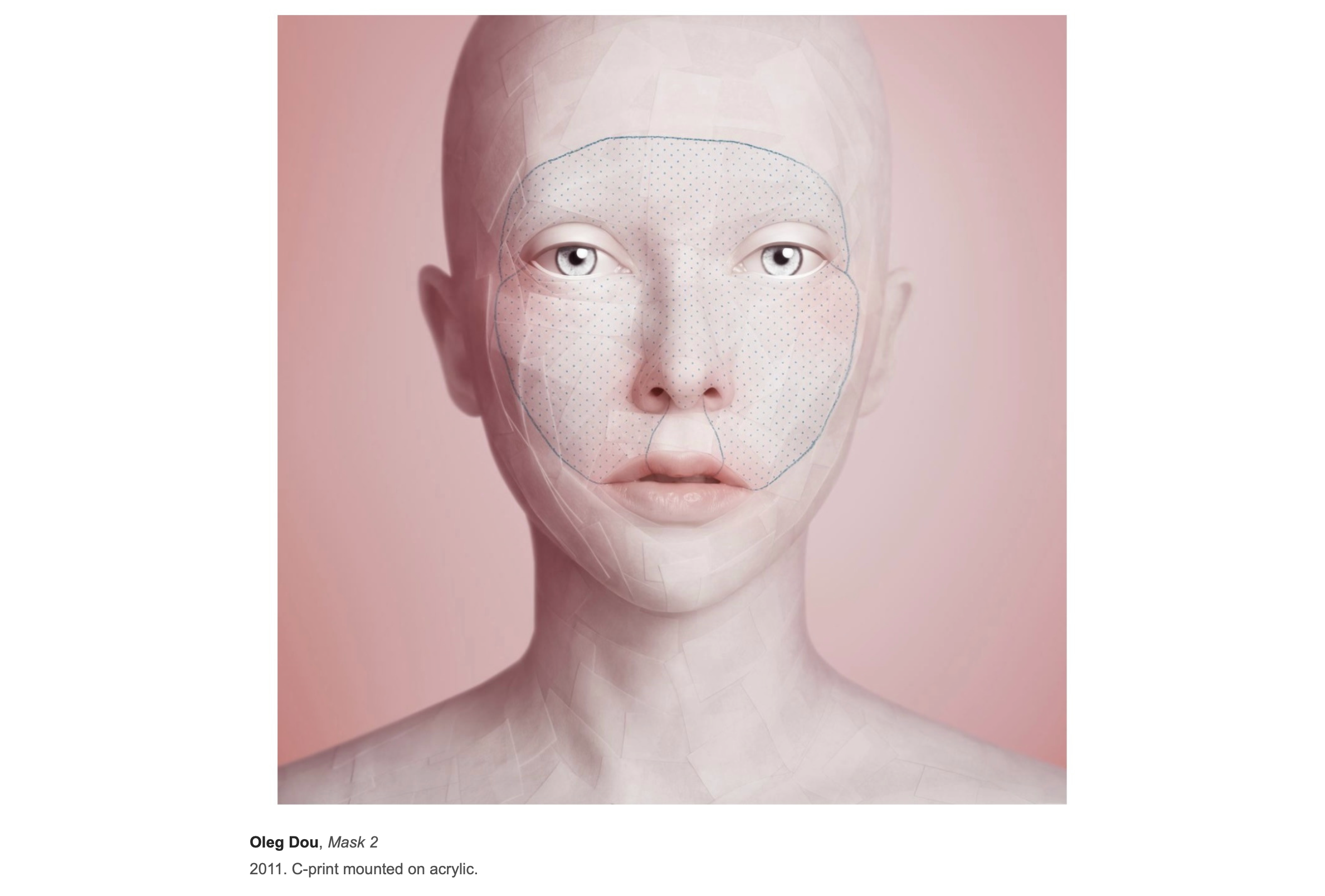
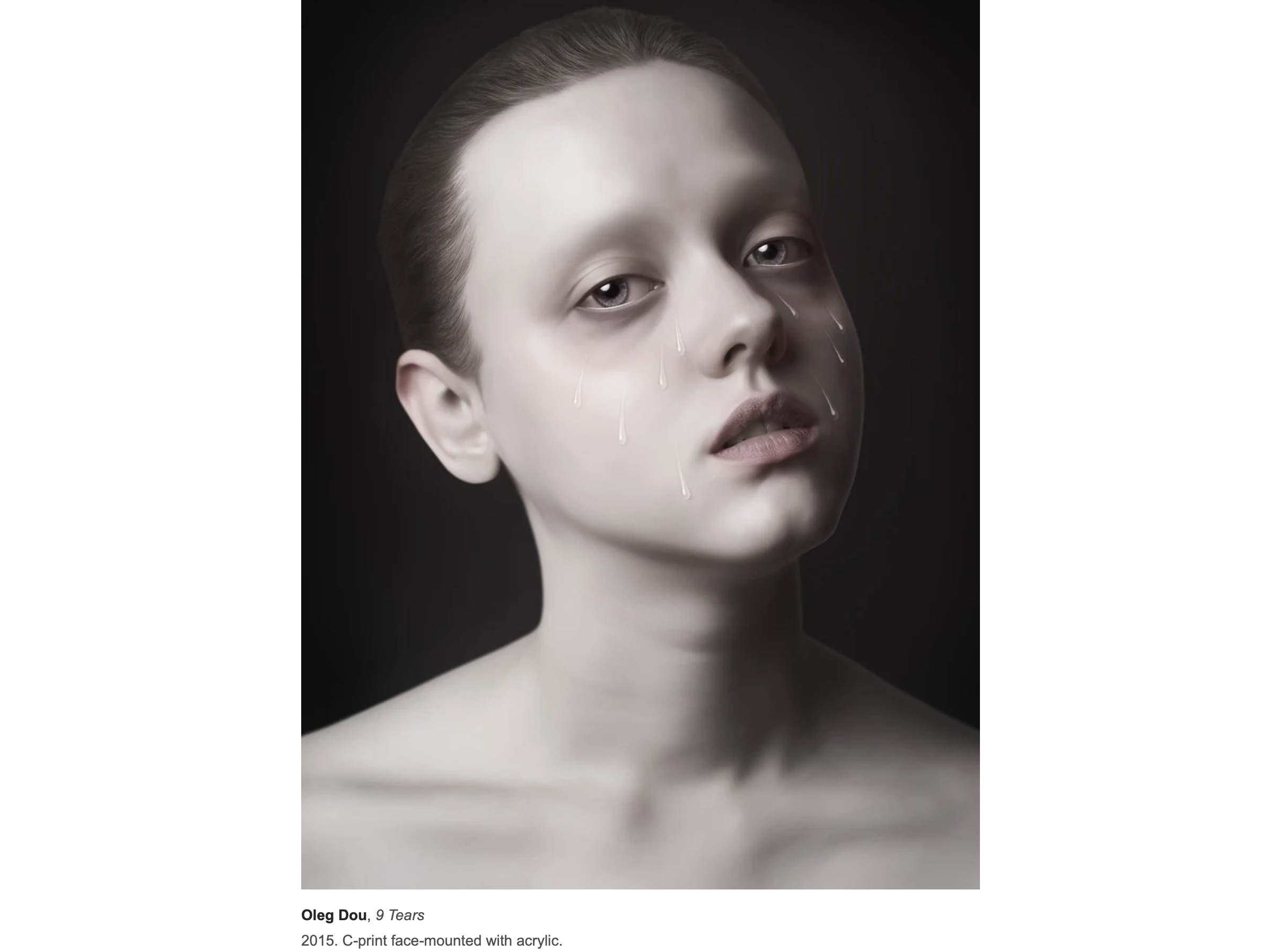
In Mask 2, a pale face meets the viewer directly while its surface is marked by fine divisions and a masklike configuration. The gaze offers a familiar connection, but the face does not entirely yield to the conventions of individual recognition. The related work 9 Tears, discussed here as a comparison rather than an exhibited work, complicates the relationship between sign and feeling through the delicacy of the face and the deliberate arrangement of tears. Tears can signify grief, but their precise appearance within such a controlled composition makes it difficult to treat them as unmediated evidence of an emotional life. The viewer recognizes a vocabulary of vulnerability while remaining outside the experience it seems to represent.1
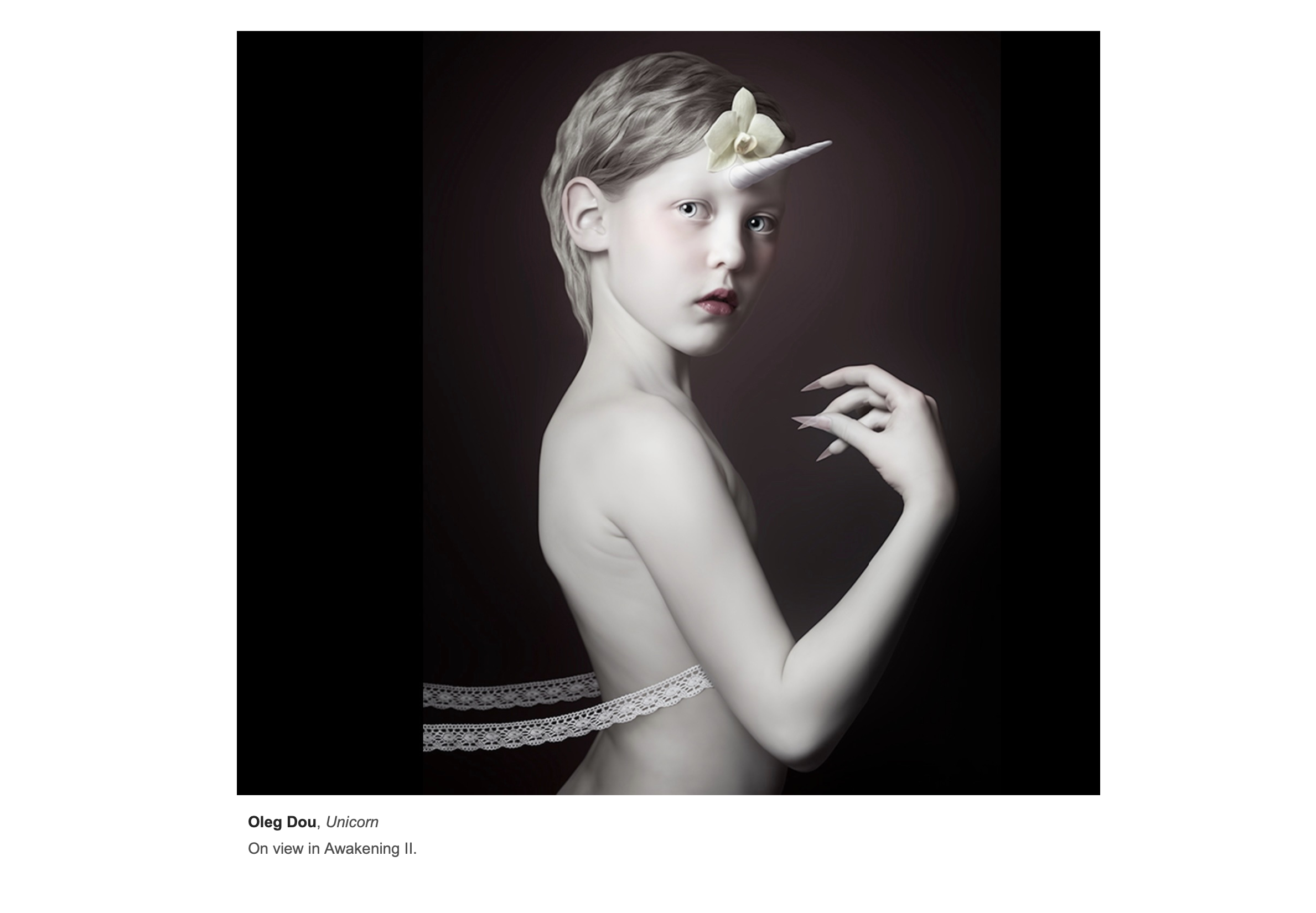
Unicorn, also on view in the exhibition, introduces an explicitly imaginary element into this field of exacting portraiture. The figure's careful pose, physical delicacy, and direct relationship to the camera preserve many of the conventions through which photographic identity is established, but the invented detail changes the terms of that relationship. The subject does not cease to appear human, nor does the work become a conventional fantasy illustration. Instead, a plausible likeness becomes the vehicle for an impossible body. Considered in relation to Mask 2 and 9 Tears, Unicornbroadens the range of Dou's inquiry, revealing the portrait as a place where social expectation, bodily familiarity, and invention can occupy the same surface.
An Exhibition with an Open Future
The relationship between these three practices becomes more productive when their differences are allowed to stand. Tobreluts returns to subjects whose historical authority is already established, changing the processes through which they are presented. Plusch makes the setting itself participate in the instability of a figure and increasingly gives painterly form an independent life. Dou directs attention toward the face, where recognition is expected to be immediate and can nevertheless remain uncertain. Each practice reveals that the experience of an image depends on more than its identifiable subject, but none arrives at that realization by the same route.1
The exhibition also continues a relationship brought together publicly through Deborah Colton Gallery’s Awakening in 2020. Six years later, the Matney presentation brings works from different periods into a new arrangement, allowing continuity in artistic thinking to be distinguished from the repetition of a recognizable appearance.1, 13
At Matney Gallery, the placement of earlier figurative works alongside recent abstractions makes these continuities available to direct comparison. A classical profile, a disrupted interior, and an abstract volume can be considered not only as different subjects, but as successive occasions for examining how an image is constructed. Dou’s photographic portraits introduce a contrasting approach, keeping the relationship between recognition and identity in view. The individual work can be considered closely while its place within a larger body of thought remains visible.1
Awakening II ultimately proposes that continuity in an artist's work is not the preservation of an unchanging appearance. It may reside in the return to a classical head through another optical process, in the renewal of a spatial problem through increasingly independent paint, or in a portrait's refusal to surrender its human presence despite its evident construction. Historical reference, material experiment, and the possibility of further work are therefore not separate concerns. They meet in the particular artworks, and in the attention those works ask of the viewer. The exhibition leaves that encounter open, suggesting that the most consequential directions in an artistic practice often become visible through what the artist has already learned to transform.
Awakening II is presented in collaboration with Deborah Colton Gallery / OUTPOST NYC.
Sources
Matney Gallery. Exhibition records and artwork documentation for Awakening II, 2026. Artwork information and exhibition status supplied by gallery director Lee Matney.
Pearl Fincher Museum of Fine Arts. Where Meanings Collide: A Conversation on Abstraction, January 31 through May 16, 2026.
The Museum of Modern Art. InterNyet: St. Petersburg, Dispatch 02, July 5, 1998.
Tate Liverpool. Heaven: An Exhibition That Will Break Your Heart, 1999–2000. Exhibition archive, including discussion of Sacred Figures.
Ludwig Museum. Absolute Beauty: Neoacademism in Saint Petersburg, 2015.
Estonian National Museum. Olga Tobreluts: New Mythology, 2023.
Olga Tobreluts. Artist statement for Where Meanings Collide: A Conversation on Abstraction. Pearl Fincher Museum of Fine Arts, 2026.
Matney Gallery. Artist Interview with Ivan Plusch: The Existential Threshold within Paint. Matney Gallery, May 10, 2023.
Glasstress / Fondazione Berengo. Ivan Plusch. Artist record and documentation of Glass Malaise and Illusion of Disappearance of Fullness, 2015.
Glasstress / Fondazione Berengo. Glasstress 2015 / Gotika, May 9 through November 22, 2015. Official record of the collateral event of the 56th Venice Biennale.
Deborah Colton Gallery. Ivan Plusch. Artist page and artwork catalog.
Matney Gallery. Awakening II: Contemporary Works from Eastern Europe. Exhibition announcement, September 30, 2026.