
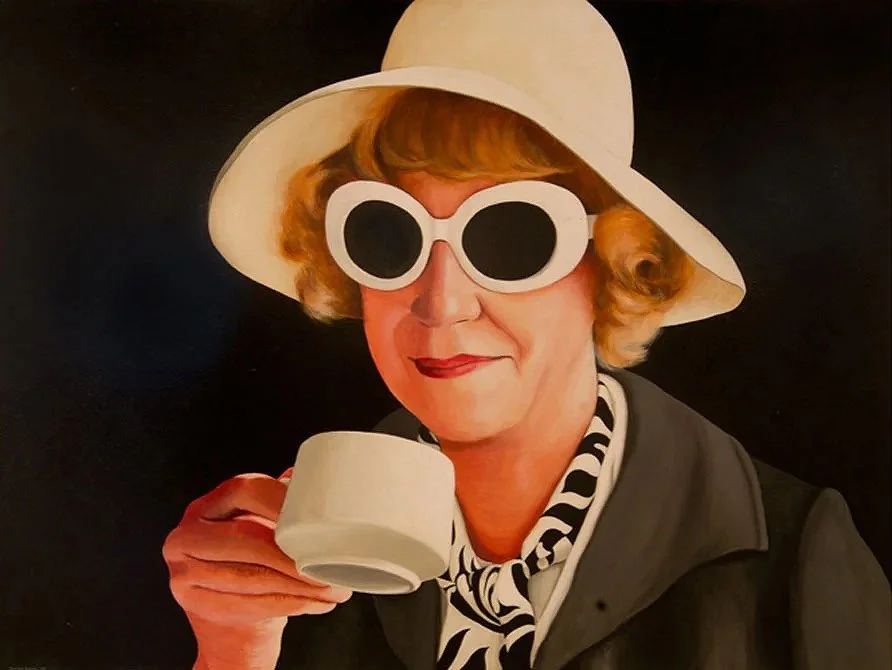
Barclay Sheaks and the Watchers
I met renowned Virginia artist Barclay Sheaks when I was eleven years old at a birthday party for my childhood friend Glenn Shepard, who was Sheaks’s godson. Glenn’s father, area physician Glenn Shepard MD, was a lifelong friend and supporter of Sheaks and currently owns the largest private collection of Sheaks works.
As I entered the regional arts scene, I worked as the assistant to the director of a gallery in the 1990s, where I installed Sheaks’s work, supported exhibitions through marketing and general gallery operations, and produced slides documenting the work.
At the center of Barclay Sheaks’s work is the Watcher series, begun in the late 1960s and developed over decades. These paintings, figures positioned at railings, looking outward, are grounded in observation rather than narrative. They hold attention quietly, and over time.
In 2011, Matney Gallery brought together a focused group of these works, many from the Shepard family collection, allowing the series to be seen as a coherent body rather than individual paintings. More recently, a signed Watcher painting surfaced in Norfolk. I acquired it and placed it with the Shepard collection, where it now sits in relation to the larger group. That movement, from discovery to placement, is a pattern that continues to define how this work circulates.
Here I expand on my observations about the Watcher series from the 2011 exhibition, and explain why this work remains relevant for collectors and institutions now.

Watcher on the Stairs, Barclay Sheaks, 1974, acrylic on canvas
Barclay Sheaks and the Watcher Series: Structure and Resolution
The work of Barclay Sheaks occupies a distinct position within postwar American painting, particularly in the Mid-Atlantic region, where his pioneering involvement and sustained engagement with acrylic paints and his focus on perceptual stillness distinguish his practice from both academic realism and more overtly expressive modes of the period.
At the center of this contribution is the Watcher series, initiated in the late 1960s and developed over the following decades into a sustained and evolving body of work. These paintings—typically structured around solitary figures positioned along thresholds such as ferry rails or waterfront edges—form one of the most coherent and enduring investigations into figure and perception produced in Virginia in the second half of the twentieth century.
The Watcher series is defined by its discipline. The compositions are built around a single figure, often turned away from the viewer, absorbed in looking outward. Many of the paintings are quite large, surpassing 40 by 50 inches, with bold colors in sharply dilineated planes. Structural elements—railings, horizons, and architectural edges—anchor the image, creating a stable framework within which attention is directed beyond the picture plane. This produces a doubled condition of observation: the viewer encounters a figure engaged in looking, and in doing so is drawn into the same act. The paintings resist narrative resolution. Instead, they hold a sustained perceptual state.

Sky Watcher III, Barclay Sheaks, silkscreen, edition of 50
The Watcher series gained Sheaks national recognition. Sheaks was recognized in a show at the National Portrait Gallery in the late 1980s alongside works by Andy Warhol. In the epoch-defining 1976 film All The Presidents Men, a Sheaks Watcher series print appears behind Robert Redford and Dustin Hoff in two scenes shot on location in a DC bank.
Works such as Watcher on the Beach and Coffee Cup Watcher demonstrate Sheaks’s command of acrylic as a medium. Color is applied with clarity and control, often flattened to emphasize structure while maintaining a precise chromatic tension. Edges are deliberate. Spatial relationships are simplified without collapsing into abstraction. Within a broader art historical framework, the Watcher series can be understood alongside American figurative practices that engage stillness and perception, while remaining distinct in its regional grounding and its refusal of overt narrative or gesture.
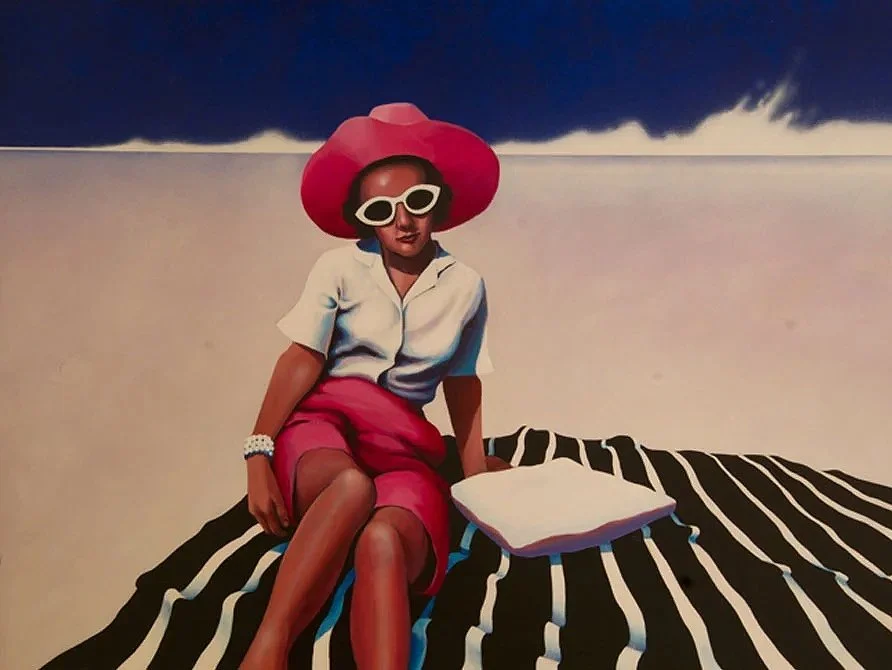
Watcher on the Beach, Barclay Sheaks, 1967, acrylic on canvas
Collector Stewardship: Glenn Shepard
The long-term coherence of the Watcher series is closely tied to the collecting activity of Glenn Shepard MD
Barclay Sheaks was Glenn Shepard Sr.’s high school art teacher, and the two became lifelong friends. Shepard became a major patron of Sheaks’s paintings, and also built a large collection of American marine paintings, The Shepard collection contains over 400 Sheaks paintings including some 15 from the Watcher series. This collection thus represents a significant holding in terms of both scale and internal continuity. The works have been maintained in relation to one another, allowing the series to be understood as a unified investigation rather than a dispersed group of individual paintings.
From an institutional perspective, this concentration presents a meaningful opportunity. The presence of a coherent body of work within a single collection supports exhibition, scholarship, and potential acquisition strategies that preserve the integrity of the series.
The 2011 Matney Gallery Exhibition
In 2011, Matney Gallery organized an exhibition that brought together early works by Sheaks alongside a focused group of Watcher paintings, many drawn from the Shepard collection.
The exhibition was not structured as a retrospective. Instead, it functioned as a re-contextualization, placing early works in dialogue with the Watcher series to clarify the evolution and resolution of Sheaks’s formal language.
The installation was deliberately restrained. Works were given space, allowing their internal structure and perceptual quiet to operate without distraction. This approach was essential for a body of work that depends on sustained attention rather than visual density.
For many viewers, the exhibition provided a first opportunity to encounter the Watcher series as a coherent body of work. The presence of multiple paintings from a single collection allowed for a level of continuity that is rarely achieved in group exhibition formats.
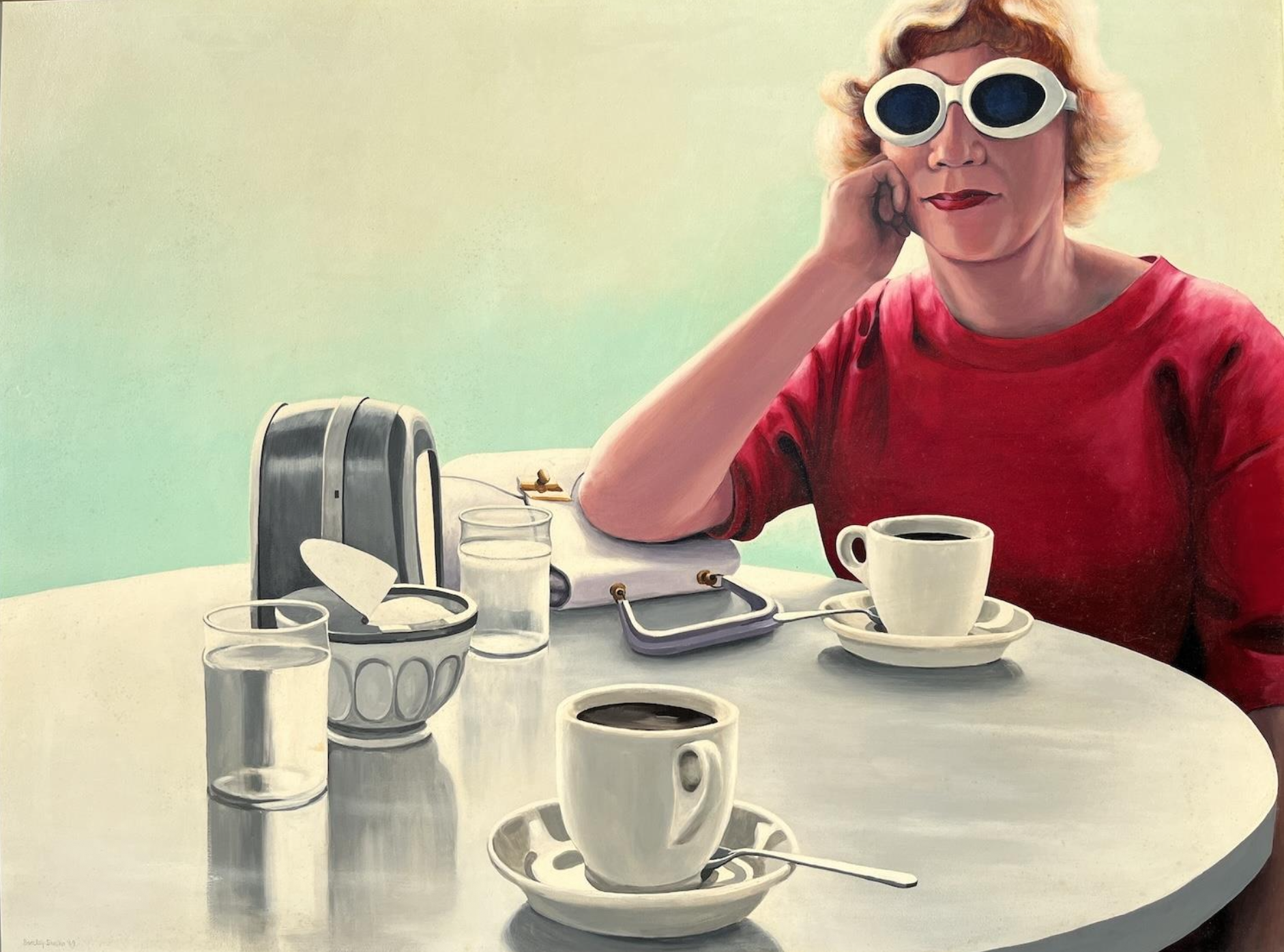
Coffee for Two Watcher, Barclay Sheaks, 1969, acrylic on canvas
A New Addition and the Question of Circulation
A signed work from the Watcher series, Coffee for Two Watcher (Barclay Sheaks, 1969, acrylic on canvas), encountered in Norfolk, provides further insight into how Sheaks’s work has circulated beyond formal institutional frameworks.
The painting, clearly identified through both signature and formal structure, had surfaced without broader contextual documentation. Recognizing its significance, I acquired the work and subsequently placed it within the Shepard collection.
This trajectory—from informal emergence to informed placement within a coherent collection—is consistent with the broader afterlife of Sheaks’s work. It underscores the role of direct knowledge, long-term engagement, and collector alignment in shaping how such work is preserved and positioned for future institutional consideration.
Institutional Relevance
The Watcher series warrants renewed institutional attention on several levels:
Formal coherence: The series represents a sustained and resolved investigation into figure, space, and perception
Material significance: Sheaks’s early and consistent use of acrylic situates the work within broader developments in postwar painting
Contextual flexibility: While grounded in the Chesapeake Bay environment, the work engages themes that extend beyond regional classification
Collector concentration: The existence of a focused body of work within a single collection creates viable pathways for exhibition and acquisition
Taken together, these factors position the Watcher series as a body of work capable of supporting both scholarly research and public presentation.
Conclusion
My long term personal and professional involvement with Barclay Sheaks and his works reflects a sustained alignment between artist, collector, and curatorial practice.
The Watcher series in particular offers a model of how works can maintain relevance through formal discipline, perceptual clarity, and the long-term commitment of those engaged in their preservation. The 2011 exhibition at Matney Gallery represented a key moment within this trajectory—one that clarified the significance of the work and its potential for continued institutional engagement.
The Matney Gallery is now seeking institutional collaborations to organize a major exhibition Watcher series works from the Shepard family collection.